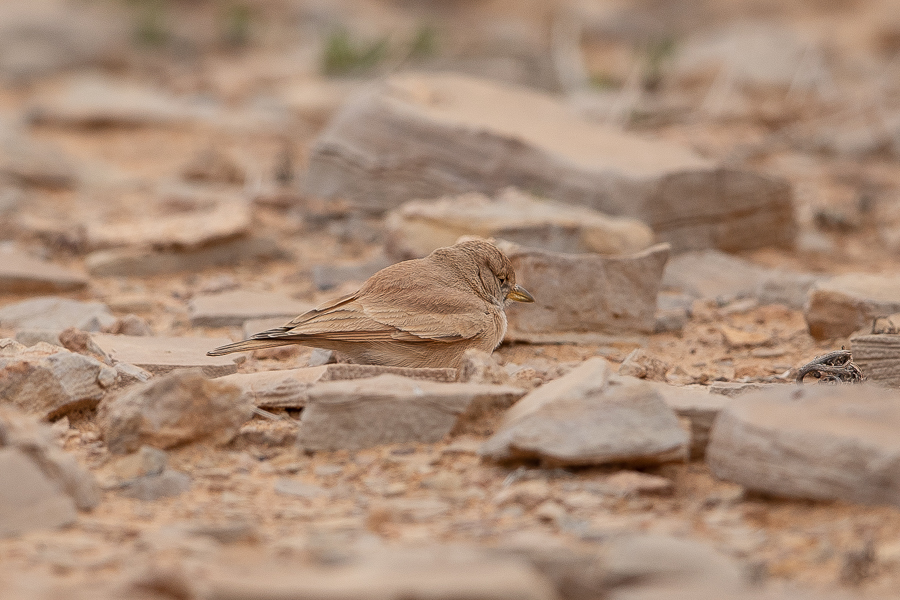
Whilst birding the Al Jouf area of northwest Saudi Arabia we came across some pale looking Desert Lark Alauda deserti near Sakaka, resembling A. d. isabellinus. Geographical variation in Desert Lark is complex, and numerous races have been named mainly on the basis of plumage coloration. The colour of the birds appears to be directly related to the colour of the local soil and rocks with birds from sandy habitats are mostly buff-coloured, those of stony or rocky ground various shades of grey, rufous, or brown with blackish races living in black lava deserts. Confusingly, pale and dark birds occasionally live side by side in some areas and bleaching and abrasion have marked effect on colouration and produce further complications often making sub-specific identification difficult. A. d. isabellinus occurs from northern Egypt, east to south and east Israel, southern Jordan, north-west Saudi Arabia and southern Iraq and is small and pale, generally light sandy to pale buff-brown with greyish or pale olive-grey tinge above, buff or creamy buff below, tail rufous with triangular black area at tip. Birds presumably of this subspecies occur throughout northern Saudi Arabia gradually becoming plaler towards the east becoming pale cream similar to A. d. azizi, which is the subspecies that occurs ear to me in the Eastern Province of Saudi Arabia around the Hufuf and Shedgum areas and is the palest race with pale creamy plumage. It is clear there is some difference between colouration, bill size and tail colour of many of the birds in Saudi Arabia but how much of this is clinal is unknown.
Jem's Birding & Ringing Exploits in the Eastern Province and elsewhere in Saudi Arabia
23 January 2023
05 February 2022
Larks in the Pivot Fields - Judah
An early morning trip to Judah, a limestone escarpment with three pivot fields we have access too, an hour and a half drive towards Riyadh from Dhahran where we live, was undertaken at the end of January. The pivot fields were green and short and looked promising for larks but we were a little disappointed with what we found. Larks were not as common as previous visits with only a few Lesser Short-toed Larks, several pale coloured Desert Larks and a single Eurasian Skylark for our troubles. A small number of Tawny Pipit were scattered around the field edges but not much else was seen. We did hear a Pharaoh Eagle Owl calling on arrival and several real looking Rock Dove were on the cliffs with a couple of Brown-necked Raven flying over, but otherwise not too much else. The large amount of rain recently may have made it easy for birds to feed elsewhere, but this is only a guess as to why the number of birds seen was lower than normal.
| Desert Lark |
| Eurasian Skylark |
| Lesser Short-toed Lark |
| Tawny Pipit |
| Tawny Pipit |
30 September 2021
Steppe Eagles – Ushaiqer Dump Site
The Ushaiqer dump site is at the end of a 5 km graded track that splits off from the road between the towns of Ushaiqer and Shaqra (25.326°N, 45.173°E) and heads west (Figure 1a). The site at Ushaiqer previously received large amounts of chicken offal, which attracted the largest number of eagles ever recorded at a single site in winter 2019 with approximately 7500 birds recorded. Now, however, the dumping of food waste is no longer permitted and the eagle numbers have significantly decreased with only several hundred seen last winter. Early morning 23 September Phil Roberts and I went to the site to see if any eagles had returned. Although the date was quite early, with main migration through Saudi Arabia in October, we managed to locate up to 50 Steppe Eagles. Most birds were adults with only four first year birds seen. It will be interesting to see over the winter if birds remain at this location or move elsewhere due to lack of food. This location is also a good place to see various species of lark, and this trip we saw both Desert Lark and Greater Hoopoe-lark with a nice flock of 20+ Trumpeter Finch.
![]() |
| Steppe Eagle |
![]() |
| Steppe Eagle |
![]() |
| Desert Lark |
![]() |
| Greater Hoopoe-Lark |
29 July 2020
Birds at drinking pool – Abha area
![]() |
| Arabian Serin |
![]() |
| Arabian Serin |
![]() |
| Crested Lark |
![]() |
| Desert Lark |
![]() |
| Laughing Dove |
21 March 2020
Desert Larks - Judah
21 February 2020
Larks – Ushaiqer
![]() |
| Bar-tailed Lark |
![]() |
| Desert Lark |
![]() |
| Desert Lark |
![]() |
| Desert Lark |
![]() |
| Greater Hoopoe-Lark |
01 February 2020
Looking for See See Partridge – Sakaka
![]() |
| White-crowned Wheatear |
![]() |
| Desert Lark |
03 May 2019
Camouflaged Desert Larks – Jebal Hamrah
31 March 2018
Birding the jebals – Jebal Hamrah
![]() |
| Hooded Wheatear - female |
![]() |
| Hooded Wheatear - female |
![]() |
| White-crowned Wheatear |
![]() |
| Desert Lark |
![]() |
| Desert Lark |
![]() |
| Desert Lark |
![]() |
| Desert Lark |
![]() |
| Desert Lark |
12 March 2018
Desert Larks – Jebal Hamrah
15 March 2017
Desert Lark - Jabal Nayriyyah
24 April 2016
Desert Larks – Shedgum Escarpment
09 December 2015
Crakes and rails near Tabuk – Records by Viv Wilson
![]() |
| Spotted Crake |
![]() |
| Water Rail |
![]() |
| Black Kite |
![]() |
| Citrine Wagtail |
![]() |
| Common Chiffchaff |
![]() |
| Desert Lark |
![]() |
| Desert Lark |
![]() |
| Northern Lapwing |
![]() |
| Pallid Harrier |
![]() |
| Pied Avocet |
![]() |
| Sand Partridge |
![]() |
| Western Cattle Egret |