10 February 2016

Saudi Arabia largest flock of Northern Lapwings - Haradh

As mentioned in a previous post Phil Roberts and I travelled to Haradh an area of extensive pivot irrigation fields three hours drive from Dhahran and found some access to some very good looking fields in various stages of growth from ploughed to fallow to newly growing. We eventually came across two very damp newly ploughed fields that had a single Northern Lapwing in it, but as we got closer more and more birds flew out. The birds turned into a flock of over two hundred and at one stage we saw an even bigger flock in flight over the second field making a total count of at least 425 birds. This is the largest flock ever in the Kingdom and is probably due to the exceptionally cold weather we have had recently with temperatures at 4 degrees Celsius the day we were at Haradh and even colder in the Hail area where it was minus three degrees Celsius. The Birds of the Eastern Province 1989 mentioned they were a scarce and somewhat irregular visitor with records from November to early April but chiefly from November through January.  In 1979-71 up to 15 wintered in Dhahran but this proved to be exceptional, showing how large this flock was. Elsewhere in Saudi Arabia high counts have been at Al Safi Dairy farm, Central province, where at least 111 individuals were seen 25 January 2001. Birds of Thumamah 1988-1994 said maximum numbers were 100 in the winter 1992/1993. It status in the Kingdom is as an uncommon winter visitor to all areas north of a line from Hofuf, through Riyadh to Hail.
Northern Lapwing

Northern Lapwing

09 February 2016

Three Caspian Plovers - Haradh

On 5 February Phil Roberts and I travelled to Haradh an area of extensive pivot irrigation fields three hours drive from Dhahran. We left at 03:00 hrs to allow us to be at the site at first light. After plenty of searching we eventually came across a very damp newly ploughed field that had a single Northern Lapwing in it, but as we got closer more and more birds flew out. After an hour or so of checking through the Northern Lapwings we came across an odd looking wader at some distance that on putting the telescope on was obviously a winter plumaged Caspian Plovers. After looking further we found an additional winter plumaged bird as well as one in summer plumage making three in total. Caspian Plover is an uncommon but regular passage migrant in the Eastern Province in small numbers during March and April and again from late July until early September. The peak passage of adults is during March and again from August when juveniles are also frequently seen. A flock of 500 was seen in late March 1982 on the northern steppes with other good numbers from the same area including 45 on the Dibdibah 14 April 1983, 30 there 4 November 1983 and 100 in the same area 28 March 1985. Most sightings occur away from the coast but they are often near inland waters.
Eurasian Dotterel

Eurasian Dotterel

Eurasian Dotterel

08 February 2016

Sixteen Sociable Lapwing - Haradh

On 5 February Phil Roberts and I travelled to Haradh an area of extensive pivot irrigation fields three hours drive from Dhahran. We left at 03:00 hrs to allow us to be at the site at first light. We tried the big farm complexes first but were not allowed entry to any so tried a set of fields off the main road some distance and eventually found some access to some very good looking fields in various stages of growth from ploughed to fallow to newly growing. We eventually came across a very damp newly ploughed field that had a single Northern Lapwing in it, but as we got closer more and more birds flew out. After a couple of minutes I saw two Sociable Lapwings in flight at the back of the flock that flew around and landed in the ploughed field. We drove around to the area where the access track was to the pivot irrigation bars and moved down this into the middle of the field. Here we scanned through the Northern Lapwings we could see and eventually found eight Sociable Lapwings. We also found a second large flock of Northern Lapwings in a second ploughed field and went to look at this flock and found another eight Sociable Lapwings in amongst them. At one stage both the flocks joined together and so did the Sociable Lapwings but they split up again with eight staying with each flock. These birds are only the second time the species has been recorded in the Eastern Province after an adult at Haradh farm on 25 February 1982
Sociable Lapwing

Sociable Lapwing

Sociable Lapwing

Sociable Lapwing

Sociable Lapwing

Sociable Lapwing

Sociable Lapwing

The species status in Saudi Arabia is a locally scarce passage migrant and winter visitor, which has historically been recorded north of Jeddah near the coast. Other records come from north of Yanbu, one near Riyadh, An adult at Haradh farm 1982 and one near the National Wildlife Research Center at Taif. Previous historical records include flocks 25 in 1934 and 45 in 1988 and there have only been eight records since 1950. These include one satellite-tagged bird from central Kazakhstan that wintered in Saudi Arabia for several weeks in 2011, just north of Tabuk by the main road and another satellite-tagged bird in the same area in November 2013, where they probably used irrigated fields for feeding. On 17 November 2012, a group of 10 birds were recorded north of Tabuk in the same area as the satellite tagged birds had been recorded and 35 birds were in irrigation fields north of Jizan 14 January 2013. Whilst birding in the Jizan area on 19 November 2013, Seven birds were in a stubble field near Sabya 21- 22 November 2103. Satellite tracking of Sociable Lapwings from their breeding grounds in central Kazakhstan has suggested that Saudi Arabia is an important stop-over and wintering area. Tagged birds appear to be associated with agricultural areas in the north of the country, especially Tabuk and Al Jawf. In October 2015, three satellite tagged birds were in Saudi Arabia - west of Tabuk, west of Al Jawf and also west of Tayma. Following a request from BirdLife International, The Saudi Wildlife Authority organised a rapid survey to try and locate the Sociable Lapwings in northern Saudi Arabia. The survey was conducted from 13-16 November 2015 and found17 birds in west Tamya 13 November 2015 with 22 birds at west Tabuk 15 November 2015 that increased in size to a flock of 46 on 20 November 2015, this being the largest flock seen in the Kingdom for many years. Sociable Lapwing is listed as Critically Endangered because its population has undergone a very rapid reduction, for reasons that are poorly understood. This decline is projected to continue and increase in the future. Fieldwork in Kazakhstan (and counts in Turkey and the Middle East) has shown the population to be substantially larger than previously feared, but recent demographic studies have found low adult survival, possibly largely driven by hunting pressure along the migration routes and wintering grounds. Important wintering areas have been identified in Saudi Arabia in the northwest of the Kingdom from satellite tracked birds. Below is a photo of the field where the Sociable Lapwings were seen.

07 February 2016

A very cold winter day – Jubail

I went birding on 29 January to Jubail on a very cold and windy day. The temperature was 5 degrees Celsius, the coldest temperature I have seen in Saudi Arabia since I have been here. Temperatures in Hail in the northwest of the Kingdom reached minus 3 degrees Celsius some of the coldest weather in the country for more than fifty years. The temperature felt even colder as a strong wind was also blowing and as a result the birds were hiding from the wind and not really showing well. One example of this was the 100+ Greater Flamingo’s. They are normally spread out over the sabkhat in loose flocks but this time every bird was huddled together in a tightly packed group to keep warm and out of the wind. The adults were in the middle and the less knowledgeable juveniles on the outside. Other birds hiding from the wind included 18 Western Cattle Egrets, and I suppose many other species as well as our total for the day was well down on normal. We only really saw the winter visitors in any numbers with large numbers of White Wagtails and Water Pipits and smaller groups of both Spanish Sparrows and Common Starlings. Wader numbers were well down on normal as combined with the cold weather and strong winds was high water so there was not many places for waders to use. We did see a few Black-winged Stilts, Common Redshaks and Common Greenshanks but very little else. The only other birds seen in any numbers were Squacco Herons, Gulls of various species and terns including four Whiskered Terns. A few early migrants were located including Barn Swallows, Common House Martins and Common Swifts.
Black-winged Stilt
Black-winged Stilt 
Common Greenshank
Common Greenshank
Common Starling
Common Starling
Western Cattle Egret
Spanish Sparrow - male
White Wagtail
White Wagtail
White-winged Tern
Whiskered Tern

06 February 2016

A flock of Common House Martin - Jubail

Whilst birding near Jubail Phil and I found a group of over 50 Common House Martins associating with a flock of similar numbers of Barn Swallows. The Common House Martin is a common passage migrant, which moves very early in the spring. Their spring passage is quite spread out and lasts until mid-March although stragglers occur until May. The return autumn passage is short occurring in September and early October. It is always nice to see this species and worth checking thoroughly for the as yet unrecorded in Saudi Arabia Asian House Martin.
Common House Martin

Common House Martin

Common House Martin

05 February 2016

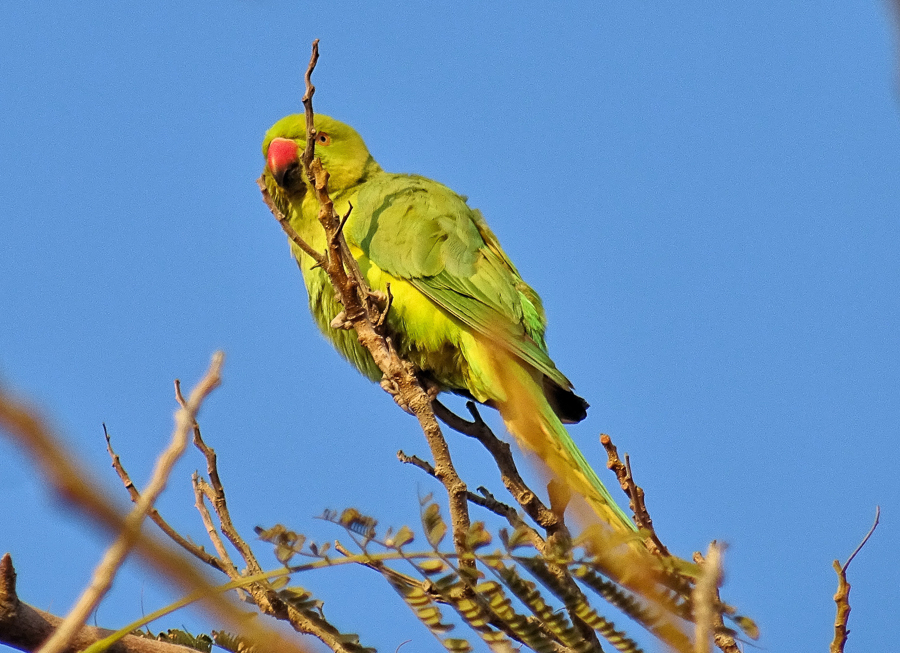
Rose-ringed Parakeet in Dhahran – Bird records by Paul Wells

Paul Wells sends me photos of the birds he sees in Dhahran and recently sent me an excellent photo of a Rose-ringed Parakeet a species that although common on Saudi Aramco camp is very difficult to Photograph. As Paul mentioned they're not easy birds to photograph because they seem to spend a lot of time in dense trees and then fly fast and low. Paul, however, knew the birds frequented the area behind his house but it still took him four days of sitting in his back yard after work to finally get a picture. I have never photographed this species in Dhahran although I have seen it hundreds of times, so Paul has done very well to get the photo and has kindly given me permission to use it on my website which is reproduced below.
Rose-ringed Parakeet

04 February 2016

Long-legged Buzzard - Jubail

Whilst birding in Jubail at the weekend Phil and I saw a Long-legged Buzzard Buteo rufinus possibly the same bird that has been about most of the winter, although has not been seen for a month or more. Long-legged Buzzard is an uncommon breeding resident in all areas of the Kingdom. In the Riyadh area it is a scarce resident as well as a migrant and winter visitor. It is not seen as often as it has been as it has retreated for breeding to remoter areas as urbanisation and farming have expanded. It remains a breeding resident in small numbers and sightings suggest a big increase in the winter population, with more sightings in the last few years than previously during this period. In the southwest it is regarded as an uncommon resident seen in all months except January. There is one recent record from the Empty Quarter of a bird coming to drink at an irrigation pipe at GOSP 2 although the bird is a resident of the Rub al Khali. In the Eastern Province it is a breeding resident, which is thinly distributed in small numbers.
Long-legged Buzzard

Long-legged Buzzard

Long-legged Buzzard

03 February 2016

Wintering Greater Spotted Eagles – near Jubail

At least seventeen Greater Spotted Eagles Clanga clanga were recorded at a wetland site near Jubail on 20 November 2015, the highest single day count for the site. Since this time numbers have decreased but there are still at least eight and probably more Greater Spotted Eagles remaining for the winter. Birds winter at a number of sites in Saudi Arabia with the Jubail area the best for the species in the Eastern province. In winter birds are almost always near wetland areas with large areas where they can hunt undisturbed. They occupy a fragmented range, breeding mainly in Estonia, Poland, Belarus, Moldova, Russia, Ukraine, Kazakhstan, mainland China and Mongolia. Passage or wintering birds occur in small numbers over a vast area, including central and eastern Europe, North Africa, East Africa, the Middle East, the Arabian peninsula, the Indian Subcontinent, south Asia and South-East Asia. The Greater Spotted Eagle is suspected to have undergone at least a moderately rapid decline over the last three generations as a result of habitat loss and degradation throughout its breeding and wintering ranges, together with the effects of disturbance, persecution and competition with other predators. The species is listed on the Red Data list as Vulnerable as the species is facing a high risk of extinction in the wild in the medium-term future.
Greater Spotted Eagle

Greater Spotted Eagle

Greater Spotted Eagle

02 February 2016

Black-necked Grebes and more – Sabkhat Al Fasl

Whilst looking around the area near Sabkhat Al Fasl, I saw a number of good birds including four black-necked Grebes together. Black-necked Grebes are uncommon winter visitors to the Eastern Province of Saudi Arabia but are always good birds to find and see as they are never common. Other winter specialties seen included, Western Marsh Harriers, Daurian Shrikes, Common Chiffchaffs, Slender-billed Gulls, Common Starlings and Great Cormorants. Other more unusual winter species included Purple Herons and a Citrine Wagtail. Some species are already showing signs of breeding with Indian (Clamorous) Reed Warblers singing loudly from almost all prominent reed stems and some Squacco Herons in almost full breeding plumage.
Black-necked Grebes
Black-necked Grebes
Daurian Shrike
Daurian Shrike
Western Marsh Harrier
Great Cormorant
Great Cormorant
Water Pipit
Water Pipit
Slender-billed Gull
Slender-billed Gull
Indian Reed Warbler
Indian Reed Warbler

01 February 2016

Four Pied Kingfishers wintering – Sabkhat Al Fasl

The major influx of Pied Kingfishers into eastern Arabia this winter has resulted in at last four Pied Kingfishers wintering at Sabkhat Al Fasl. These birds have taken up residence in a couple of different locations with birds being seen at the two sites each visit in 2016. The birds are extremely beautiful and are always exciting to see, with some of them giving very good views perched on sunken dead trees and nearby reeds. Although this winter has been exceptional for them in the region, they remain a rare/scarce winter visitor. It will be interesting to see if this status changes after such a large influx, as some of these birds may return next winter to the same site?