Showing posts with label Eastern Mourning Wheatear. Show all posts

14 February 2023

Birding the Judah and Hanidh areas

In late January Phil Roberts and I set out early to go to Judah and Hanidh. We stopped at Judah first, but it was very slow going without a bird being seen for the first thirty minutes excluding feral Rock Dove. The pivot fields that used to attract a lot of birds to this area are now dismantled and the vegetation around the bottom of the escarpment is either dead or dying and this is even after a lot of heavy rain in recent weeks. We did eventually see Desert Lark and Pale Crag Martin, two common birds in the area and as always in winter Desert Wheatear and Eastern Morning Wheatear. This is probably to best site to see the later species in the Eastern Province with birds being very confiding when found. We moved on Hanidh in the hope of seeing more birds with the total species count from Judah amounting to nine. We went to a couple of large pivot irrigation fields a couple of which we gained permission to look around. Best birds seen were nine Common House Martin, a very early migrant species in KSA, as well as European Stonechat, Daurian Shrike, Tawny Pipit, a single Northern Lapwing, several Eurasian Skylark, Asian Desert Warbler & Menetries’s Warbler. Whilst driving along a road we saw a single Steppe Eagle in flight, which along with a single Common Kestrel were our only birds of prey.

Desert Wheatear

Eastern Morning Wheatear

Eastern Morning Wheatear

Eastern Morning Wheatear

Eastern Morning Wheatear

Steppe Eagle

Steppe Eagle

Steppe Eagle

Steppe Eagle

Tawny Pipit

Asian Desert Warbler


19 January 2023

Three species of Wheatear – Sakaka

Whilst birding the stony Desert area around Sakaka with Phil Roberts and Nader Fahd, we came across a wheatear at the bottom of the escarpment on the stony ground. It was a black and white wheatear, which Nader pointed out had more extensive black on the throat that the nearby Eastern Morning Wheatear and on closer inspection in became apparent it was a male Hooded Wheatear. These birds are quite distinct with their large size and long thin bill but this single bird was hard to judge the size on. They are a scarce but widespread bird throughout the region and are most often encountered in barren, remote stretches. They are a rare but widespread breeding resident of Central Arabia and also occur at Najran in the south to the Northern Hejaz. This was the first time I have seen a male of this species with all previous records having been females. We also saw two Eastern Morning Wheatear and a few White-crowned Wheatears in the same area.

Eastern Morning Wheatear

Eastern Morning Wheatear

White-crowned Wheatear

White-crowned Wheatear

White-crowned Wheatear

White-crowned Wheatear

Hooded Wheatear - male

Hooded Wheatear - male

Hooded Wheatear - male

Hooded Wheatear - male


28 January 2022

Mourning & White-Crowned Wheatears - Judah

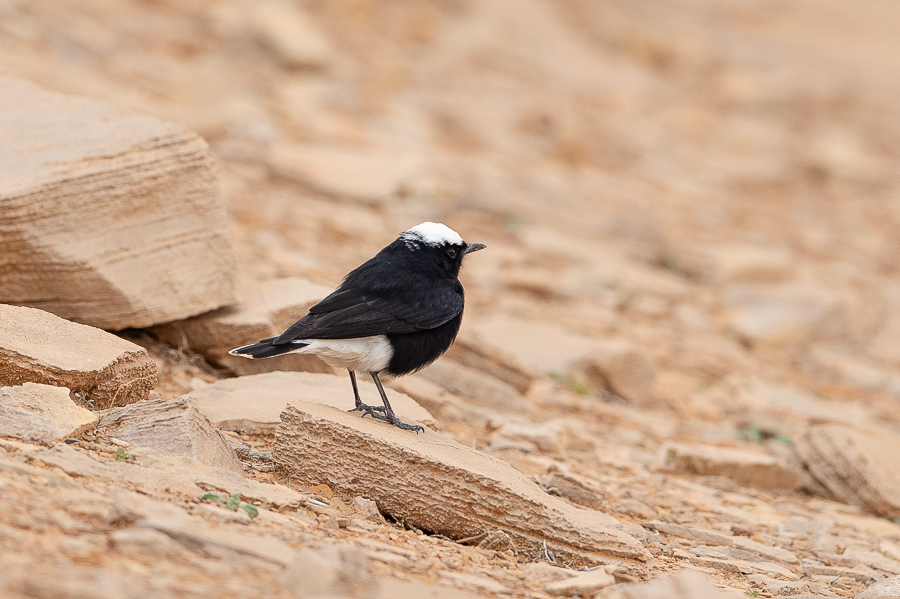
A very early morning trip to Judah in mid-January saw Phil Roberts and I finding eleven Eastern Morning Wheatears and three White-crowned Wheatears. These limestone escarpments are a very good place in winter to see both species and the below photographs were obtained. The White-crowned Wheatear was seen in the middle of a pivot irrigation filed a very strange place to locate one, but it was some distance away. Amazingly as soon as it had been seen it flew and came straight towards us landing only a few metres away. Unfortunately, the sun was not in a good position but some reasonable photos were taken. Eastern mooring Wheatear is quite a specialty of the Arabian Peninsula and is bird sought after by the big birding groups who occasionally visit Bahrain where the species can be seen. Numbers in Saudi Arabia are much higher and easier to see but visiting restrictions to the country have made seeing them more difficult, although it is now possible to obtain tourist visas so anyone really interested can now can and look for them here. 

Eastern Morning Wheatear

Eastern Morning Wheatear

Eastern Morning Wheatear

Eastern Morning Wheatear

Eastern Morning Wheatear

Eastern Morning Wheatear

White-crowned Wheatear

White-crowned Wheatear

White-crowned Wheatear

White-crowned Wheatear


08 February 2021

Seven species of Wheatear – Wadi Ad Dewasir

Whilst birding the Wadi Ad Dewasir area of central Saudi Arabia in November Phil Roberts and I found seven species of Wheatear. The most common was Isabelline Wheatear that were common in many of the spray fields visited. Desert Wheatear, Northern Wheatear, Pied Wheatear and a single Eastern Black-eared Wheatear were also seen in the fields. Closer to the escarpment edge, in rocky areas with some cover, we found both Red-tailed Wheatear and Eastern Mourning Wheatear (persica). As Wadi Ad Dewasir is in central Saudi Arabia and bird numbers are relatively low the seven species of Wheatear made up 12% of all the species we recorded in three days birding the location.

Eastern Morning Wheatear

Eastern Morning Wheatear

Eastern Morning Wheatear

Isabelline Wheatear

Red-tailed Wheatear

Red-tailed Wheatear


27 February 2020

A few Wheatears - Ushaiqer

Whilst birding the rocky desert near Ushaiqer I came across several Wheatear species. Isabelline Wheatear was seen a couple of times and Iranian Wheatear Oenanthe persicapreviously a subspecies of Eastern Morning Wheatear more often. The most common wheatear was White-crowned, which I have posted about already. Birds were not easy to photograph as they were constantly on the move. Several Blackstarts were also located in the area.
Isabelline Wheatear
Isabelline Wheatear
Iranian Wheatear
Iranian Wheatear
Iranian Wheatear
Iranian Wheatear
Blackstart
Blackstart

05 December 2019

Birding the Riyadh River – Al Hair

I went birding to the Riyadh River near Al Hair recently. It is an amazing site with running river, reed beds and nearby pivot irrigation fields. As I live four hours drive away from Riyadh, I have not been before, but this will certainly not be my last trip. On arrival at the site I saw a huge flock of over one hundred Black-crowned Night Herons, easily the largest number I have seen in Saudi Arabia. A Western Osprey was sitting in a tree and groups of Mallard and Pintail were flying around. There were six or more White-throated Kingfishers and plenty of Arabian Bee-eaters sitting around along with some Crested Larks. One pivot irrigation field held two European Rollers and plenty of Streaked Weavers, Arabian Golden Sparrows, Red Avadavat and Spanish Sparrows as well as a few Black Scrub Robin. The rocky areas nearby held Blackstart and Eastern Morning Wheatears. The Riyadh area is the closest place Arabian Bee-eater and Blackstart occur to the Eastern Province although both are common further west and south. The pools and rivers held large numbers of Grey Heron and a few Purple Heron and Common Moorhen were everywhere. 
Arabian Bee-eater
Arabian Bee-eater
Arabian Bee-eater
Arabian Bee-eater
Arabian Bee-eater
Arabian Bee-eater
Black-crowned Night Heron
Blackstart
Blackstart
Crested Lark
Crested Lark
Eastern Mourning Wheatear
European Roller
European Roller
Mallard
Mallard
Namaqua Dove
Namaqua Dove
Spanish Sparrow
Spanish Sparrow