Showing posts with label Arabian Green Bee-eater. Show all posts

09 March 2024

Arabian Green Bee-eater – Tendaha Dam

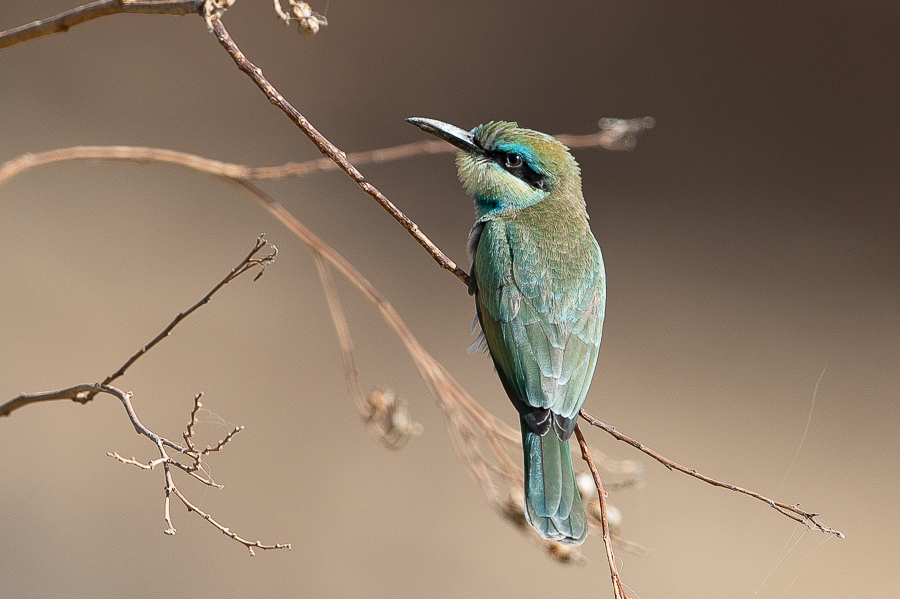
Whilst birding at Tendaha Dam, near Khamis Mushait, Southwest Saudi Arabia I came across some Arabian Green Bee-eaters. It has a status as a common breeding resident in central and western areas of the Kingdom. This species is widely spread from the Riyadh area and central Saudi Arabia across to the Red Sea coast in the west of the Kingdom. There are two subspecies Merops cyanophrys cyanophrys southern Israel, western Jordan and western & southern Arabia and Merops cyanophrys muscatensis central Saudi Arabia, eastern Yemen, United Arab Emirates and Oman. The differences between the two subspecies are very subtle with the following the main points. 

Merops cyanophrys cyanophrys

Green colours less bronzy and more blue-tinged

Forehead, eyebrow and throat blue

Gorget deep and less well defined

Tail streamers short and pointed

Merops cyanophrys muscatensis

Paler

More yellowish and less blueish above and below

Breast band narrower


18 February 2023

Arabian Green Bee-eater – Al Hair

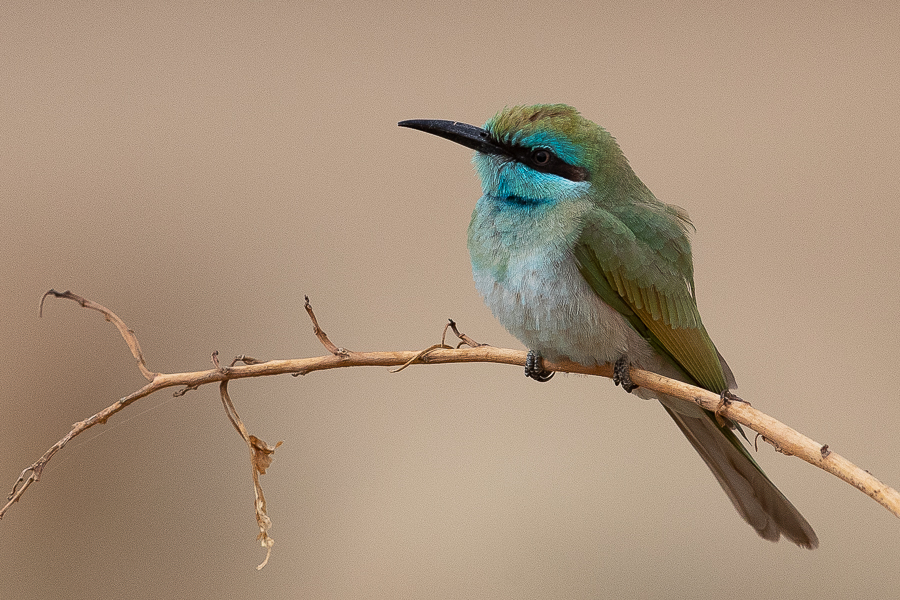
Whilst birding the Al Hair area of Riyadh I came across some Arabian Green Bee-eaters. It has a status as a common breeding resident in central and western areas of the Kingdom. It is a common species in Al Hair and I see them every time I visit. This time I managed to take a few nice photos of them and at one point two were perched close together. This species is widely spread from the Riyadh area and central Saudi Arabia across to the Red Sea coast in the west of the Kingdom. There are two subspecies Merops cyanophrys cyanophryssouthern Israel, western Jordan and western & southern Arabia and Merops cyanophrys muscatensis central Saudi Arabia, eastern Yemen, United Arab Emirates and Oman. The birds from Riyadh are from central Saudi Arabia, which is the furthest east the species occurs in Saudi Arabia. Arabian Green Bee-eater is not difficult to see in the Riyadh area where birds, look to me, very similar to the birds seen in southwest Saudi Arabia which are M. c. cyanophrys although they are Merops cyanophrys muscatensis. The differences between the two subspecies are very subtle with the following the main points. 

Merops cyanophrys cyanophrys

·      Green colours less bronzy and more blue-tinged

·      Forehead, eyebrow and throat blue

·      Gorget deep and less well defined

·      Tail streamers short and pointed

Merops cyanophrys muscatensis

·      Paler

·      More yellowish and less blueish above and below

·      Breast band narrower


09 September 2022

Arabian Green Bee-eater

Whilst birding the southwest recently I came across quite a few Arabian Green Bee-eaters in various locations, a species that is a common breeding resident. They are more easily seen in the mountains and often occur in wadies where they use trees and shrubs as lookouts for prey. The Arabian Green Bee-eater was previously treated as conspecific with M. viridissimus and M. orientalis, but differs from both in its very short stub-ended central tail feathers; bright blue forehead, supercilium and throat, and bluer lower belly; broader, smudgy black breast-bar; marginally larger size and clearly longer tail (minus the tail extensions) than the other taxa. The new species has two proposed subspecies M. c. cyanophrys occurring from southern Israel to western Jordan and west and south Arabian coasts of Saudi Arabia and M. c. muscatensis occurring from central Arabian plateau and east Arabia (E Yemen to Oman and United Arab Emirates). Arabian Green Bee-eater is not difficult to see in the southwest where M. c. cyanophrys is the subspecies.  


11 December 2021

Dhahran Al Janob

Whilst in the southwest in mid-November we travelled across to Najran birding the wadies and hills in areas where very few birders have ventured in recent years or even before that. The idea was to try to see what the range of some of the commoner birds were. We located a few birds that have not been recorded in the area previously such as Abyssinian White-eye and Arabian Babbler and others that have not been recorded since 1984 such as Arabian Warbler, Arabian Scops Owl & Arabian Wheatear. Other species seen and photographed included Palestine Sunbird, Arabian Green Bee-eater, Graceful Prinia & Arabian Sunbird.

Palestine Sunbird

Graceful Prinia

Arabian Wheatear

Arabian Wheatear

Arabian Warbler

Arabian Sunbird

Arabian Green Bee-eater

Abyssinian White-eye

27 June 2021

Birding Wadi Grosbeak

This wadi located near Taif is a site where I have seen Arabian Golden-winged Grosbeak on two occasions in previous years but unfortunately not in recent visits. Arabian Golden-winged Grosbeak is the scarcest endemic in Saudi Arabia and the most difficult to see. We again failed to locate it on this visit but did see a few good birds including Arabian Green Bee-eater, Arabian Wheatear, Red-breasted Wheatear, Arabian Serin, Arabian Woodpecker, Yemen Linnet, Yemen Thrush and Streaked Scrub Warbler. I hope the species is still present in the area as this is the only area where birds have been seen in the Kingdom in recent years.

Arabian Green Bee-eater

Arabian Serin

Streaked Scrub Warbler

Arabian Wheatear

Arabian Wheatear - male


12 February 2021

Some good birds in the pivot fields – Wadi Ad Dewasir

Wadi Ad Dewasir has several thousand pivot irrigation fields and is situated in central Saudi Arabia 1000 kilometes southwest of Dhahran. We spent three days birding the area in November and located some very interesting species. One species which had not been recorded there before but which we found in many places in small flocks totaling over 150 birds was Chestnut-bellied Sandgrouse. A local farmer I asked about the birds suggested they were common in the area, and this proved to be correct from our observations. Other species that were common were Cream-coloured Courser with over 50 seen each day and in one field a very large winter gathering of Caspian Plover totaling 36 birds. This is the largest winter group for many years in the Kingdom although hundreds were recorded in the Eastern Province in the 1980’s. Greater Hoopoe Lark was found feeding around the edge of several pivot fields with Great Grey Shrike (aucheri) seen occasionally perched in trees, shrubs or on hay bales. Commoner birds included House Sparrow, Indian Silverbill, Crested Lark, Yellow Wagtail, Arabian Green Bee-eater and Western Marsh Harrier. Lastly, at last two Pharaoh Eagle Owls were noted on the escarpment edge.

Arabian Green Bee-eater

Caspian Plover


Caspian Plover

Chestnut-bellied Sandgrouse

Chestnut-bellied Sandgrouse

Cream-coloured Courser

Cream-coloured Courser

Crested Lark

Crested Lark

Great Grey Shrike

Great Grey Shrike

Greater Hoopoe-Lark

Greater Hoopoe-Lark

Greater Hoopoe-Lark

Yellow Wagtail

Yellow Wagtail