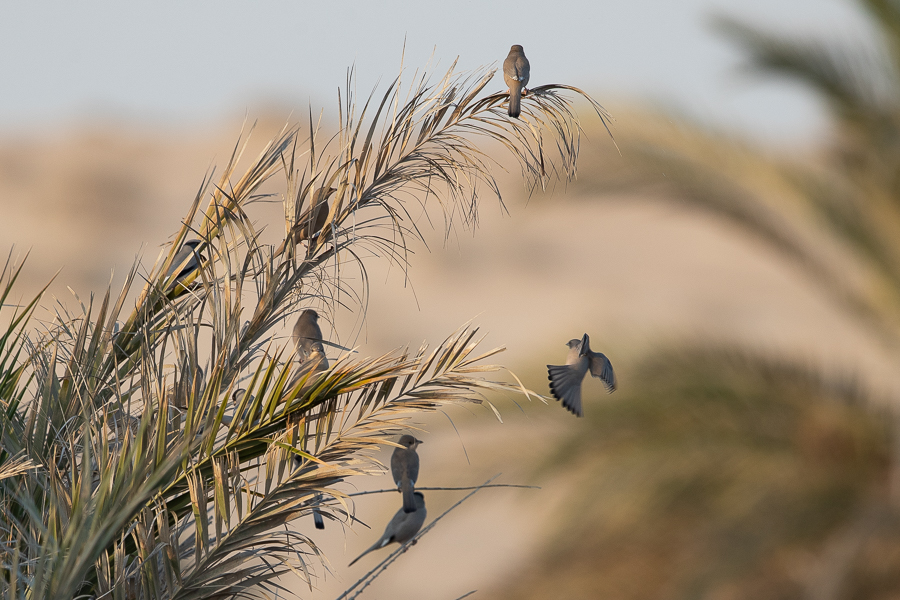
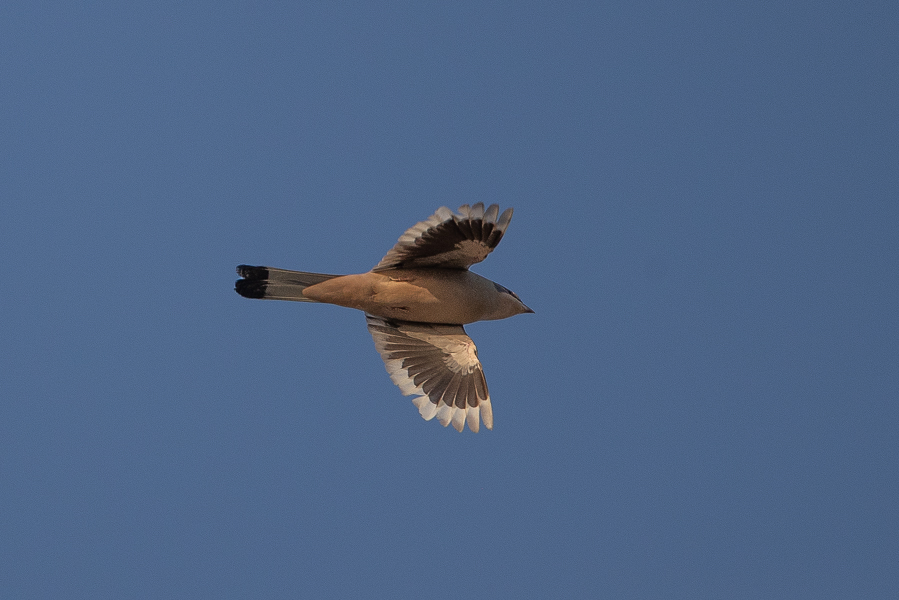
I went to Al Uqair in early November in the hope of seeing Hypocolius, a species that has wintered in the area the last few years. I saw over fifty birds with initially the birds being few and far between but as the sun rose they started flying in from other areas. They appeared to be mainly coming to drink from a small area of pools by the sea, where presumably there is some fresh water. Birds would gather in the trees near the water edge and then fly down to drink briefly before flying off. A few birds were continually calling their soft calls whilst in the trees. Hypocolius have been recorded at this location for the last four winters with the highest counts being 300 plus birds in December 2023.
Jem's Birding & Ringing Exploits in the Eastern Province and elsewhere in Saudi Arabia
12 November 2024
17 January 2024
Male & female Hypocolius – Al Uqair
I posted photos of Hypocolius that are wintering in the Al Uqair area recently with birds perched together, in flight as well as drinking. Here are some more photos of males and females, showing the obvious differences between the sexes. This species is much sought after by birdwatchers as they mainly occur in difficult to access areas, such as Iraq, Iran and Saudi Arabia and they are a family on their own. Birds are relatively easy to see in Saudi Arabia in their favoured wintering sites but much more difficult to see elsewhere and on migration.
15 January 2024
Several hundred Hypocolius – Al Uqair
I went to Al Uqair in mid-January in the hope of see the Hypocolius that are wintering in the area. In November I saw over a hundred birds but in late December only seven. I was trying to see if the birds had departed or were still present and was surprised to see several hundred birds, possibly as many as 300. The birds were few and far between in the very early morning but as the sun rose they started flying in from other areas. They appeared to be mainly coming to drink from a small area of pools by the sea, where presumably there is some fresh water. Birds would gather in the trees near the waters edge and then fly down to drink briefly before flying off. As the sun was out it gave good opportunities to photograph the birds both at rest as well as drinking. The birds were continually calling their soft calls whilst in the trees but as it was windy it was difficult to tell where they were calling from. Hypocolius have been recorded at this location for the last three winters with another large flock of about 100 birds at Haradh over the same period. Birds have also been seen in good numbers near Buraydah this winter.
18 November 2023
Over one hundred Hypocolius – Uqair
Phil Roberts and I went to Uqair in the hope of finding some Hypocolius as they here had been a large flock of several hundred birds in every winter since 2020. We arrived just as it was getting light and saw a few White-eared Bulbuls flying around but no Hypocolius. After about 15 minutes I saw a single male bird fly and land in a tree, but at some distance. We walked around the area and during the next 30 minutes saw a few more birds taking the total to about twenty birds. We then started seeing a few flocks of 10 plus birds flying over all heading south. Eventually some started to land in the palm trees but getting close was difficult on foot and over the next hour we were present we eventually saw a conservative number of 100-150 birds. Hypocolius are quite difficult to see worldwide as they occur in regions that are not so easy to access like Iran, Iraq and Saudi Arabia. Hypocolius is mainly a short-distance migrant, although small numbers remain in western Iran throughout the year, but the majority migrate south and east to their main wintering areas in southern Iran, Pakistan, western India, west and central Saudi Arabia, and Arabian Gulf States (notably Bahrain). Departure from the breeding areas mainly occurs in August with birds arriving back in April. In Saudi Arabia as a whole, they are an uncommon, but may be a locally common, winter visitor to Central Arabia, Northern Hejaz, Hejaz and Northern Red Sea. Flocks of over 100 birds have been recorded in Riyadh each winter for many years and in the last three winters a large flock of about 100 birds has been at Haradh and these birds in Uqair.
13 January 2023
Flock of Hypocolius - Haradh
Recently I saw a flock of approximately 100 Hypocolius in Haradh in the same area where they have been present the last three years. They are quite a difficult species to see, as they occur in regions that are not so easy to access like Iran, Iraq and Saudi Arabia and are a short-distance migrant. Small numbers remain in western Iran throughout the year, but the majority migrate south and east to their main wintering areas in southern Iran, Pakistan, western India, west and central Saudi Arabia, and Arabian Gulf States (notably Bahrain). Departure from the breeding areas mainly occurs in August with birds arriving back in April. In Saudi Arabia as a whole, they are an uncommon, but may be a locally common, winter visitor to Eastern and Central Arabia, Northern Hejaz, Hejaz and Northern Red Sea. Flocks of over 100 birds have been recorded in Riyadh each winter and the last couple of winter flocks of several hundred birds have been seen in Uqair and Haradh. The birds we saw in Haradh at the end of December were feeding in an area of vegetation next to large pivot irrigation fields and returning to some large acacia bushes at the side of a track. The birds were, as always, quite noisy calling to each other but never settle long enough for good photos.
24 December 2022
Hypocolius flock still present – Uqair
A visit to Uqair in early December to see if the large flock (400 birds) of Hypocolius were present was rewarded with more than 300 birds being seen. This suggests these birds may be wintering which will be great and we will look again later in the winter to see if they are still present. Birds were not on view at first light but as the sun started to rise they came out of their roosting trees and started flying around and calling. It seems quite difficult to get the birds perched in the open and the best chance of photography seems to be to get them in flight. The below photos are the best ones I obtained on the day.
24 November 2022
Large gathering of Hypocolius - Uqair
Phil Roberts and I went to Uqair in the hope of finding some Hypocolius as they here had been a large flock of 150 birds in winter 2020. The birds did not return as far as I am aware in 2021 but we hoped we may get lucky. We arrived just as it was getting light and saw a few White-eared Bulbuls flying around but no Hypocolius. After about 15 minutes I saw a single male bird fly and land in a tree, but at some distance. We walked around the area and during the next 30 minutes saw a few more singles taking the total to about ten birds. We then started walking back towards the car and started having quite a few flocks of 20 plus birds flying over all heading south-west. Eventually some started to land in the palm trees but getting close was difficult on foot. Over the two hours we were present we eventually saw a conservative number of 400 birds with some of the best photos I took shown below. This is easily the largest gathering of the species I have seen and was really an amazing spectacle. Hypocolius are quite difficult to see worldwide as they occur in regions that are not so easy to access like Iran, Iraq and Saudi Arabia. Hypocolius is mainly a short-distance migrant, although small numbers remain in western Iran throughout the year, but the majority migrate south and east to their main wintering areas in southern Iran, Pakistan, western India, west and central Saudi Arabia, and Arabian Gulf States (notably Bahrain). Departure from the breeding areas mainly occurs in August with birds arriving back in April. In Saudi Arabia as a whole, they are an uncommon, but may be a locally common, winter visitor to Central Arabia, Northern Hejaz, Hejaz and Northern Red Sea. Flocks of over 100 birds have been recorded in Riyadh each winter for many years and in the last two winter a large flock of about 100 birds has been at Haradh.