Showing posts with label White-crowned Wheatear. Show all posts

19 January 2023

Three species of Wheatear – Sakaka

Whilst birding the stony Desert area around Sakaka with Phil Roberts and Nader Fahd, we came across a wheatear at the bottom of the escarpment on the stony ground. It was a black and white wheatear, which Nader pointed out had more extensive black on the throat that the nearby Eastern Morning Wheatear and on closer inspection in became apparent it was a male Hooded Wheatear. These birds are quite distinct with their large size and long thin bill but this single bird was hard to judge the size on. They are a scarce but widespread bird throughout the region and are most often encountered in barren, remote stretches. They are a rare but widespread breeding resident of Central Arabia and also occur at Najran in the south to the Northern Hejaz. This was the first time I have seen a male of this species with all previous records having been females. We also saw two Eastern Morning Wheatear and a few White-crowned Wheatears in the same area.

Eastern Morning Wheatear

Eastern Morning Wheatear

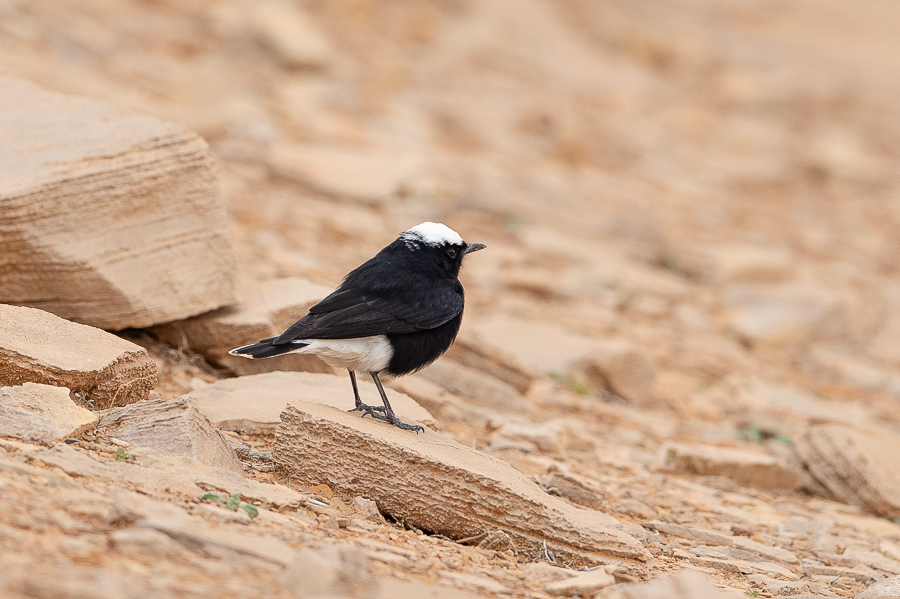
White-crowned Wheatear

White-crowned Wheatear

White-crowned Wheatear

White-crowned Wheatear

Hooded Wheatear - male

Hooded Wheatear - male

Hooded Wheatear - male

Hooded Wheatear - male


28 January 2022

Mourning & White-Crowned Wheatears - Judah

A very early morning trip to Judah in mid-January saw Phil Roberts and I finding eleven Eastern Morning Wheatears and three White-crowned Wheatears. These limestone escarpments are a very good place in winter to see both species and the below photographs were obtained. The White-crowned Wheatear was seen in the middle of a pivot irrigation filed a very strange place to locate one, but it was some distance away. Amazingly as soon as it had been seen it flew and came straight towards us landing only a few metres away. Unfortunately, the sun was not in a good position but some reasonable photos were taken. Eastern mooring Wheatear is quite a specialty of the Arabian Peninsula and is bird sought after by the big birding groups who occasionally visit Bahrain where the species can be seen. Numbers in Saudi Arabia are much higher and easier to see but visiting restrictions to the country have made seeing them more difficult, although it is now possible to obtain tourist visas so anyone really interested can now can and look for them here. 

Eastern Morning Wheatear

Eastern Morning Wheatear

Eastern Morning Wheatear

Eastern Morning Wheatear

Eastern Morning Wheatear

Eastern Morning Wheatear

White-crowned Wheatear

White-crowned Wheatear

White-crowned Wheatear

White-crowned Wheatear


15 February 2020

White-crowned Wheatear – Ushaiqer

 The Ushaiqer area, 180 km northwest of Riyadh is a good area for seeing White-crowned Wheatear. Most of the birds we saw were black crowned with no white cap indicating they were juveniles with only two out of about fifteen birds showing white on the head. They are a locally common breeding resident in dry rocky areas of Saudi Arabia and occur from the Hejaz north from Taif, Northern Hejaz, Asir south of Soudah and Najran, Tuwaiq escarpment and locally in the Gulf in areas like Shedgum escarpment and Jebal Hamrah. Also Jauf, Hail and Dawadimi.
White-crowned Wheatear

White-crowned Wheatear

White-crowned Wheatear


01 February 2020

Looking for See See Partridge – Sakaka

We went to Sakaka in the hope of locating See See Partrige that has been seen there in the past. We went to a location, on two separate days where birds were seen in 2017, but failed to find them or almost any birds of any type. We only saw a few White-crowned Wheatear, several Desert Larks and a five Crested Larks. The area is currently being developed, with large construction works going on, so maybe the Partridges have moved off because of the disturbance. Even when they were seen in 2017 they were only seen on one date despite additional searches of the area by the finders who were carrying out an environmental survey.
White-crowned Wheatear
Desert Lark
Desert Lark

17 March 2019

Wheatears– Shedgum Escarpment

Whilst birdwatching at Shedgum Escarpment we saw a few interesting birds although the weather was not good so photos were average to poor. Winter birding at this location is always difficult with few species seen but it is an excellent place to see White-crowned Wheatear. We first went to the bottom of the Escarpment and looked around the base of the cliffs and found a up to five White-crowned Wheatears including young birds with black heads and no white caps. There were many Tawny Pipits feeding around in the newly grown plants that have popped up due to all the rain we have had recently. Other species seen included a couple of distant Desert Larks and several Desert Wheatears, Isabelline Wheatears and a single Eastern Mourning Wheatear. We then went to the top of the escarpment as Trumpeter Fiches have been seen breeding here at this time of year, many years ago, but we saw little except a Long-legged Buzzard and several House Sparrows. 
White-crowned Wheatear
Eastern Mourning Wheatear
Desert Wheatear - female
Isabelline Wheatear


31 March 2018

Birding the jebals – Jebal Hamrah

Whilst birding the Jebals of the Jebal Hamrah area with Phil Roberts we relocated the Hooded Wheatear that I had seen the week previously. This may be because the bird has wintered here although alternatively may be a long staying spring migrant or possibly looking for somewhere to breed. A visit during the summer may shed some more light on the species status in the Eastern Province as a possible breeder. A single Blue Rock Thrush was located at the bottom of the escarpment, but did not linger long before flying off. This species is an uncommon passage migrant to the Eastern Province and is generally not seen on the coast, with most birds moving well inland before settling as this bird did. The number of species seen in the jebal areas is normally very low but this area is very good for both White-crowned Wheatear and Desert Lark. More than ten of each of these species were seen, with a few of the Wheatears singing and the larks regularly calling to each other. This area is a less populated and more pleasant area to bird then the Shedgum Escarpment but is further to drive to reach unfortunately.
Hooded Wheatear - female
White-crowned Wheatear

White-crowned Wheatear
Desert Lark
Desert Lark
Desert Lark
Desert Lark
Desert Lark
Desert Lark
Desert Lark
Desert Lark
Desert Lark
Blue Rock-Thrush - female

28 March 2018

Seven species of Wheatear – Jebal Hamrah

Whilst birding the Jebal Hamrah area in March I came across seven species of Wheatear in a single day including Black-eared Wheatear, Hooded Wheatear, White-crowned Wheatear, Northern Wheatear, Isabelline Wheatear, Pied Wheatear and Desert Wheatear. The week previously, I also saw an Eastern Mourning Wheatear, making a total of eight species in a week. The birds were found in varying habitats with the Jebals holding Hooded Wheatear and White-crowned Wheatear, the pivot fields holding Northern Wheatear, Isabelline Wheatear and Pied Wheatear and the surrounding stony desert having both Black-eared Wheatear and Desert Wheatear. This location is proving to be a very good one for wintering birds as well as residents and passage migrants and is certainly worth looking at more regularly from my point of view.
Eastern Black-eared Wheatear
Hooded Wheatear - female
Hooded Wheatear - female 
Isabelline Wheatear
Isabelline Wheatear
Pied Wheatear
Pied Wheatear
White-crowned Wheatear

21 March 2018

Plenty of White-crowned Wheatear – Jebal Hamrah

A very early morning trip to Jebal Hamrah turned up plenty of White-crowned Wheatear Oenanthe leucopyga. The birds preferred areas near to the steep cliff faces and as we arrived at dawn it was not too hot so we had a walk around some likely looking areas seeing quite a few and many more whilst driving along the edge of the escarpment. Their song and calls are very distinctive and makes them relatively easy to find. They are a locally common breeding resident in dry rocky areas of Saudi Arabia and occur from the Hejaz north from Taif, Northern Hejaz, Asir south of Soudah and Najran, Tuwaiq escarpment and locally in the Gulf in areas like Shedgum escarpment and Jebal Hamrah. Also Jauf, Hail and Dawadimi.
White-crowned Wheatear

White-crowned Wheatear

20 October 2017

Looking for Chukar Partridge – Jebal Lawz

On 7 October Phil Roberts and I went to Jebal Lawz, about 200 kilometres outside Tabuk, to look for Chukar Partridge. We git there before first light and waiting to try to hear any birds calling. The site is very remote and as a result is very quiet so hearing calling birds should have been easy. In reality it was very difficult, made more so by the closed and locked gate across the road preventing access to the top of the mountain where birds had been seen before. We did eventually hear birds calling lower down the road, but they were high up on a rocky mountain. I eventually saw two birds calling from this high cliff face but the distance from the birds was huge and the views poor. We stayed around for almost ten hours trying to hear or see the birds again but without luck. Bird life was very limited in the area and we only saw a few species including White-crowned Wheatear, Montagu’s Harrier, Common Kestrel, Rock Dove, Desert Lark, Tristram’s Starling, Lesser Grey Shrike, Pale Crag Martin, Scrub Warbler and Sinai Rosefinch.
White-crowned Wheatear
White-crowned Wheatear 
Streaked Scrub Warbler
Pale Crag Martin
Pale Crag Martin