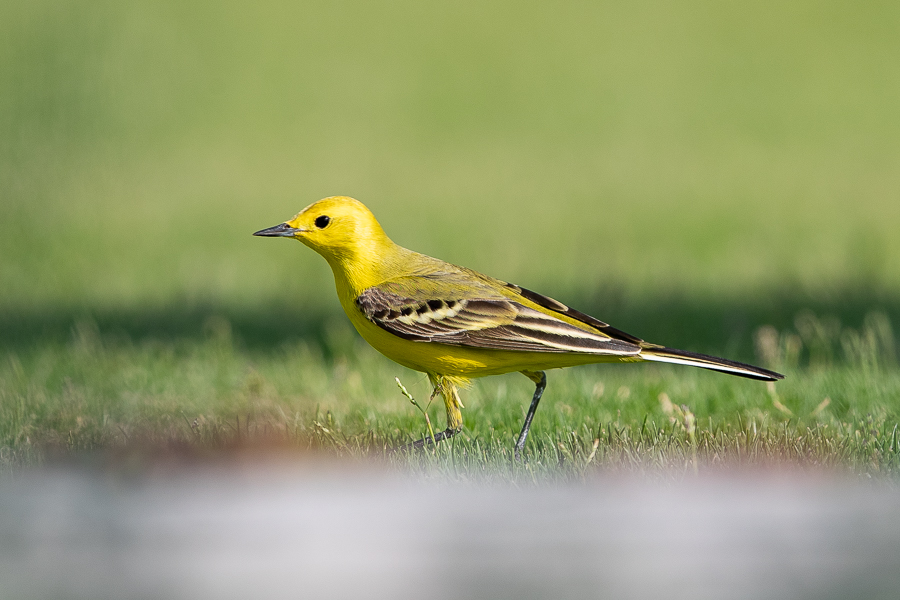
Yellow Wagtails have been plentiful this spring, with hundreds seen on some days. Over the last week numbers have been declining but there are still tens to be seen most days including various sub-species such as Grey-headed, Yellow-headed and Sykes’s Wagtails. I have not been able to get to the area at first light recently and by the time I have arrived the light has not been so good but I still managed to take a few reasonable photos of some of them. The autumn is not as good as the spring for this species and birds are nt in as good plumage either so I have spent quite a lot of time enjoying the birds over the past month or so.
Jem's Birding & Ringing Exploits in the Eastern Province and elsewhere in Saudi Arabia
19 May 2024
13 April 2024
lutea Yellow Wagtail – Dhahran Hills
Birding the football fields near Dhahran Wastewater Lake at the end of March produced fifteen Yellow Wagtails. One of the Yellow Wagtails was a bright adult male lutea Yellow Wagtail. It was feeding around the grassy football fields but came close to the edge near the road allowing some close-up photos to be taken. The plumage variation of the male lutea in summer can by divided into three main types: a) wholly yellow head, b) yellow supercilium and forehead, and largely yellow ear-coverts & c) yellow supercilium, greenish forehead and crown, largely greenish ear-coverts, and distinct dark loral stripe. The bird seen had a wholly yellow head and was a very bright individual. In Saudi Arabia, it is uncommon and usually occurs singly or a few individuals in flocks of M. f. flava. They occur in the central regions from March to May and again from August to November. In the Eastern Province, birds occur from March to mid-May where it appears to be the least common western yellow wagtail along with the superciliaris. In the western part of Saudi Arabia, four males were captured in Hadda (Makkah Region) on 3rd April 1948 (Meinertzhagen, 1949) and there is a record from Wadi Muhayil (Asir Province) on 8 May 2002.
10 May 2023
lutea Yellow Wagtail – Dhahran Hills
Birding the football fields near Dhahran Wastewater Lake in 6 May produced twenty plus Yellow Wagtails. One of the Yellow Wagtails was a bright adult male lutea Yellow Wagtail. It was feeding around the grassy football fields but came close to the edge near the road allowing some close-up photos to be taken. I rarely see this sub-species and was pleasantly surprised when I located the bird on the field. The plumage variation of the male lutea in summer can by divided into three main types: a) wholly yellow head, b) yellow supercilium and forehead, and largely yellow ear-coverts & c) yellow supercilium, greenish forehead and crown, largely greenish ear-coverts, and distinct dark loral stripe. The bird seen had a wholly yellow head and was a very bright individual. In Saudi Arabia, it is uncommon and usually occurs singly or a few individuals in flocks of M. f. flava. They occur in the central regions from March to May and again from August to November. In the Eastern Province, birds occur from mid-April to mid-May where it appears to be the least common western yellow wagtail along with the superciliaris. In the western part of Saudi Arabia, four males were captured in Hadda (Makkah Region) on 3rd April 1948 (Meinertzhagen, 1949) and there is a record from Wadi Muhayil (Asir Province) on 8 May 2002.
28 April 2015
Hundreds of Bee-eaters - Ash Shargiyah Development Company Farm
![]() |
| Blue-cheeked Bee-eater |
![]() |
| Blue-cheeked Bee-eater |
![]() |
| European Bee-eater |
![]() |
| European Bee-eater |
![]() |
| European Turtle Dove |
![]() |
| Lesser Kestrel |
![]() |
| Ortolan Bunting |
![]() |
| Rufous-tailed Rock Thrush |
![]() |
| Yellow Wagtail - lutea |
16 May 2013
lutea Yellow Wagtail – Dhahran Hills
Although the number of Yellow Wagtails has dropped off considerably over the last week or so from 50+ birds to just five, one of them is a quite bright adult male lutea Yellow-headed Wagtail. It was feeding around the muddy edges of the settling pond for a couple of days. I had only seen one Yellow-headed Wagtail in Dhahran prior to this year, but this year I have seen eight different birds. I am still to see one of the really bright birds with little or no green no the crown clearly making it a lutea but have seen a number of males like the one in the photograph. These birds are lutea on range but are very similar to the UK race of Yellow Wagtail flavissima.
![]() |
| lutea Yellow Wagtail (Yellow-headed Wagtail) |
![]() |
| lutea Yellow Wagtail (Yellow-headed Wagtail) |
![]() |
| Purple Heron - immature |
![]() |
| Little Stints |
26 April 2013
Plenty of birds passing through – Dhahran Hills
![]() |
| Purple Heron |
![]() |
| Squacco Heron |
![]() |
| Yellow Wagtail - lutea/flavissima |
![]() |
| Yellow Wagtail - lutea/flavissima |
21 April 2013
Corncrake a new ‘patch’ species – Dhahran Hills
The ‘patch’ has been alive with birds the last few days, probably caused by the inclement weather we have been having with rain, wind and dust all combining to make it a period when bird would rather be resting than continuing their migration. One such bird was a Corncrake that was a new ‘patch’ species for me. The bird was flushed from the spray fields as I was walking across them to try to get a better look a small flock of Yellow Wagtails I could see from the edge. The flock of Yellow Wagtails had mainly thunbergi but one beema was present and two female type lutea were also present. Whilst walking through the field I also flushed a Common Quail and a Jack Snipe.
![]() |
| Corncrake (taken at Sabkhat Al Fasl May 2012) |
![]() |
| Yellow Wagtail - lutea |
![]() |
| Ortolan Bunting |
![]() |
| Upcher's Warbler |
![]() |
| Upcher's Warbler |
![]() |
| Upcher's Warbler |
![]() |
| Blue-cheeked Bee-eater |
![]() |
| Blue-cheeked Bee-eater |