Showing posts with label Purple Swamphen. Show all posts

02 August 2015

Racial identity of Purple Swamphens from DNA - Sabkhat Al Fasl


Steve Trewick, an expert on the Purple Swamphen group who has written a number of papers of the species, very kindly analised some DNA from two dropped Purple Swamphen feathers I sent him from two birds we trapped and ringed at Sabkhat Al Fasl, Saudi Arabia. Steve sequenced a New Zealand bird at the same time as a control for the Saudi Arabian birds. The idea was to try to ascertain the subspecies involved in the birds occurring in Saudi Arabia. Steve said the following “As expected the birds appear to fall with the poliocephalus samples we have”. I then asked Steve if he knew if the DNA from my bird was from P. p. poliocephalus or from P. p. caspius or P. p. seistanicus. These are all grey-headed types like our birds. Steve replied saying “That’s the problem at the moment there are simply not enough data for all populations for comparison. I’m working on getting additional sampling that will help answer your question”. The good news is that even with a few, and very small, feathers we can get some good data. We still need to search for better tissue so that other markers can be used too. The problem with mitochondrial DNA that includes Control Region is it is maternally inherited so if there is inter-racial mating then we will get confused but the more data we have the less chance of this occurring.


13 May 2015

Breeding Purple Swamphens at Sabkhat Al Fasl - Bird records by Phil Roberts

Phil went to Sabkhat Al Fasl near Jubail last weekend but didn't really see anything out of the ordinary with a Eurasian Spoonbill probably the best bird.  This species although common on the west coast of the Kingdom is an uncommon visitor to the Eastern Province with the coasts near Jubail and Dammam the best places to see them. Phil also saw quite a few Red-backed Shrikes, though not in the vast numbers seen some years. Purple Swamphens were still about in good numbers at always with Phil managing to get a photo of an adult with young showing breeding has occurred again at this breeding site, which is only one of two known sites in the Kingdom. Square Herons in full breeding plumage were also seen where they possibly breed but this has not been proven conclusively yet. Phil has kindly allowed me to use a few of his photos below of birds seen on his last visit.
Purple Swamphen with chick
Squacco Heron
Squacco Heron

10 May 2015

Birds in flight – Sabkhat Al Fasl

Taking photographs of birds in flight is tricky and results can be disappointing but if you get it right the photos can be very satisfying. I had a go at a few birds, with all these photos being grab shots. That is I saw a bird flying and grabbed my camera and tried my luck. None of the photos are very good but show some interesting aspects of the birds behavior. At some stage I will try to actually concentrate of taking some proper photos of flying birds as I have some good results in the past. The photos below show Purple Swamphen a common breeding resident, Western Marsh Harrier a common winter visitor, Great-black-headed Gull and uncommon winter and spring passage migrant and Squacco Heron a common passage migrant and winter visitor.
Purple Swamphen
Purple Swamphen
Great Black-headed Gull
Steppe Gull
Steppe Gull
Squacco Heron
Squacco Heron
Western Marsh Harrier

15 March 2015

Things hotting up – Sabkhat Al Fasl

Whilst birding Sabkhat Al Fasl 6 March a lot more migrants were seen than in previous trips. Things started off well with three Pied Wheatears seen on arrival at the site just after first light and got better with a singing Savi’s Warbler shortly afterwards. Plenty of shrikes were seen including Daurian, Turkestan and Woodchat (see previous post) and good numbers of Common Swift, Barn Swallow, Red-rumped Swallow and Sand Martin were also seen. Good numbers of Black-headed Wagtails along with White Wagtails were also present and a few wintering Water Pipits and Red-spotted Bluethroats were also around the reed edges. Clamorous and Caspian Reed Warblers were singing from almost every stretch of reed-beds showing the breeding season is here or nearly so. A few more Pied Wheatears and several Isabelline Wheatears were hopping around on the bare earth and several waders species including Kentish Plover, Ruff, Common Redshank, Common Greenshank, Marsh Sandpiper and Wood Sandpiper were seen. Only one Greater Spotted Eagle and less than ten Western Marsh Harriers were seen showing birds are moving off back to their breeding grounds. Common Kingfishers were still present in small numbers as were Eastern Stonechats and resident species such as Purple Swamphen and Caspian Terns were seen.
Black-headed Wagtail
Isabelline Wheatear
Isabelline Wheatear
Wood Sandpiper
Wood Sandpiper
Marsh Sandpiper
Marsh Sandpiper
Common Kingfisher
Common Kingfisher
Purple Swamphen
Purple Swamphen
Caspian Tern
Caspian Tern

08 March 2015

Winter birds & Residents – Sabkhat Al Fasl

Last weekend’s birding trip to Sabkhat Al Fasl produced quite a few winter visitors as well as resident species. One of the most unusual was a juvenile Long-legged Buzzard. This species is rarely seen at the location although presumably the same bird has been around for a few months. It is never easy to photograph and I managed to grab a single flight shot as it flew over the car. Other winter species seen included Red-spotted Bluethroat that have been common at the site this year as well as Common Kingfisher. Most Common Kingfishers have been females but a couple of males have been seen recently possibly showing the males and females winter in different areas and males are now starting to pass back through on migration? Western Osprey is a resident and is also not regularly seen at the site although sightings are much commoner than Long-legged Buzzard. A single Western Osprey was seen over the wetlands near the power station and three Greater Spotted Eagles were also seen. Although Purple Swamphen is resident and common at this site it is the only place where seeing the species is guaranteed and double figures were encountered on this trip. A good number of Common Starlings were also seen in the reeds, a species that winters at the location but is often not seen as they spend much of their time feeding inside the reed beds and out of view. Various Eastern Stonechats were also located during the mornings birding as were plenty of herons including Western Great Egret, Western Cattle Egret, Indian Reef Heron, Little Egret and Grey Heron. A couple of other good wintering birds included a Mauryan Grey Shrike and four Song Thrushes.
Long-legged Buzzard
Long-legged Buzzard
Red-spotted Bluethroat
Western Osprey
Western Osprey
Purple Swamphen
Purple Swamphen
Squacco Heron
Squacco Heron
Mauryan (Steppe) Grey Shrike
Song Thrush
Song Thrush

23 February 2015

A mix of winter visitors and migrants – Sabkhat Al Fasl

I went birding to Sabkhat Al Fasl as it was too windy for ringing and although we did not see anything out of the ordinary we did see a good mix of winter visitors and migrants. Winter visitors included Greater Spotted Eagles, Common Kingfishers, European Stonechats (although this bird may have been an early migrant) and Red-spotted Bluethroats. Other winter birds included Great Cormorant and Pied Avocet. Most of these birds will be feeding up now to get ready for their long migrations north to their breeding grounds. Migrants included Yellow Wagtail, Barn Swallow and Little Ringed Plover all of which are early migrants through the Eastern Province of Saudi Arabia. One Barn Swallow had very rufous underparts suggesting it may have been a different subspecies to the ones we normally get. A few of the resident species were also seen with good numbers of Purple Swamphens and Little Grebes in particular. 
Greater Spotted Eagle
Common Kingfisher - male
Red-spotted Bluethroat
Yellow Wagtail
Yellow Wagtail
Little Ringed Plover
Barn Swallow
Barn Swallow
Great Cormorant
Great Cormorant
Pied Avocet
Pied Avocet
Purple Swamphen
Purple Swamphen
Little Grebe
Little Grebe
Little Grebe
Little Grebe

16 February 2015

The first signs of migration starting – Sabkhat Al Fasl

Migration starts very early in Saudi Arabia compared to my home country of the UK. Here migrants can be seen in January and by early February numbers are increasing. The first signs of migration are normally Barn Swallows and Pallid Swifts with small numbers of each seen in the last few weeks. Phil Roberts also saw a couple of House Martins that are also early migrants. A good number of singing Reed Warblers were also migrants as these are not resident in the Eastern Province although stay until November and are only absent for a couple of months. A few Purple Herons in the last three weeks may well also have been migrants but it is difficult to tell. A number of waders may also be moving as there are now a few more Green Sandpipers and Wood Sandpipers present. Another species it is difficult to tell if they are migrants or not are the Stonechats as some winter and some are on passage  We saw a few SCT Stonechats as well as a smart male NCT Stonechat this I failed to get any photographs of. Migration should start building over the next few weeks and peak in March and April. Let’s hope we get a good spring migration this spring as last year was relatively poor compared to other recent years.
SCT Stonechat - male
Citrine Wagtail
Citrine Wagtail
Common Kingfisher - male
Daurian Shrike
Daurian Shrike
Green Sandpiper
Green Sandpiper
Little Grebe
Little Grebe
Purple Swamphen
Purple Swamphen
Red-spotted Bluethroat
Slender-billed Gull
Slender-billed Gull

11 February 2015

Another Moustached Warbler & Grey-headed Swamphen trapped and ringed – Sabkhat Al Fasl

Nicole and I went ringing to Sabkhat Al Fasl on Saturday rather than our normal Friday as the wind was forecast to be a little less strong on the Saturday. We set off from Dhahran at 03:30 hrs and had all the nets set up by first light of 06:15 hrs. The wind was a little stronger than we would have liked but we caught a reasonable number of birds for us ending the morning with 25 birds. Most were the normal suspects for this time of year with wintering birds including Bluethroat, Common Chiffchaff, Common Kingfisher, Moustached Warbler and Water Pipit, resident species including Indian (Clamorous) Reed Warblers and Purple Swamphen. The Purple Swamphen was caught in a mist net as it flew across an open area of water to a reed bed and is the second one we have caught in two weeks after not catching any up to that point. They are really smart birds and I have collected a couple of loose feathers from both birds and will, hopefully, be sending them off for DNA work to be conducted on them to try to work out exactly which subspecies occurs here as currently we are uncertain. They are certainly a Grey-headed type but which of the several grey-headed subspecies are involved we do not know. The other stand out bird was the second Moustached Warbler in two weeks which is only the third record since we started ringing.
Moustached Warbler
Moustached Warbler
Grey-headed (Purple) Swamphen
Common Chiffchaff
Common Chiffchaff
Common Kingfisher - female
Indian (Clamorous) Reed Warbler
Red-spotted Bluethroat
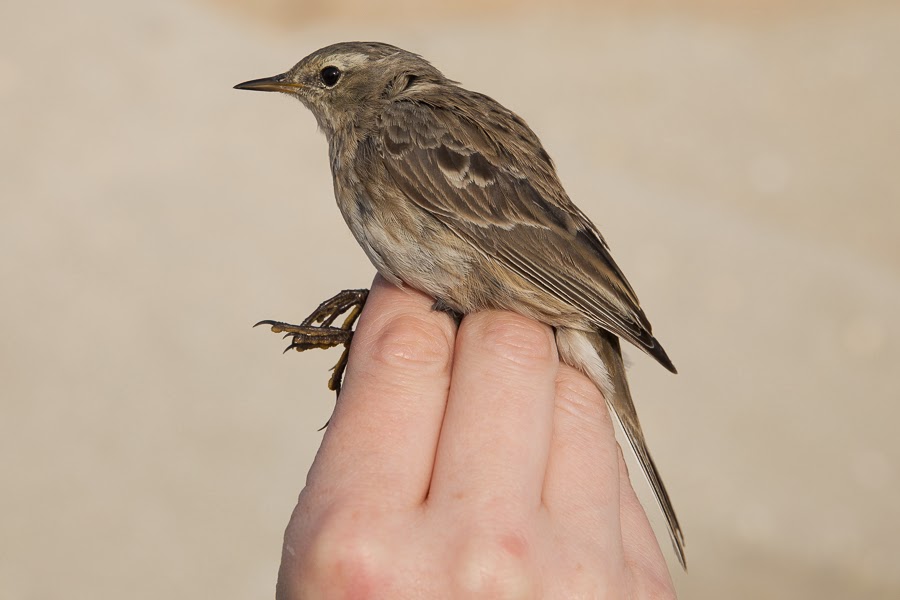
Water Pipit - coutelli