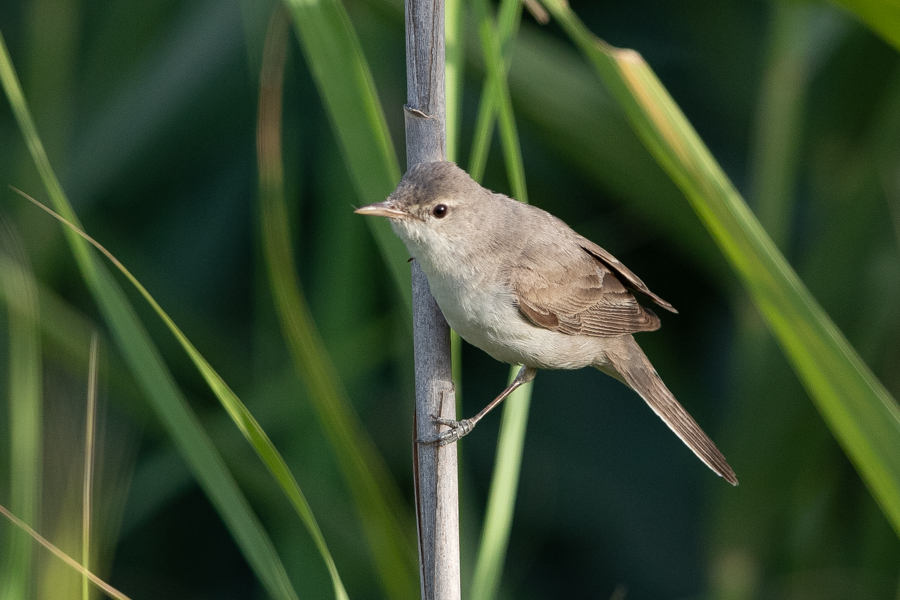
Whilst birding the scrubby area at the side of Dhahran Waste Water Lake at the end of April I came across an Upcher’s Warbler busily feeding in the abundant vegetation that has been recently planted by Saudi Aramco. Even though I was on foot, as the bird was busy feeding I managed to get quite close and took the below photos, The species is an uncommon passage migrant through the Eastern Province that is rare in summer. The main identification points to separate Upcher’s Warbler and Eastern Olivceous Warbler are that Upcher’s Warbler is generally bigger and has a stockier appearance although this can be difficult to judge on a lone bird if unfamiliar with them. Wings, legs, tail and bill are all longer on Upcher’s Warbler than on Eastern Olivaceous Warbler with the legs and bill being thicker on Upcher’s Warbler. The tail on Upcher’s Warbler is long and ‘full’ and darkens towards the tip, which is not the case in Eastern Olivaceous Warbler. This darkening of the tail can be seen in the below photographs. The tail is also moved in a rather lazy swinging motion often sideways and also upwards and is also fanned, which is not often if ever shown by Eastern Olivaceous Warbler. The exaggerated tail movements of Upcher’s Warbler are often the first thing that draws attention to the species, especially if they are deep in cover.
Jem's Birding & Ringing Exploits in the Eastern Province and elsewhere in Saudi Arabia
05 May 2024
02 July 2023
Summer Upcher’s Warbler – Jubail area
Whilst birding the Jubail area in late-June I came across an Upcher’s Warbler. This was a very unusual sight as the birds are passage migrants in the Eastern Province as far as we are aware. I have seen birds in the summer months in the west of the Kingdom but never in the east. The main identification points to separate Upcher’s Warbler and Eastern Olivceous Warbler are that Upcher’s Warbler is generally bigger and has a stockier appearance although this can be difficult to judge on a lone bird if unfamiliar with them. Wings, legs, tail and bill are all longer on Upcher’s Warbler than on Eastern Olivaceous Warbler with the legs and bill being thicker on Upcher’s Warbler. The tail on Upcher’s Warbler is long and ‘full’ and darkens towards the tip, which is not the case in Eastern Olivaceous Warbler. This darkening of the tail can be seen in the below photographs. The tail is also moved in a rather lazy swinging motion often sideways and also upwards and is also fanned, which is not often if ever shown by Eastern Olivaceous Warbler. The exaggerated tail movements of Upcher’s Warbler are often the first thing that draws attention to the species, especially if they are deep in cover. This bird did not move its tail like this and just did a single downwards movement that is similar to Eastern Olivaceous Warbler. Unfortunately, the bird did not stay on the open for very long and good views could not be obtained.
26 June 2021
Birding Jabal Ibrahim
I visited Jabal Ibrahim recently, the first time I had been to the location. This massive Jabal is located between Taif and Al Baha in the western mountains and is an excellent site for birds. The habitat looks very good and held some good birds, such as Black-crowned Tchagra, Arabian Serin and Arabian Partridge. Other good birds seen included Long-billed Pipit, Abyssynian White-eye, Palestinian Sunbird and Gambaga Flycathcer. We also saw a few migrants such as Upcher’s Warbler and plenty of lizards that were mainly Anderson’s Rock Agama.
![]() |
| Arabian Sunbird |
![]() |
| Upcher's Warbler |
![]() |
| Gambaga Flycatcher |
28 August 2013
Early migration through Zulfi – Bird records by Mansur Al Fahad
Mansur Al Fahad is a very good Saudi Arabian birdwatcher, as well as all round naturalist, who currently lives in Riyadh, but who is originally from Zulfi (north-central Saudi Arabia). Mansur has previously sent me photographs of a number of lizards he has seen in the region as well as helped me with the identification of a lizard I saw at Sabkhat Al Fasl in the Eastern Province. Recently he sent me some excellent photographs, which he has kindly allowed me to reproduce here, taken with his new camera set up of a Canon 7D and 600mm F4 ISII which he took when on holiday in his original home town of Zulfi in August. Copyright of the below photos remains with Mansur.
Zulfi consists of five main environments:
1 - Sand dunes with some shrubs and palm oases constitute two-thirds of the area and are mainly in the north and west.
2 – The eastern plateau with high ground and valleys with some acacia trees and shrubs.
3 – The sharp western edge of the plateau overlooking the city with good vegetation cover and valleys.
4 - Farms around the city consisting mostly of palm plantations, animal feed fields and vegetables
5 - Large farms in western Zulfi (in the sandy plains), for grain and animal feed (pivot irrigation) with some new palm plantations.
Central Saudi Arabia has quite a different birding fauna to the Eastern Province and birds pass through the region and slightly different times and in slightly different numbers. Mansur photographed a number of birds that have yet to come through the Eastern Province this autumn, as far as I am aware, including White-throated Robin and Greater Short-toed Lark. White-throated Robin is a very scarce autumn migrant through the Eastern Province with only two documented records until 1989 (Bundy et al) although it is more regular in spring. Large numbers of this species have recently been seen in the Abha region of South-west Saudi Arabia indicating it has a westerly migration route in autumn through Saudi Arabia. Greater Short-toed Lark is seen in autumn from September until October in the Eastern Province, but again is commoner in spring, showing this species passes earlier through central Saudi Arabia than the east of the country. These records appear to show that Zulfi is on a migration route of a number of birds that do not occur as regularly further east in the country.
![]() |
| White-throated Robin |
![]() |
| Greater Short-toed Lark |
![]() |
| Upcher's Warbler |
![]() |
| Eurasian Hoopoe |
![]() |
| Rufous-tailed Scrub Robin |
![]() |
| European Reed Warbler |
![]() |
| Marsh Warbler |
04 August 2013
Upcher's Warblers - Dhahran Hills
Whilst birding the ‘patch’ in the spring a number of Upcher’s Warblers have been seen with the highest daily count five birds. They are mainly seen in the scrub and bushes near to the spray fields and percolation pond with the below photos taken at the edge of the spray fields. The main identification points to separate Upcher’s Warbler and Eastern Olivceous Warbler are that Upcher’s Warbler is generally bigger and has a more stocky appearance although this can be difficult to judge on a lone bird if unfamiliar with them. Wings, legs, tail and bill are all longer on Upcher’s Warbler than on Eastern Olivaceous Warbler with the legs and bill being thicker on Upcher’s Warbler. The tail on Upcher’s Warbler is long and ‘full’ and darkens towards the tip, which is not the case in Eastern Olivaceous Warbler. This darkening of the tail can be seen clearly in the below photographs. The tail is also moved in a rather lazy swinging motion often sideways and also upwards and is also fanned, which is not often if ever shown by Eastern Olivaceous Warbler. The exaggerated tail movements of Upcher’s Warbler are often the first thing that draws attention to the species, especially if they are deep in cover.
The wing is fairly dark and contrasts with the mantle and also has quite a long primary projection and the wing has a pale whitish secondary panel in Upcher’s Warbler, with Eastern Olivaceous Warbler having a paler less contrasting wing with shorter primary projection and a pale buffish secondary panel which is much less obvious and more difficult to see than the panel in Upcher’s Warbler. Another quite obvious difference is the spacing on the tertial feathers, with the tip of the middle terital closer to the outermost tertial than it is to the innermost one on Upcher’s Warbler and these being evenly spaced on Eastern Olivaceous Warbler.
The general plumage of Upcher’s Warbler is quite greyish, rather than the brownish and yellowish tone of Eastern Olivaceous Warbler and the lores appear quite bare on Upcher’s Warbler. Lastly the bill is relatively stout looking and has a pale pinkish base on Upcher’s Warbler, and is less stout with a yellowish base on Eastern Olivaceous Warbler.
19 May 2013
Bird numbers dropping - Dhahran Hills
Bird numbers have decreased significantly over the last few days with the only migrant still in good numbers being the Willow Warbler. There are still a few Red-backed Shrikes about and surprisingly a nice adult male Turkestan Shrike, which is the first male of this species I have seen for more than two weeks. The scrubby desert area had two European Bee-eaters and an Upcher’s Warbler showing very well in the low bushes.
![]() |
| Upcher's Warbler |
![]() |
| Red-backed Shrike |
![]() |
| Turkestan Shrike |
![]() |
| Namaqua Dove |
![]() |
| Namaqua Dove |
![]() |
| Sand Martin |
14 May 2013
Some late birds - Sabkhat Al Fasl
![]() |
| Upcher's Warbler |
![]() |
| Ortolan Bunting |
![]() |
| Ortolan Bunting |
![]() |
| Common Snipe |
![]() |
| Common Snipe |
![]() |
| Common Snipe |
![]() |
| Purple Swamphen |
06 May 2013
Egyptian Nightjar and more – Sabkhat Al Fasl
An early morning trip to Sabkhat Al Fasl last Thursday produced an unusual record of an Egyptian Nightjar. The bird was flushed from below a Tamarisk bush and flew a short distance allowing identification in flight as an Egyptian Nightjar. It was then located out in the open and a couple of photos taken to confirm its identification. Egyptian Nightjar is a regular visitor to the site and can been seen most years, but these record are from the summer months of June and July. As far as I know there are no spring records, but I am sure they must pass through each spring. It would be interesting to know if the birds breed in this area. There are no confirmed breeding records for Arabia, but the regular occurrence of birds in summer in Saudi Arabia and Kuwait lead to the suspicion they may breed in the region.
![]() |
| Egyptian Nightjar |
![]() |
| Red-backed Shrike - adult male |
![]() |
| European Roller |
![]() |
| Blue-cheeked Bee-eater |
![]() |
| European Bee-eater |
![]() |
| Turkestan Shrike |
![]() |
| Upcher's Wabler |
![]() |
| Spotted Flycatcher |
![]() |
| Whinchat |
![]() |
| Purple Heron - juvenile |
![]() |
| Squacco Heron |
![]() |
| Temminck's Stint |
![]() |
| Curlew Sandpiper |