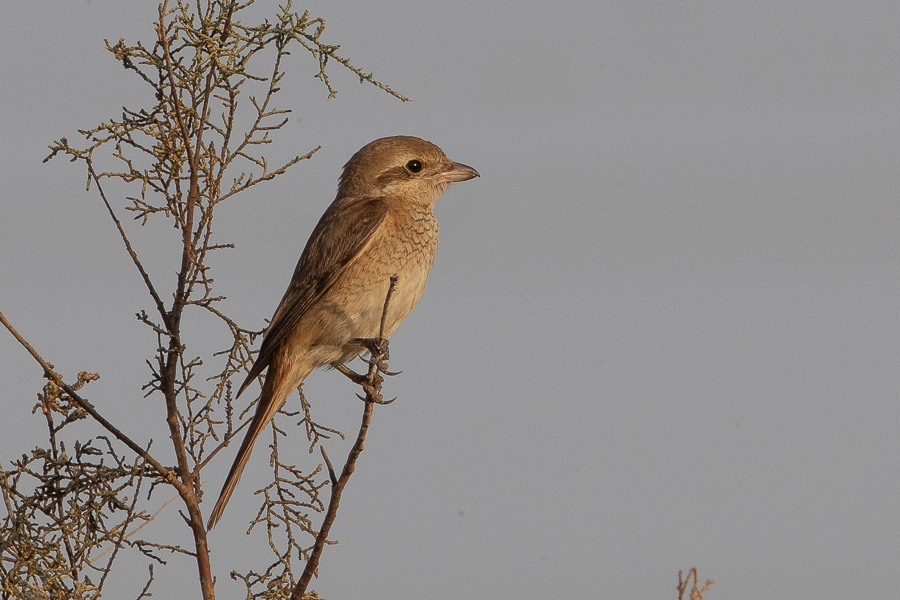
Whilst birding the area between Judah and Al Wannan area on 4 November Phil Roberts and I came across a Red-breasted Flycatcher along the edge of fenced off area of farmland including a large pivot irrigation field. The area was fenced with a set off trees growing along a couple of sides and the Red-breasted Flycatcher was mainly spending its time along the barbed wire fence line. The bird was very active and it was not easy trying to get close to it for photographs with the below photos the best I managed. This was only the third one I had seen so was a very nice surprise, with the last one also in November in Jubail on 19 November 2021. Red-breasted Flycatcher is a rare passage migrant and winter visitor to Saudi Arabia with records scattered around the Kingdom with a number from the northwest, particularly Yanbu mainly in November. A number of records have occurred in the Riyadh area from October to January, but mainly in November. Birds from the Eastern Province have occurred from September to March with most in October and November and the best areas Dhahran and Abqaiq. This record from Hanidh fits nicely the pattern of occurrence of late autumn early winter.
Jem's Birding & Ringing Exploits in the Eastern Province and elsewhere in Saudi Arabia
12 November 2022
10 November 2022
Booted Eagle at Judah – Bird record by Ed Blackthorne
Ed Blackthorne recently (end of October) saw a the below Booted Eagle near Judah’s Thumb. He has just sent me the photos and details and has kindly allowed me to add them to my website. Judah is between Dhahran and Riyadh, but is still in the Eastern Province where the species is vagrant with seven records. In the Kingdom as a whole it is mainly a scarce passage migrant en-route to Africa via the Bab al-Mandab Strait in Yemen. An increasing number of records in December and January, however, indicate it is now also a rare winter visitor, with the majority of these records in the northwest of the Kingdom. They breed from northwestern Africa and Iberia to Mongolia and winter south in sub-Saharan Africa and India.
08 November 2022
Wader numbers dropping - Jubail
Whilst birding Jubail recently it has been noticeable the wader numbers are dropping. The most common wader remains the Little Stint, followed by Dunlin and Black-winged Stilt. Smaller numbers of Common Ringed Plover are still around and only a handful of Common Greenshank. All the Sand Plovers seem to have moved off, but Kentish Plover is still plentiful.

Little Stint 
Little Stint 
Little Stint
![]() |
| Dunlin |
![]() |
| Dunlin |
![]() |
| Dunlin |
![]() |
| Dunlin |
![]() |
| Dunlin |
![]() |
| Dunlin |
![]() |
| Dunlin |
![]() |
| Dunlin |
![]() |
| Common Ringed Plover |
![]() |
| Common Ringed Plover |
![]() |
| Common Greenshank |
![]() |
| Common Greenshank |
![]() |
| Common Greenshank |
![]() |
| Black-winged Stilt |
![]() |
| Black-winged Stilt |
06 November 2022
Returning Greater Spotted Eagles – Jubail
The first Greater Spotted Eagle returned mid-October when three were seen. Since this date numbers slowly increased to eleven by 21 October and sixteen by 29 October. Birds have included adults, sub-adults and juveniles in roughly equal numbers. This buildup in numbers matches that from previous years when the majority of birds that will spend the winter in Jubail have arrived by the end of October. More individuals do arrive as the winter progresses and 18 have been recorded on a single day. In winter birds are almost always near wetland areas with large areas where they can hunt undisturbed. They occupy a fragmented range, breeding mainly in Estonia, Poland, Belarus, Moldova, Russia, Ukraine, Kazakhstan, mainland China and Mongolia. Passage or wintering birds occur in small numbers over a vast area, including central and eastern Europe, North Africa, East Africa, the Middle East, the Arabian-peninsula, the Indian Subcontinent, south Asia and South-East Asia. The Greater Spotted Eagle is suspected to have undergone at least a moderately rapid decline over the last three generations as a result of habitat loss and degradation throughout its breeding and wintering ranges, together with the effects of disturbance, persecution and competition with other predators. The species is listed on the Red Data list as Vulnerable as the species is facing a high risk of extinction in the wild in the medium-term future. Birds can be seen perched on the power pylons as well as in the reed islands but are not so often seen on the ground. This was not the case with a bird recently that allowed relatively close approach I the car when sitting on a large sandy track.
05 November 2022
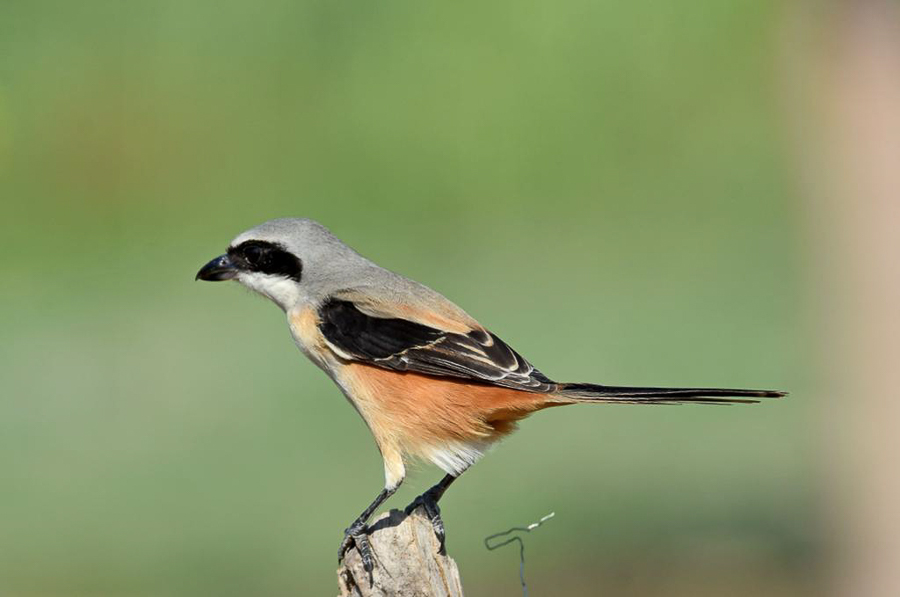
Long-tailed Shrike in Bahrain – Bird record by Jehad Alammadi
Jehad Alammadi kindly sent me some of his excellent photos of a Long-tailed Shrike he found at a farm Barbar in the north of Bahrain on 31 October 2022. Jehad also found one last year on 27 October on a private farm in Galali also in the north of Bahrain and thinks it may be the same bird. As far as I am aware these are the first records for the species for Bahrain. I am now hoping one will cross the water and be found in Saudi Arabia. We only have one record for the Kingdom of an adult at Dhahran golf course, Dhahran, 14 February to 4 April 2015. Although this bird stayed for quite some time I din not manage to get anywhere near as good as set of photos as Jehad has done of his bird. Jehad has kindly given me permission to use his photos on my website which are shown below.
04 November 2022
Vary slow migrant wise – Jubail
My recent visits to Jubail have turned up very few migrants. The only migrants that have been about in numbers have been Barn Swallow and Bank Martin as well as Blue-cheeked Bee-eaters. Many have been flying over but other have stayed for a short period of time resting up. Very small numbers of Western Yellow Wagtails have been seen and Pied Wheatears are slowly building up in numbers. A few winter birds have been seen to liven things up including reasonable numbers of Northern Pintail, Daurian Shrike and still five Black-necked Grebe. Heron numbers are increasing as are Caspian Tern.
![]() |
| Pied Wheatear |
![]() |
| Daurian Shrike |
![]() |
| Daurian Shrike |
![]() |
| Daurian Shrike |
![]() |
| Daurian Shrike |
![]() |
| Blue-cheeked Bee-eater |
![]() |
| Black-necked Grebe |
02 November 2022
Grey-headed Swamphen – Jubail
Whilst birding the Jubail area recently I managed to see a Grey-headed Swamphen close on the edge of an open flooded area of Sabkha. It is unusual to be able to get close to them when fully out in the open as they either slowly walk off or run. This one allowed me to take some of the best photos I have of the species so far and was very pleased with the results. The Grey-headed Swamphen is a common resident and was first found breeding in Saudi Arabia in August 2011 at Sabkhat Al Fasl, Jubail. It has since rapidly expanded and now breeds at Khafrah Marsh a wetland site 30 kilometres south-west of Sabkhat, Dammam, Al Hassa, Qatif and probably elsewhere. This rapid spread of birds is probably due to the rapid population increase observed at Sabkhat al Fasl over the past few years, which has created pressures on territories and prompted some birds to move to alternative suitable habitats within the Eastern Province and thereby expand its range. The Eastern Province still remains the only part of Saudi Arabia where they occur, but this is likely to change over the next few years.