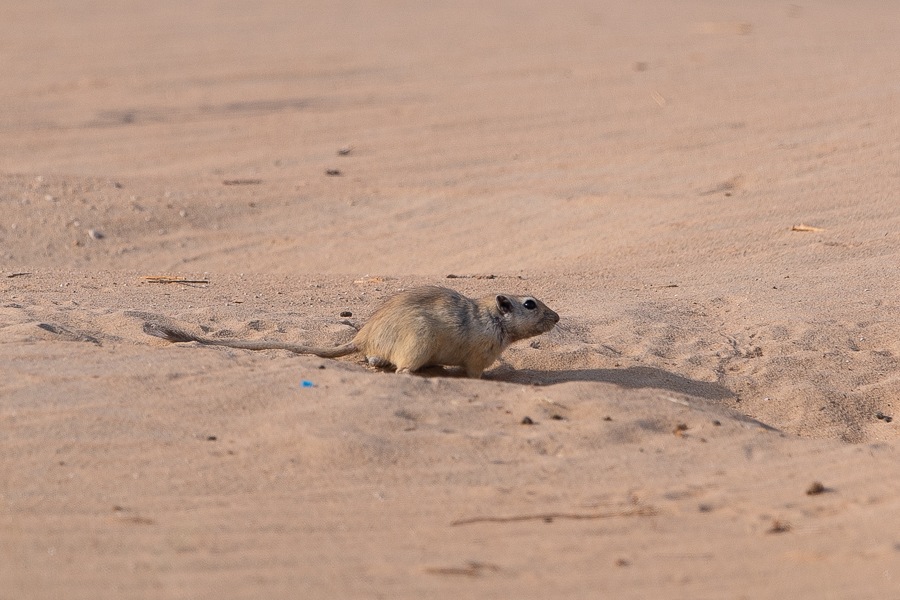
Whilst looking for Fat Sand Rats in Khursaniyah recently we got excellent views of a couple of Schmidt's Fringed-toed Lizard Acanthodactylus schmidti just outside the car. The lizards would quickly run across the sand and then stop and dig up a black coloured ant, which it would then take to a nearby bush to eat. Once, one found an ant on the surface and remained motionless as the ant came closer and then struck and killed the insect. I have seen this lizard many times before but these were some of the best views and was the first time I had seen one eating ants. Schmidt's Fringed-toed Lizard is one of the most abundant species in the genus Acanthodactylus found in Saudi Arabia and occupies sandy plains, dunes and sabkhas (salt flats), particularly in areas of scrubby vegetation. It was named after Karl Patterson Schmidt, with a type locality of Dhahran, Saudi Arabia and it can be distinguished by the exceptionally long fourth toe found on each of its rear feet. As its name suggests it has 'fringes' of elongated scales along the sides of each toe, which are thought to provide better traction on loose sand. It has a light brown or coffee coloured back that is richly speckled with oval-shaped, pale or white spots and can grow to 18 centimetres in length. They have a cylindrical body with smooth, rectangular scales on the belly that are arranged in well-defined rows and scales on the head that are larger than those on the rest of the body. Little is known about the biology of the species but its main prey is ants and when prey is located they instantly go rigid, suddenly quiver their tail and strike. It is a diurnal species that digs burrows in the sand among the roots of vegetation and is found throughout the Arabian Peninsula including Saudi Arabia, United Arab Emirates, Jordan, Kuwait, Oman, southeast Iraq and south-west Iran.
Jem's Birding & Ringing Exploits in the Eastern Province and elsewhere in Saudi Arabia
25 October 2022
23 October 2022
Sanderling - Jubail
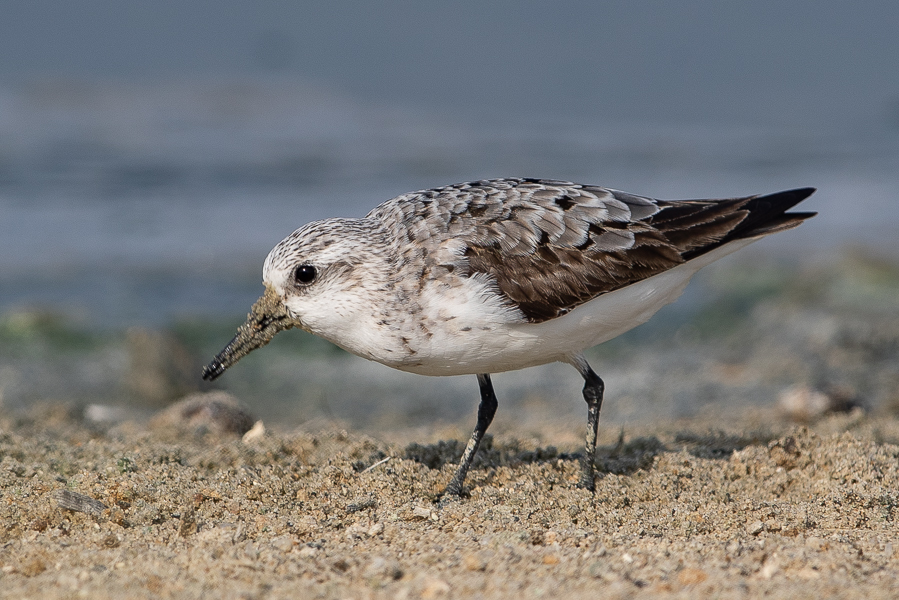
Whilst birding the Jubail area recently I came across a single Sanderling feeding along the edge of a large area of flooded sabkha. The bird was feeding activel as they always seem to do making getting good photos a little tricky. This is a species that occurs rarely inland in Jubail and was a pleasing find. The Sanderling is a migratory bird that is a common passage migrant and uncommon winter visitor in Saudi Arabia. It occurs on both coasts during migration (Apr–Jun, Sep–Oct) and occasionally inland, especially in spring but is more common on the west coast than the east coast. It prefers sandy beaches but is also less commonly seen on muddy shores and saline lagoons.
21 October 2022
Fat Sand Rats - Khursaniyah
19 October 2022
A few migrants - Aqua Park
Last weekend in Jubail, I saw a few migrants at Aqua Park. I arrived at first light and as the park was being watered spent the first hour looking at the birds on the grassy areas. Here I noted a few migrants like a couple of Spotted Flycatcher and three Tree Pipit with up to ten Yellow Wagtail. The park is neat to a water area and here there were a few waders such as Eurasian Whimbrel, Dunlin, Kentish Plover and Black-winged Stilts. Egrets were numerous with most birds being Indian Reef Herons and a few Slender-billed Gulls were also present. A single duck noted at some distance turned out to be a female Northern Pintail on closer inspection. The trees held a few birds with a Masked Shrike noted along with a Lesser Whitethroat and birds flying over included good numbers of both Barn Swallow and Sand Martin.
![]() |
| Northern Pintail |
![]() |
| Spotted Flycatcher |
![]() |
| Tree Pipit |
![]() |
| Yellow Wagtail |
![]() |
| Yellow Wagtail |
17 October 2022
Libyan Jirds – Khafra Marsh
As my daughters are back in Saudi Arabia for the summer school holidays and one wanted to see the Libyan Jirds I had seen earlier in the year. As a result, we set off from home at 03:45 in late August to get to Jubail for first light. By 05:15 just as it was getting light, we noticed the first Jirds on the side of the road where I had seen them before. The sun was not up, but as the animals were very close photography was possible. We stayed looking at the Jirds for a couple of hours and during this time the light became better and better photographs could be taken. Once the temperature started to get too hot, around 07:00 the jirds started to disappeare down their burrows. The underground burrow system of these animals is extensive and often they would go down one hole and reappear hortly after some distance away out of another burrow. The climate of Saudi Arabia is characteristically harsh with rainfall being sporadic and unpredictable and temperatures often climbing well above 40 °C. Under such conditions food resources and water are scarce, yet many small mammals can survive and reproduce, one of the most successful being the Libyan Jird Meriones libycus. The Libyan Jird is one of the most widely distributed species among rodents, ranging across nearly the entire Palearctic Desert Belt from Morocco in Northwest Africa to China. It occupies desert and semi‐desert habitats, generally in areas with stabilized dunes. It becomes most abundant in unflooded river plains, and it is often found close to wadies and occasionally in arable land. A recent study defined subspecies limits within Meriones libycus into three allopatric lineages within M. libycus: Western lineage in North Africa Meriones libycus libycus, Central lineage in Saudi Arabia, Jordan, and Syria M. l. syrius, and Eastern lineage in Iran, Afghanistan, and China Meriones libycus erythrourus.