Whilst birding Jubail I came across well over fifty adult summer plumaged Squacco Herons. They were all sitting out in the reeds in the flooded sabkha with a few close by in the track side vegetation. A number of birds were seen flying past allowing some close up flight shots. Adult summer plumage birds are being seen much more commonly in recent years suggesting birds are breeding in the area as numbers have significantly increased in the summer months in the last three or four years. Significant numbers of juveniles are seen in the early autumn also suggesting breeding is occurring either here or very nearby. The species is very common here on spring and autumn migration as well as in the winter but has only been recorded breeding occasionally in the Eastern province previously although they breed commonly in the west of the Kingdom.
Jem's Birding & Ringing Exploits in the Eastern Province and elsewhere in Saudi Arabia
18 June 2023
16 June 2023
White-cheeked Terns - Jubail
Whilst in the Jubail area recently I came across good numbers of White-cheeked Tern Sterna repressa. This is a common breeding summer visitor to the Gulf and Red Sea coast north to Jeddah. Birds start occurring in April and by June there are very large numbers as this is the start of their breeding season. Birds are often seen sitting around on the ground but on this occasion I only saw birds flying around, some catching fish. White-cheeked Tern juveniles occur from late July and August and some remaining until October. Winter records are rare in the Eastern Province, although they have been seen occasionally. Birds breed offshore Jubail on small islands and use wetland areas of Jubail as feeding areas. It is not easy to get photos with light showing in the eyes as their plumage is grey, black and white, but birds do come close along the open water areas so close up shots are possible. In June many birds also form groups sitting on sandbanks and feed on some water outflows so close up photography becomes easier.
14 June 2023
Blandford’s Agama - Jubail
Whilst birding Jubail area 9 June I saw a Blandford’s Agama Trapelus ruderatus resting in the top of a fence on the way out of the location. They are seen occasionally in this area but they are not often seen, although are probably common. They range from northeast Jordan and southern Syria, through northern and eastern Saudi Arabia, Iraq, Kuwait and southern and central Iran as far south as Shiraz. The species occurs from close to sea level to around 1,000 metres above sea level. It can be moderately common in suitable habitat. This ground-dwelling species is associated with low shrubs (Nitraria) on the fringe of sandy dunes in arid areas and in sandy desert areas. It can sometimes be found perching on bushes but is not found in modified areas. It is very similar to Yellow-spotted Agama Trapelus flavimaculatus but Blanford's Agama has lines on its back that are missing on Yellow-spotted Agama. They remain very still when seen and allow extremely close approach and can be photographed well with a camera phone although these photos below were taken with my 600mm lens.
12 June 2023
First Egyptian Nightjar of year – Jubail
Whilst birding the Jubail area 9 June I found an Egyptian Nightjar sitting next to the track. These birds are extremely well camouflaged and are very difficult to see unless they fly or are on the track itself. Egyptian Nightjars are now an easily seen species during the summer months in the Jubail area with a maximum of sixteen birds seen in 2021 and twenty in 2022 with numbers increasing almost every year since they were first found in 2006. Birds have been seen twice in May, but early June is an early record for the species. They often sit on the car tracks, and you can get very close to them in the car without disturbing them as they are convinced their camouflage will protect them. The bird shown here is an adult and we hope that juveniles will be seen over the next month showing they are continuing to breed in the area as in the last three years where they were recorded breeding in the area or very nearby.
10 June 2023
Young Camels – Salwa
Camels are quite a common sight in the deserts of Saudi Arabia and they come in all sorts of different colours. I have taken numerous photos of them over the years against their desert backgrounds, with these ones quite young animals, although their mother was close by to ensure they were safe from harm. No matter how many times I see camels I am always happy to see more. They are extraordinary creatures, but it is wise to keep some distance from them as they can be a bit temperamental if you get too close.
08 June 2023
Common Birds – Tanoumah
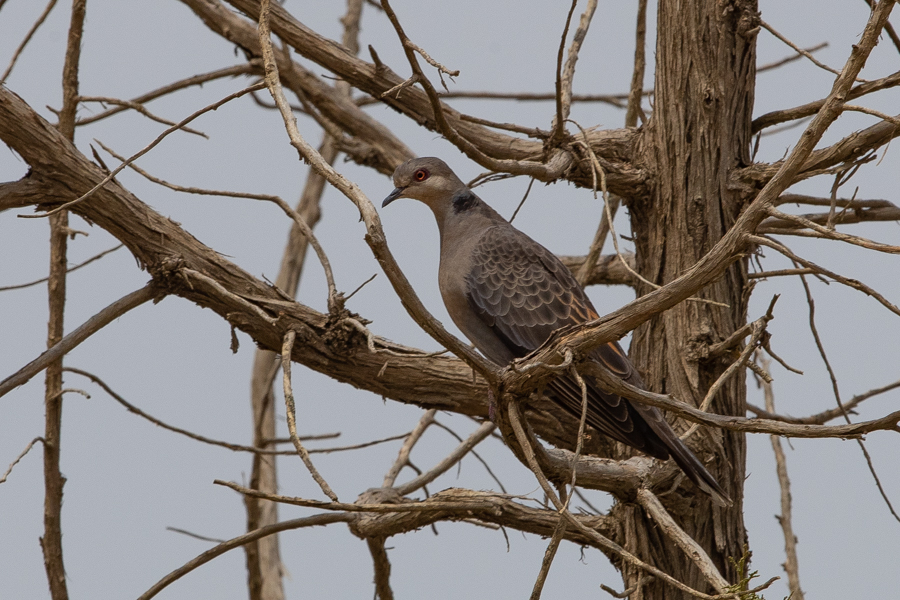
Whilst birding the Tanoumah are I managed to photograph a few of the common species that occur there. Mainly ground dwelling birds seen included Arabian Babblers, in small groups as well a two Streaked Scrub Warblers that normally favour the rocky areas, although the one I photographed had jumped down to feed in a small, cultivated field. The large juniper trees held plenty of the endemic Yemen Thrush and smaller numbers of the large Dusky Turtle Dove. The ever-present Palestine Sunbirds were feeding busily on their favourite flowers.
![]() |
| Arabian Babbler |
![]() |
| Dusky Turtle Dove |
![]() |
| Palestine Sunbird - female |
![]() |
| Palestine Sunbird - male |
![]() |
| Streaked Scrub Warbler |
![]() |
| Yemen Thrush |
![]() |
| Yemen Thrush |
06 June 2023
Arabian & Palestine Sunbird – Tanoumah
Whilst birding the Raydah Escarpment recently I saw a few Arabian Sunbird Cinnyris hellmayri & Palestine Sunbird Cinnyris osea. The birds were feeding on flower heads and were very active. Arabian Sunbird has previously been treated as conspecific with Shining Sunbird Cinnyris habessinicus, but differs in males by having much-reduced and slightly duller red breast-band and more extensive and deeper blue reflectant uppertail-coverts. In females they differ by having much darker grey or grey-brown plumage. They are a larger size and have a different song. There are locally common in their favoured areas. The Palestine Sunbird occurs mainly in Arabia, which comprises more than 70% of its global range with the subspecies C. o. osea occurring which is near endemic to Arabia. It is a very common breeding resident in Saudi Arabia and easy to locate due to its bright sparkling plumage. It is the smallest bird in Saudi Arabia and is found mainly throughout the Hijaz and ‘Asir highlands, normally above 1,500 m, but occasionally from sea level on the northern Red Sea coast.
![]() |
| Arabian Sunbird |
![]() |
| Arabian Sunbird |
![]() |
| Arabian Sunbird |
![]() |
| Palestine Sunbird |
![]() |
| Palestine Sunbird |
![]() |
| Palestine Sunbird |
![]() |
| Palestine Sunbird |
![]() |
| Palestine Sunbird |
04 June 2023
Arabian Warbler nesting – Taif
Whilst birding the Taif area my wife found the nest of an Arabian Warbler in some acacia trees by the side of a wadi in the city. We took a couple of quick photos and left the bird in peace. This is the first time I have seen the nest of this species although I regularly see the species itself. The Arabian Warbler is a locally common breeding resident in bushy areas of the Hejaz and Asir mountains occurring in the eastern desert fringes as well as on the temperate summits. It has a somewhat narrow habitat preference, of thick acacia scrub in dry locations, notably scrub-covered hillsides, and is not so easy to locate. The Saudi Arabian sub-species is Silvia. I. leucomelaena.
02 June 2023
Arabian Waxbill – Taif
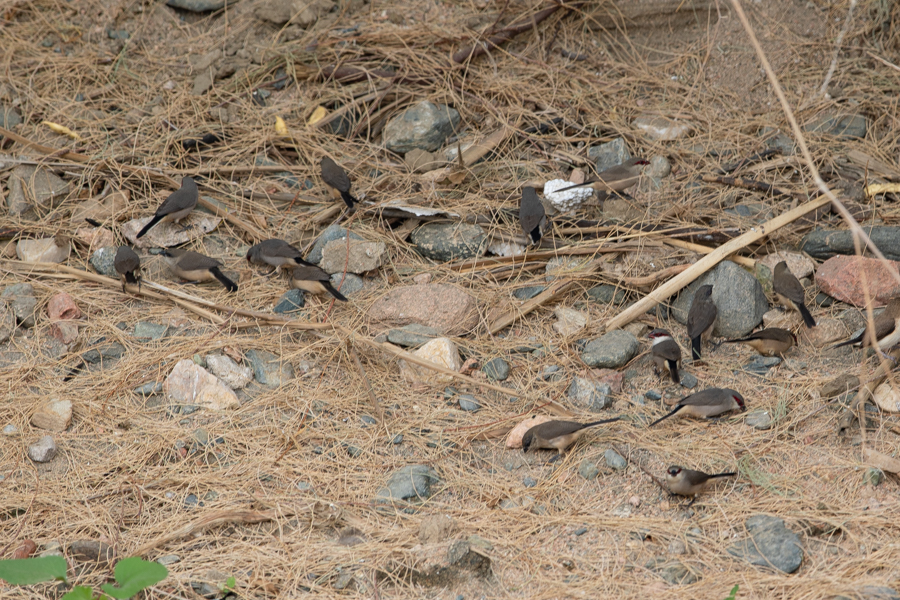
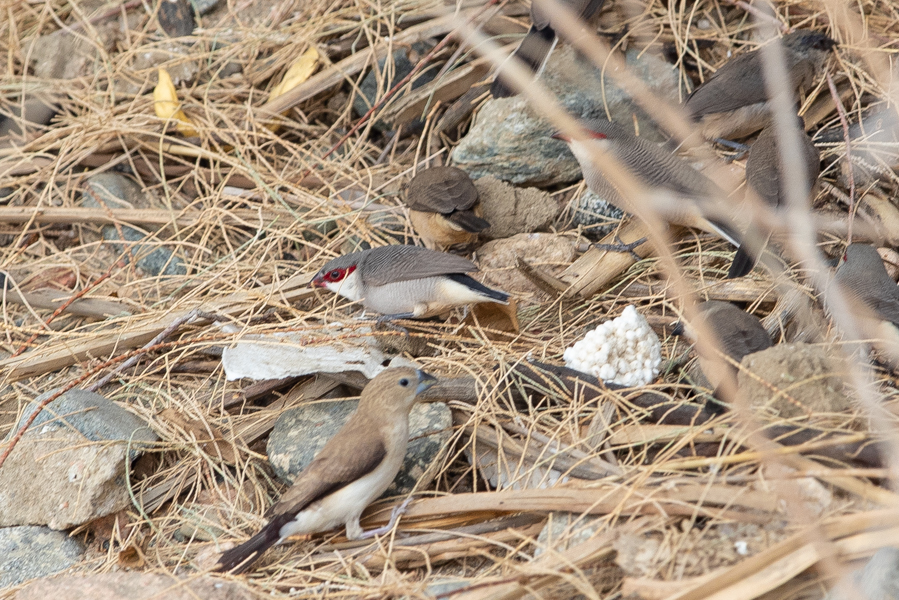
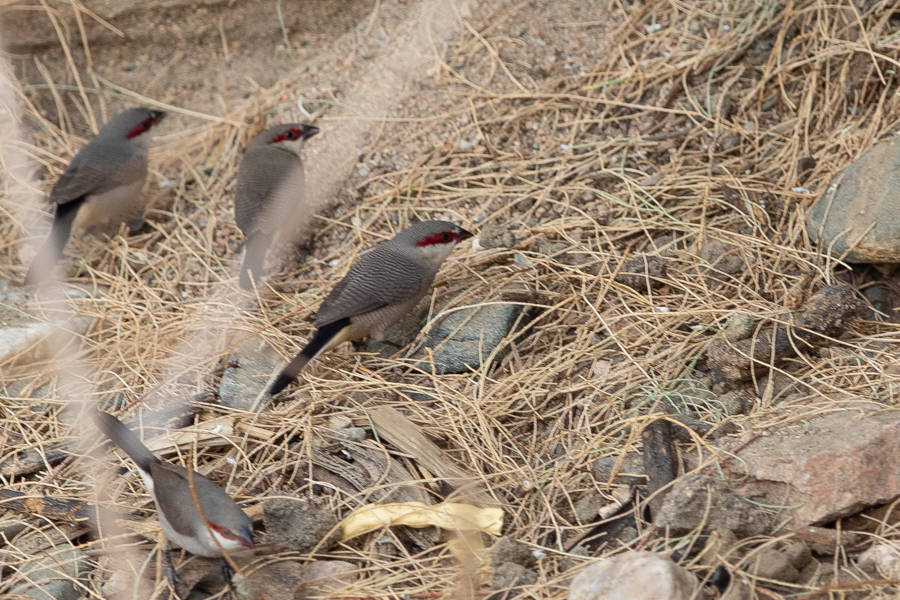
Whilst birding some small valleys inside Taif city we came across a reasonable flock of Arabian Waxbill Estrilda rubibarba. This species is a rather scarce resident of the Tihama region where they have been seen on Jebal Faifa summit and at Jebal Gaha. Birds have also been seen near Tanoumah, Al Baha and as far north as Taif where they can be seen at Wadi Thee Gazelle and several wadis in the town itself, such as the one we saw them at. The Arabian Waxbill is endemic to Saudi Arabia and Yemen and occurs in the mesic uplands of the Tihamah foothills, occasionally straying onto the lowland Tihamah proper. The species is described as scarce in southern Saudi Arabia and the population is suspected to be in decline due to habitat loss as a result of the increasing use of modern agricultural techniques. They are highly social, and occur from 250-2,500 m in fertile cultivated Wadis, plains, rocky hillsides and terraced slopes, usually with a dense cover of trees and bushes. The species roosts communally in this dense vegetation, and recently fledged juveniles have been recorded in May. It has become closely associated with regularly irrigated agricultural areas with flowing water and is one of the more difficult of the Arabian Endemics to see.