18 May 2013

Collared Pratincoles lacking white trailing edge to wing


Whilst birding at Sabkhat Al Fasl in April I saw a flock of ten Collared Pratincoles with at least three birds without the normal white trailing edge to the secondaries. Initially there was only one bird present and it lacked the white trailing edge, but on closer inspection it had rufous underwing coverts making it a Collared or Oriental Pratincole. The lack of white trailing edge and rufous underwing coverts are features of Oriental Pratincole so I took a few photographs of the bird. I managed to obtain one with its wings stretched showing the lack of white trailing edge to the secondaries. The bird than flew and was joined by the other birds, all of which seemed to be Collared Pratincoles, although two more lacked the white trailing edge. A few birds were typical Collared Pratincoles with long tails and broad white trailing edge to the wing in flight. When resting on the ground there did not appear to be any difference in size, plumage or colouration between any of the birds. As a result I came to the conclusion that all the birds were probably Collared Pratincoles but thought I should get a second opinion as Oriental Pratincole has not, to my knowledge, been recorded in Saudi Arabia. The problem with the interesting bird, first photograph below, was it was on its own when thoughts of Oriental Pratincole entered my head. Unfortunately it then flew some distance and landed, but when we drove to where it had landed it was with a group of other Collared Pratincoles. I found what I thought was the same bird, photographs two and three below, at the edge of the group and took photos of it. It eventually flew off, when I failed to get a flight shot, but did notice the bird lacked an obvious white-trailing edge to the wing and had red underwing coverts. I thought this bird may have been the same bird as that shown in the first photograph due to it having a short looking tail and longer wings but on looking at the photos this was not the case as the bird has one wing dropped down causing an illusion of a short tail and the tail is in fact quite long. As a result I cannot be certain photographs two and three below are the same bird as photograph one below. Likewise the bird in flight may not be the same as the previous bird(s) but certainly lacks an obvious white trailing edge to the wing.


I sent some photos of the interesting birds for comments to a few people with extensive knowledge of the species such as Gerald Driessens, Brian Small,  & Lars Svensson with Gerald and Lars having written an excellent identification paper on Collared and Oriental Pratincoles.
Driessens, G & Svensson, L. 2005. Identification of Collared Pratincole and Oriental Pratincole – a critical review of characters. Dutch Birding 27: 1-35.

Brian mentioned that the apparently evenly dark secondaries and lack of white trailing edge initially confused him but he came to the conclusion the bird was a Collared Pratincole, although suggested it was definitely worth getting a second opinion as the bird was not a typical, easy to identify, Collared Pratincole. He reached his conclusion for the following reasons:
Flight above - note the dark shaft of Oriental Pratincole this bird has white shaft. Flight below - orange breast band seems to grade broadly onto underparts on Oriental Pratincole unlike this bird
Flight - fanned tail shows minimal amount of black on outer tail feather on Oriental (20%) and is usually about half on Collared Pratincole like on the bird in flight

Gerald Driessens mentioned to me that after taking his time to look at the photographs he became convinced that the bird in the first picture (and also the others) showed a Collared Pratincole. He mentioned that there certainly is ‘something strange’ with (some of) the Middle Eastern Collared Pratincoles, with several pictures of odd individuals reaching him since he published the ID-paper. To quote from Gerald “Your bird looks quite compact, somewhat Oriental-like. If it is the same bird as in the next two pictures, the tail streamers are certainly too long (not visible on the first photograph). If it is not the same, than still the pale tips of the secondaries are too washed out and there is too much merging with the dark part of the feather. On Oriental, you see a sharp demarcation with the pale fringe (if there is a fringe in the first place). Also, in my opinion, the spread primaries show a difference between dark outer and paler inner webs on the 4 to 5 inner primaries. As you noticed yourself, the picture of the flying bird shows the typical tail pattern, the outer tail-feather immediately ruling out Oriental, as the dark base never reaches halfway up the shaft in that species”.

Lars Svensson agreed with Gerald’s views saying that on looking a little more at the photographs he “saw that characters for Collared dominated over some vague Oriental-looking traits. Difficult bird(s) anyway”.


Surprisingly quite a few (+/- 25%) of the Collared Pratincoles I have seen in spring in Saudi Arabia appear to lack an obvious white trailing edge to the wing. I wondered if these birds were the African sub-species known as Afrotropical Oriental Pratincole in Gerald Driessens paper:
Driessens, G 2005. Field identification of Afrotropical Collared Pratincole. Dutch Birding 27: 35-40.
The bill pattern and head pattern of these should look more like Oriental Pratincole, and the necklace should have less obvious pale inner throat surround to the black boarder not shown by these birds, so these birds fitted Collared Pratincole better. As a result I concluded they were not Afrotropical Collared Pratincole even though they showed a long black gape line stripe typical of this type.

I asked Gerald and Lars if they had seen birds without the white-trailing edge to the wing, as I had not seen this documented anywhere, and got the following reply. Gerald said “We were able to find some skins with very narrow, and some completely worn off (which is surely not the case in yours) trailing edges. I don’t expect them to be Africans, as they have quite some other characters which are not shared by your bird (like the white edge inside the dark throat band. Would be interesting to know the origin of the Saudi-Arabian birds...”.

Lars said “Personally I have never seen such a white-trailing-edge-lacking Collared Pratincole before, but the whole reason for the paper, which Gerald started and I was invited later to join, was the occurrence of such a bird”.

Here are some photos taken in Saudi Arabia of a reasonably well marked Collared Partincole taken this spring

A poorly marked bird in spring 2012

The conclusion that the birds are Collared Pratincoles was agreed to by all parties but these pictures certainly show that you need very good views of a vagrant bird before coming to the conclusion it is an Oriental Pratincole. This was a great learning experience and I will certainly be looking at all the Pratincoles I see very closely, to see if I can learn anything more. I would like to thank Gerald, Brian and Lars for their thoughts on this interesting bird(s) and for allowing me to publish their comments.

17 May 2013

Still a few Shrikes about – Dhahran Hills


The last few days on the ‘patch’ produced few birds, although quite a few shrikes were still lingering from the big influx of a week ago. Red-backed Shrikes were the most common with 12 birds seen on one day being the most. Three Turkestan Shrikes were in the spray fields but I did not see any Daurian Shrikes. A single Lesser Grey Shrike was also in the spray fields with the only other good birds seen being two Ortolan Buntings.
Red-backed Shrike
Red-backed Shrike
Turkestan Shrike
Lesser Grey Shrike

The Percolation Pond was full of water but few birds were seen except the Greater Crested Grebe hiding in the reeds. European Bee-eaters were about the only birds of note seen around the pond. A few Willow Warblers were also seen along with several Spotted Flycatchers but little else, possibly due to the amount of dust that has been in the air in recent days?
European Bee-eater
Spotted Flycatcher

16 May 2013

lutea Yellow Wagtail – Dhahran Hills


Although the number of Yellow Wagtails has dropped off considerably over the last week or so from 50+ birds to just five, one of them is a quite bright adult male lutea Yellow-headed Wagtail. It was feeding around the muddy edges of the settling pond for a couple of days. I had only seen one Yellow-headed Wagtail in Dhahran prior to this year, but this year I have seen eight different birds. I am still to see one of the really bright birds with little or no green no the crown clearly making it a lutea but have seen a number of males like the one in the photograph. These birds are lutea on range but are very similar to the UK race of Yellow Wagtail flavissima.
lutea Yellow Wagtail (Yellow-headed Wagtail)
lutea Yellow Wagtail (Yellow-headed Wagtail)
 Other interesting birds included a Sedge Warbler, one Lesser Grey Shrike, two immature Purple Herons and an Upcher’s Warbler in the spray fields. Six Little Stints, one Little Ringed Plover and three Kentish Plovers were feeding along the edge of the settling pond, with the Little Stints all in a small group in the shallow water. A couple of other good birds for the ‘patch’ were seen this week with a fly over female Golden Oriole by the percolation pond and a Gull-billed Tern flying over the pond with two Little Terns. Both Golden Oriole and Gull-billed Tern were new for the year for me in Dhahran but not for Saudi Arabia, as I have seen many of both species at Sabkhat Al Fasl during the winter and spring.
Purple Heron - immature
Little Stints

15 May 2013

Eurasian Hobby – Dhahran Hills


Whilst birding the spray fields I found an adult Eurasian Hobby sitting on the ground by a wet patch where the field had recently been flooded. This was the first time I had seen the species in Saudi Arabia sitting on the ground. I have only seen it a few times before with all records being in Dhahran Camp with the exception of a single bird seen at Sabkhat Al Fasl. Most records are from the spring migration period. The species is an uncommon passage migrant to the Eastern Province of Saudi Arabia where it often hunts small birds and insects over wetlands and fields. Birds are mainly seen in the early morning and late evening.


The Eurasian Hobby is a long distance migrant from Europe and northern Asia to southern Africa. They migrate on a broad front crossing water freely, without concentrating along specific routes and is mainly regarded as an uncommon passage migrant throughout Arabia. Birds are mainly seen from early April until May and then from late August to early November.

Kuwait – Uncommon passage migrant.
Saudi Arabia – Uncommon passage migrant
Bahrain – Passage migrant, March to May and August to November
Qatar – Uncommon passage migrant early April to mid-June and late August to mid-October, first winter birds until mid-December
UAE - Uncommon spring and common to fairly common autumn migrant.
Oman – Fairly common migrant

14 May 2013

Some late birds - Sabkhat Al Fasl

Arrival at Sabkhat Al Fasl just after first light indicated that a few migrants were present but the large numbers of the last two weeks had decreased significantly. Signs of migration were thin on the ground but there was a single Yellow Wagtail, one Ortolan Bunting, several Willow Warblers, two Common Whitethroats and two Upcher’s Warblers. Upcher’s Warbler has had a great spring with plenty of birds seen and very good views being obtained of many of the birds present. Two Whinchats were still about but not much else. Shrikes were still the commonest sight with Red-backed Shrike being the commonest with over thirty birds seen. Other shrikes included five Turkestan Shrikes, four Lesser Grey Shrikes, three Daurian Shrikes and one very late adult male Woodchat Shrike.
Upcher's Warbler
Ortolan Bunting
Ortolan Bunting
Waders were also much reduced with three Common Snipe, several Common Ringed Plover and Little Stints, one Temminck’s Stint and one Curlew Sandpiper about all that was seen. A late group of 300+ Greater Flamingos, mainly juveniles, was seen out on the flooded Sabkha and was a pleasant surprise. A late Spotted Crake was walking around an area of water where someone had illegally dumped some building rubbish. Clamorous Reed Warblers were still in full song and today were joined by a number of singing European Reed Warblers. Little Bitterns have been a scarce sight this spring foe me but today I had nine sightings of the species. Other herons included plenty of Little Egrets, several Indian Reef Herons and ten Squacco Herons.
Common Snipe
Common Snipe
Common Snipe
Purple Swamphen

13 May 2013

Collared Pratincoles – Dhahran Hills


A trip to the ‘patch’ produced my first Collared Pratincoles of the year in Dhahran. Although I have seen quite a few at Sabkhat Al Fasl this spring I had yet to see one in the camp. This changed as I found two birds sitting at the edge of the spray fields in exactly the same place that I had seen them in the two previous springs I have been in Saudi Arabia. The birds allowed close approach and at one stage one bird flew and landed right outside the car window allowing very close photographs to be taken of it. The birds did not stay long and soon flew off and I could not locate them again. The photos below are of the two different birds seen.
Collared Pratincole
Collared Pratincole
The spray fields had a few shrikes including 10+ Red-backed Shrikes and one Lesser Grey Shrike as well as a Purple Heron.  The settling pond had four Kentish Plovers, two Little Stints, one Little Ringed Plover and three Black-winged Stilts. 200+ Sand Martins and several Barn Swallows were flying around the pond catching insects with hundreds more Sand Martins passing through.
Lesser Grey Shrike
Red-backed Shrike
Black-winged Stilt
 The percolation pond had two Little Terns and a Squacco Heron but very little else. A European Turtle Dove was the best bird seen around the edge, although there were a few Spotted Flycatchers and three Eastern Olivaceous Warblers in the bushes.
European Turtle Dove

12 May 2013

Garden Warbler new ‘patch’ species – Dhahran Hills


Whilst birding the ‘patch’ on Friday morning I saw an interesting warbler very briefly in the spray fields that gave me the impression it was a Garden Warbler. Unfortunately almost as soon as I saw the bird it flew off and disappeared. There had been a big ‘fall’ of birds and plenty of Common Whitethroats were about and given the brief views I could not be 100% certain of the its identification. I then met Phil and told him about the possible Garden Warbler. As a result we went to the area of the spray fields where I had seen the bird and fortunately relocated it with a couple of Common Whitethroats where I managed to get a couple of relatively distant photographs. This was a new species for Phil and I on the ‘Patch’ taking my total to 196 and was also a new species for Saudi Arabia for us both as well. Whilst watching the first bird, a second Garden Warbler joined it, and at times they were seen side by side with a Common Whitethroat.


Garden Warbler Sylvia borin is an uncommon migrant to all areas of Saudi Arabia from late April until May and again from September to October. It is recorded less frequently in the Eastern Province, where it is regarded as scarce, although their drab nature makes them easy to overlook so are probably more common than records suggest. In nearby Kuwait they are regarded as an uncommon passage migrant and rare winter visitor being seen in small numbers, on bushes and trees, in widely scattered areas throughout the country. To the south in the United Arab Emirates they are regarded as an uncommon migrant from April to May and September to October with two November records. In Bahrain it is an uncommon passage migrant from April to May and September to October.

11 May 2013

Large fall of birds – Dhahran Hills


Arriving at the ‘patch’ early morning on Friday proved to be a good move. It soon became apparent that there had been a big arrival of birds with Red-backed Shrikes flying around the scrubby desert area and literally hundreds of Willow Warblers flitting about. A minimum of 50 Willow Warblers were sitting on the wires surrounding the settling pond and I soon started to get the feeling that I might see some good birds. I then met Phil who said he had a Moustached / Sedge in a small reed bed on the settling pond which turned out to be a Moustached Warbler a new species for the year and then five or six Sedge Warblers, which were also new for me in Dhahran this year. Both these species were new for Phil on the ‘patch’ indicating the unusual nature of the sightings. We then decided to walk around the spray fields and percolation pond to see what else may have dropped in. A minimum of ten Common Whitethroats where seen in the fields along with three Barred Warblers.
Common Whitethroat
Common Whitethroat
A Great Reed Warbler was an unusual sighting in the spray field, indicating the movement of birds contained quite a few species. A Purple Heron flew out of the fields and a few waders were on the wet area including a Ruff, Wood Sandpiper, seven Little Stints and two Kentish Plovers. A lot of shrikes were in evidence including three Lesser Grey Shrikes, with two together in the same bush, a minimum of 25 Red-backed Shrikes and one Masked Shrike.
Red-backed Shrike
Masked Shrike
Other interesting birds seen was a single Ortolan Bunting feeding along the edge of the spray fields, a Common Cuckoo, only the second time I have seen the species in the camp, several Eastern Olivaceous Warblers, four Common Redstarts and two Rufous-tailed Scrub Robins.
Ortolan Bunting
Ortolan Bunting
Ortolan Bunting
Rufous-tailed Scrub Robin

10 May 2013

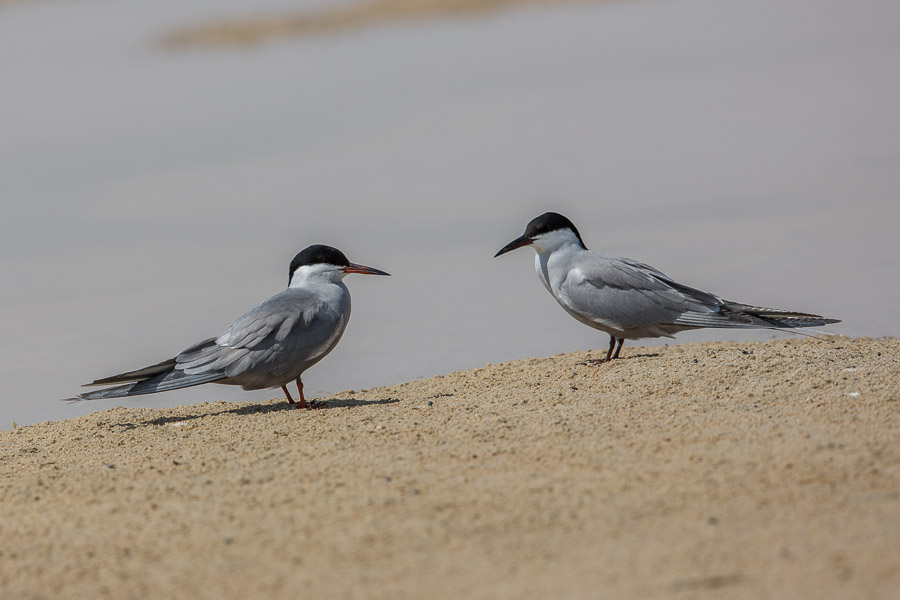
White-cheeked Terns Displaying – Sabkhat Al Fasl


Whilst at Sabkhat Al Fasl I found a pair of White-cheeked Terns on a wet pool formed by the recent heavy rainfall. The birds were sitting together so I decided to try to photograph them. The light was not great as they were slightly into the sun but as I was taking pictures they started to display to each other and I got a series of pictures to show this occurrence. White-cheeked Terns breed on the offshore islands of the Arabian Gulf in quite large numbers but are just returning from their wintering grounds. They are obviously starting to refresh their bonds as birds mate for life. White-cheeked Tern has a restricted range and the offshore islands of the Arabian Gulf form a very important breeding area for the species.