21 October 2023

Eurasian Bittern – Jubail

Whilst birding in Jubail 20 October 2023, Phil found a Eurasian Bittern on the side of the track under a small bush near the reed beds. Unfortunately, the bird soon moved into cover and disappeared. This is the first time Phil, or I have seen the species in Saudi Arabia so was a very nice find. This is a species we have always thought we would find at this site. The only photo I managed is very poor but you can see it is a Eurasian Bittern.

The species was thought to be a vagrant in the Eastern Province, prior to 2000 with the only records being as follows:

One Hofuf Lakes, 21 May 1976, 

One Dhahran, 24 November 1978, 

One Jawb, on the northern edge of the Rub’ al-Khali, 25 September 1980

One Abqaiq, 11-17 December 1982

Three Abqaiq, 19-20 October 1983

One Abqaiq, 14-21 December 1984


I then recorded birds as follows:

One bird calling six time between 19:00 -20:00, Dhahran Hills, Eastern province, 24 March 2020

One bird calling once 00:00 – 01:00 Dhahran Hills, Eastern Province, 31 March 2020

In the autumn I change the location of where I was recording and had a minimum of three further birds as follows:

A minimum of three birds calling 21 times 17:50, Sabkhat Al Fasl, Eastern Province, 12 October 2020 

One bird calling 34 times 17:45, Sabkhat Al Fasl, Eastern Province, 13 October 2020


These additional records suggest the species may not be so rare in the Eastern Province as previously thought. 


The recently published Birds of Saudi Arabia has the status as a rare passage migrant and possible breeding migrant. They are rare but widespread on migration through Saudi Arabia, passing on a broad front, mainly in central and western regions of the Kingdom. Records as late as December suggest some might spend the winter in the Kingdom and it has been heard booming several times at Khafrah Marsh in March, suggesting possible breeding. In November 2009 there were 30 birds together near Zulfi and in 2016 there were some incredible records with 15 birds 5 November 25 kilometres east of Zulfi and then six birds about 40 kilometres north of first area 11 November 2016. These birds were seen resting under the shade of some short trees, scattered over a small area. During the same period 40 birds were seen sporadically in Sakaka, Al Jouf, 7-14 November 2016.


19 October 2023

Glossy Ibis – Dhahran Cricket Field

An unusual sighting on Dhahran Cricket Field last week as a single Glossy Ibis. It flew in whilst we were watching the Sociable Lapwing and landed. Like most of the birds on the field it started eating the beetles that are plentiful and looked quite happy until a nearby noise scarred it into flight. If flew off in the direction of the Waste Water Lake where I assumed it would stay but when I went over there I could not find it. Glossy Ibis is an uncommon but regular passage migrant from March to early May and from August to November in the Eastern Province as well as a scarce summer and winter visitor. It is more common in Riyadh where it is predominantly a passage migrant and winter visitor but ones and twos are normally present throughout the year. They pass through the Riyadh area from March to early June, usually in small flocks but up to 40 together have been recorded, and again from late July to November, often in groups of 20 plus.


17 October 2023

Red-wattled Lapwing – Dhahran Cricket Field

Phil Roberts found a Red-wattled Lapwing in the morning of 10 October, whilst looking for the Sociable Lapwing on Dhahran Cricket Field. This was only the third time I have seen the species in Dhahran camp. I was at work and unable to go, so went at lunchtime and found the bird, with the Sociable Lapwing hiding from the hot sun under one of the cricket field stands. It flew almost immediately once it saw me and I managed to get a couple of nice photos of it in flight. It returned to the field but was only seen on this one day. The species is scarce in Saudi Arabia with records from Riyadh, the Empty Quarter and the Eastern Province. They are resident breeders at wetlands in United Arab Emirates, Qatar and Kuwait, and is gradually colonizing westwards. It was first recording breeding in Saudi Arabia at Sabkhat Al Fasl, a couple of years ago and has bred at Khafra Marsh, Jubail for the last two years. In the Eastern province it is regarded as a scarce passage migrant, rare breeder and scarce winter visitor although records are becoming more common with over twenty birds seen together at Shaybah in recent years. 


15 October 2023

Juvenile Sociable Lapwing – Dhahran Cricket Field

At first light on 9 October 2023 I found the first Sociable Lapwing ever recorded on my local path of Dhahran. It was feeding on beetles on the Cricket Field but was disturbed by workers repairing the field and flew off. It returned later in the morning where Phil Roberts also saw and photographed it. The bird returned in the afternoon and came very close to the car allowing some good photographs to be taken. The bird stayed around until 11 October before departing overnight. This is a very rare species worldwide and according to the IUCN Red List; Sociable Lapwing is Critically Endangered based on severe population declines across its range. It is also listed in Column A of the action plan under the African-Eurasian Migratory Water-bird Agreement (AEWA) and in appendix 1 of the Convention on Migratory Species (CMS). Research in central Kazakhstan on the species’ demography has shown that current levels of productivity are not particularly low, and that low adult survival is more likely to be the cause of recent population declines. The species status in Saudi Arabia is a locally scarce passage migrant and winter visitor with historical records from north of Jeddah near the coast, north of Yanbu, near Riyadh, and from Haradh farm – Eastern province and near Taif. During the last two decades most of the sighting of the species in Saudi Arabia have been in pivot irrigated fields around Tabuk & Tayma in the north, Sabya/Jazan in the south-west, Wadi Ad Dawasir in central Saudi Arabia (southwest of Riyadh) and Haradh farms in the east. Recent satellite tracking of Sociable Lapwings from their breeding grounds in central Kazakhstan has suggested that Saudi Arabia is an important stop-over and wintering area with Tabuk and Haradh in the Easter Province the main locations along with possibly Wadi Ad Dewasir. The species has a status as a scarce passage migrant & winter visitor to Saudi Arabia. I see Sociable Lapwing in most years but put in effort to see them by visiting suitable fields at the correct time of year. Most birds like large, ploughed pivot fields but this on was enjoying the lush wet grass of a cricket field.


14 October 2023

Lots of Dunlin – Jubail

Whilst birding the Jubail area recently I saw a lot of Dunlin with some still in partial summer plumage. The subspecies we get probably include alpina and centralis (if valid and not included in alpina) that breeds in north-east Siberia from Taymyr Peninsula to Kolyma Delta and winters from the eastern Mediterranean and Red Sea eastwards to southern Asia. Dunlin is a very common passage migrant and common winter visitor. Although I see Dunlin most visits, in the autumn this visit provided more birds than normal with quite a few different birds shown below.


13 October 2023

Juvenile Western Osprey – Dhahran Waste Water Lake

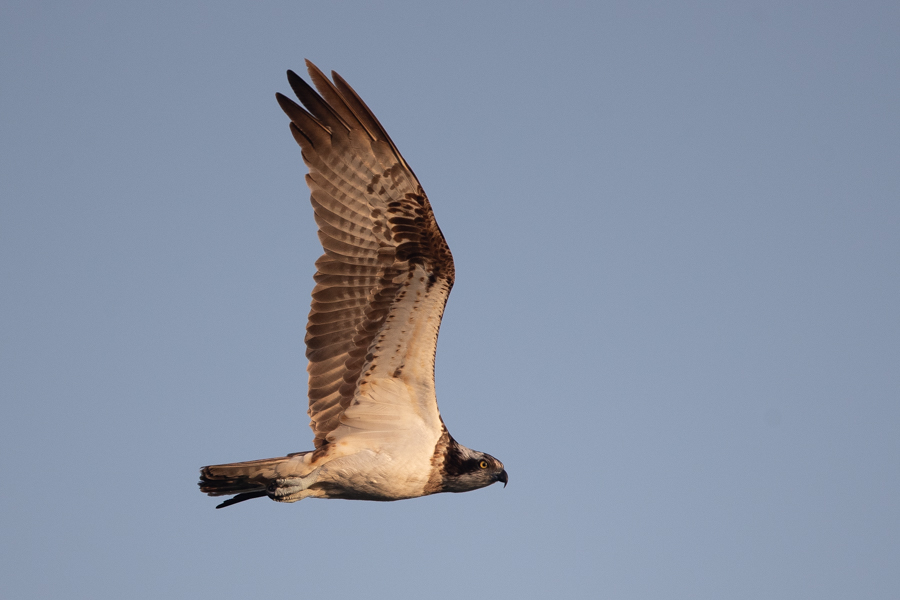
Whilst birding the Dhahran Waste Water Lake in September and October I came across a juvenile Osprey a few times and eventually managed to get a few decent photographs of the bird. Initially it was seen perched at the ned of the lake but would not allow close approach, with the photos taken below at a time when it was fishing for Talapia. Osprey is uncommon at the location but is a regular passage migrant as well as resident breeding species in the Eastern Province of Saudi Arabia. Birds breed on islands along all coasts of the Kingdom where they are also a migrant sometimes occurring far inland. Birds of the Riyadh Region by Stagg 1994 mentions it is a passage migrant and winter visitor, in small numbers, that passes from March to April then again in September and October.


12 October 2023

Female Garganey – Jubail

Whilst birding the Jubail area recently we came across a female Garganey Anas querquedula. The species is a common migrant to all areas of the Kingdom with often hundreds seen together. In the Eastern Province, it is a common passage migrant, rare summer and scarce winter visitor. Generally, they occur during spring migration from mid-February to late May with peak numbers in early March. Numbers are much more common during autumn migration which occurs from late August to mid-October with a peak in September when flocks of twenty plus birds are quite frequent. Records are rare between late May and late August and only small numbers are seen in the winter months of November to early February. Birds normally occur on freshwater lakes, pools and lagoons away from the coast although in autumn birds are sometimes seen on the shoreline and occasionally, they have even been seen on the sea. Birds normally stay at some distance from the shore as they are frightened of possible hunters but luckily the one shown below did not fly, as it appeared very tiered from migration and allowed close approach in the car allowing some photos to be taken before it was left in place to rest.