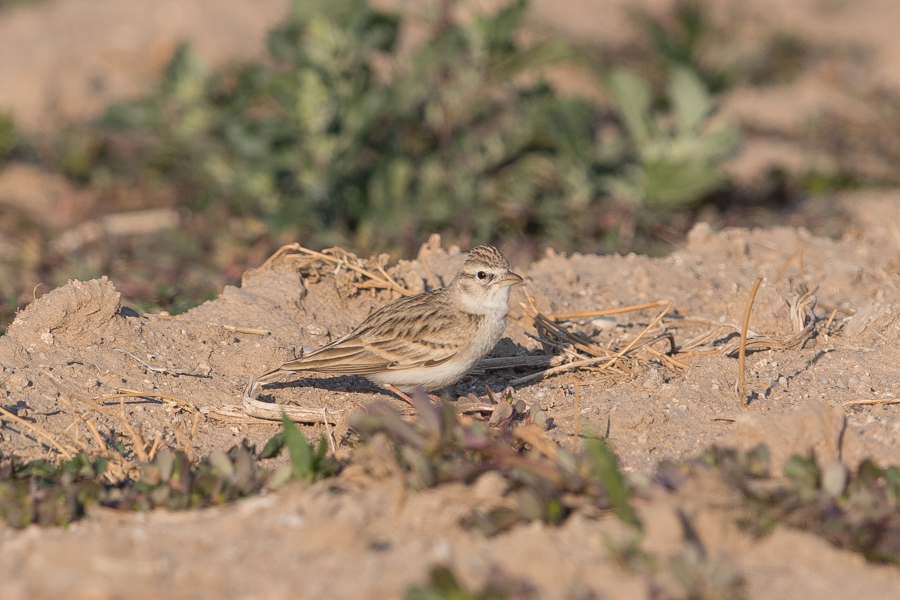
Whilst birding the rocky desert near Ushaiqer I came across a Greater Hoopoe-Lark on afternoon and got a few average photos of it. I went back the following day and managed to get better photos as it was busy feeding and pulled out a large grub that it swallowed in one go. The birds are almost always on the move so getting good photos of them is not so easy. Luckily this bird was feeding on a large grub so allowed some photos to be taken in good light. The Greater Hoopoe-Lark is a common breeding resident in all sandy desert areas of the Kingdom including the Empty Quarter, the desert regions of the Southern Red Sea and the Tihamah. They are uncommon in the North-west.
Jem's Birding & Ringing Exploits in the Eastern Province and elsewhere in Saudi Arabia
23 February 2020
21 February 2020
Larks – Ushaiqer
The rocky escarpment and desert area around Ushaiqer was a good place to see Desert Lark. They were quite common but not so easy to photograph. The area also looked good for Arabian Lark but our searches failed to locate this enigmatic species. We did however find a few Bar-tailed Larks looking a little strange but luckily for me Yoav Perman helped with the identification. Other larks located were the larger and much more obvious Greater Hoopoe-Lark. All three of these species are typical desert species that are not seen very often although all three are common breeding residents.
![]() |
| Bar-tailed Lark |
![]() |
| Desert Lark |
![]() |
| Desert Lark |
![]() |
| Desert Lark |
![]() |
| Greater Hoopoe-Lark |
19 February 2020
Trumpeter Finch – Ushaiqer
Whilst birding the Ushaiqer area with Phil Roberts we decided to go and check a few pivot irrigation fields. Whilst trying to find access into a field I saw a group of four small birds fly towards us that looked a bit different. They landed on a large earth berm and on closer inspection turned out to be Trumpeter Finches Bucanetes githagineus. This species is a locally common, widespread resident found in manly arid rocky areas where it is thinly distributed. Birds are seen throughout the year but may become common after good rains. In the Riyadh area, where we were birding, they are a common breeding resident around the Tuwaiq Escarpment but breed less commonly elsewhere. Flocks disperse after breeding and may then be encountered randomly throughout the region. I seldom see this species in the Eastern Province so was very happy with the encounter, particularly as I managed to get the best photos I have so far in Saudi Arabia of two of the birds.
17 February 2020
Spanish Sparrows – Shaqra
Whilst birding the landfill site at Shaqra looking for Steppe Eagles I can across a small flock of Spanish Sparrows. This is a common resident of northern and western parts of the Kingdom with numbers increasing in the winter months. They are not so common in the area where I live in the east of the Kingdom but numbers are increasing. They are presumably common in the area I was as it is well north and west of Riyadh in central Saudi Arabia but I only saw a few small groups. House Sparrow and Spanish Sparrow appeared to be equally common in the Sharqa area.
15 February 2020
White-crowned Wheatear – Ushaiqer
The Ushaiqer area, 180 km northwest of Riyadh is a good area for seeing White-crowned Wheatear. Most of the birds we saw were black crowned with no white cap indicating they were juveniles with only two out of about fifteen birds showing white on the head. They are a locally common breeding resident in dry rocky areas of Saudi Arabia and occur from the Hejaz north from Taif, Northern Hejaz, Asir south of Soudah and Najran, Tuwaiq escarpment and locally in the Gulf in areas like Shedgum escarpment and Jebal Hamrah. Also Jauf, Hail and Dawadimi.
13 February 2020
Great (Arabian) Grey Shrike - Ushaiqer
Whilst birding the Ushaiqer area I found a Great Grey Shrike Lanius excubitor in some bushes in a valley near the edge of the escarpment. The Grey shrikes in Saudi Arabia are very confusing and there is often healthy debate between the birders of the region over what species, and subspecies, individual birds are. Great Grey Shrike subspecies that occur in Saudi Arabia, aucheri (mainly eastern areas) and elegans (extreme west), have been reported from areas where they occur in close proximity, such as south-west Israel, eastern Egypt and north-east Sudan indicating the possibility of gene flow between them. These hybrids are likely in western Saudi Arabia as well as the range overlaps here. Mauryan Grey Shrike (Steppe Grey Shrike) pallidirostris occurs regularly in the region as a fairly common migrant and winter visitor, with peak migration in mid-March and September to October. This complicates matters with Great Grey Shrikes further as interbreeding occurs freely between pallidirostris and the locally breeding Great Grey Shrike subspecies aucheri with an intermediate population occurring in north-east Iran. These birds could quite easily occur in the Eastern Province of Saudi Arabia as well.
11 February 2020
Winter birding – Haradh
Haradh is an excellent site with many pivot irrigation fields that attract a lot of wintering birds. We visited recently and were quite disappointed to find many of the pivots have stopped being used to grow crops. This is probably as a result of the Kingdoms requirement for farmers to stop growing fodder crops from November 2018 to save precious underground water supplies. The fields were mainly there to feed the large herds of cows owned by NADEC and they have probably stopped growing the crop. There were a few fields with what looked like potatoes growing that had a few birds but numbers were significantly down on previous years due to lack of irrigated fields. We did manage to see a few good birds such as a male and female Pallid Harrier, good numbers of both Greater Short-toed Lark and Lesser Short-toed Lark and hundreds of White Wagtail. Several Desert Wheatear were also scattered around the fields. One field with crops held a flock of over thirty Northern Lapwings but nothing else of note could be seen with them. A flock of thirty Chestnut-bellied Sandgrouse flew over at one point only the fifth record for the Eastern Province but the second in two years from Haradh. A Greater Hoopoe Lark gave good views as did a few Spanish Sparrows.
![]() |
| Desert Wheatear |
![]() |
| Chestnut-bellied Sandgrouse |
![]() |
| Greater Hoopoe Lark |
![]() |
| Greater Hoopoe Lark |
![]() |
| Greater Hoopoe Lark |
![]() |
| Greater Short-toed Lark |
![]() |
| Greater Short-toed Lark |
![]() |
| Lesser Short-toed Lark |
![]() |
| Northern Lapwing |
![]() |
| Northern Lapwing |
![]() |
| Pallid Harrier |
![]() |
| Spanish Sparrow |
09 February 2020
Four Cream-coloured Courser – Haradh
The Cream-coloured Courser is a common breeding resident and uncommon winter visitor to Saudi Arabia. It is found mainly in the north and east of the Kingdom and prefers flat open areas of sand and gravel steppe deserts, sometimes with sparse, low scrub. It often winters in pivot irrigation fields where it can be seen in ploughed as well as stubble fields. It is an excellent bird but one that is not so easy to get good photos of, as they are very timid and run away quickly when approached. We found four birds together in a pivot irrigation field at Haradh last winter and I managed to take a few photos which are shown below.
07 February 2020
Lesser Short-toed Lark – Haradh
Lesser Short-toed Lark is a rare breeding resident in northern and eastern areas of Saudi Arabia, including along the Gulf coast and perhaps also in central areas. It is also a common winter visitor, mainly in the north of the Kingdom, where it prefers open sandy or gravel plains or cultivated areas including pivot irrigation fields. I do not see the species often and the gathering of up to fifty birds in a pivot irrigation field in Haradh during the winter was the largest group I have seen together in the Kingdom. The birds were in a mixed flock with Greater Short-toed Larks and were feeding actively but were easily disturbed. The long primary projection and heavily streaked breast separated them from Greater Short-toed Larks nearby.
05 February 2020
Pale Crag Martin – Lake Dumat Al Jandal
Whilst in the Al Jouf area last winter we visited Lake Dumat Al Jandal and on the second day visited the far side of the lake away from the tourist area. This side had steppe cliffs leading from the water’s edge and when we got there, there were plenty of Pale Crag Martins flying around. This is not an easy bird to photograph in flight with a heavy 600mm lens but I tried my best and got a few reasonable shots. It is a common breeding resident in Saudi Arabia but in winter, large groups gather in the north of the Kingdom often near cliffs but also over pivot fields.
Subscribe to:
Posts (Atom)