As mentioned
previously there has been a major arrival of Pied Kingfishers into Eastern
Arabia this winter including a minimum of ten birds at Sabkhat Al Fasl. All the
birds photographed and the one seen by me have been females with this bias
towards females also occurring with Common Kingfishers at this location. On 15
November I saw three Pied Kingfishers including two females but I also saw the
first male recorded this year. Males have a thin breast band under the thick breast band, whereas females just have a single thick breast band. The birds gave excellent views perched on a dead
bifurcated branch were they sat waiting for any signs of small fish below. It
was possible using the car as a hide to get very close to the birds without
frightening them and I spent a lot of time watching them fishing from their
perch. The male seen is only the second record of a male I know of in Saudi Arabia
(but there must surely have been more?) with the other male being a bird in the
Riyadh area a couple of years ago. The three birds I saw looked very settled
and were catching plenty of small fish so, hopefully, will stay for the
remainder of the winter.
Jem's Birding & Ringing Exploits in the Eastern Province and elsewhere in Saudi Arabia
21 November 2015
20 November 2015
Grey-headed Swamphen in Dammam – Bird records by Arnold Uy
Purple Swamphen is not a rare bird in the
Eastern Province and large numbers can be seen at its main breeding site of
Sabkhat Al Fasl. Although this has traditionally been the only site to see
them. Phil Roberts and I also found a second breeding site for the species at
Khafrah Marsh a couple of years ago and other birds have been seen at Dhahran
Percolation Pond and Ash Shargiyah Development Company Farm in recent times, so
it looks like the species may be extending its range as these are the only
sites in the whole of Saudi Arabia. Arnold Uy sent me some details and a couple
of photos of a Grey-headed Swamphen he saw on a small wetland in Dammam. He
mentioned the bird was used to people and allowed close approach. This location
is close to Dhahran but 125 kilometres south of the main site of Sabkhat Al
Fasl again indicating the species is spreading out from its traditional core
area. I thank Arnold for allowing me to use the photos on my website some of
which are reproduced below.
19 November 2015
International Space Station over Tabuk – Record by Viv Wilson
Viv Wilson who lives in Tabuk is very good at
taking photos of the night sky and has recently sent me a few photos of the International Space Station he saw one evening whilst out in the desert.
18 November 2015
Two satellite tagged Sociable Lapwings in Saudi Arabia – details from Amazing Journey Website
There are currently as of 11 November 2015 two
Sociable Lapwings in the northwest of Saudi Arabia. These birds have been
satellite tracked as part of the Birdlife International tracking scheme to try
to find out about their migration routes and wintering areas. Birdlife named
their birds and two of them are in Saudi Arabia (see below map). Vyan is in the
northwestern corner of Saudi Arabia and Canan further northeast, with many of
the remaining birds being tracked now in Sudan. All the information above and the
map have been taken from the Amazing Journey Website http://www.birdlife.org/sociable-lapwing/2015/11/maysa-and-tesfaye-both-in-pakistan
17 November 2015
African Lime Butterfly in Tabuk – Record by Viv Wilson
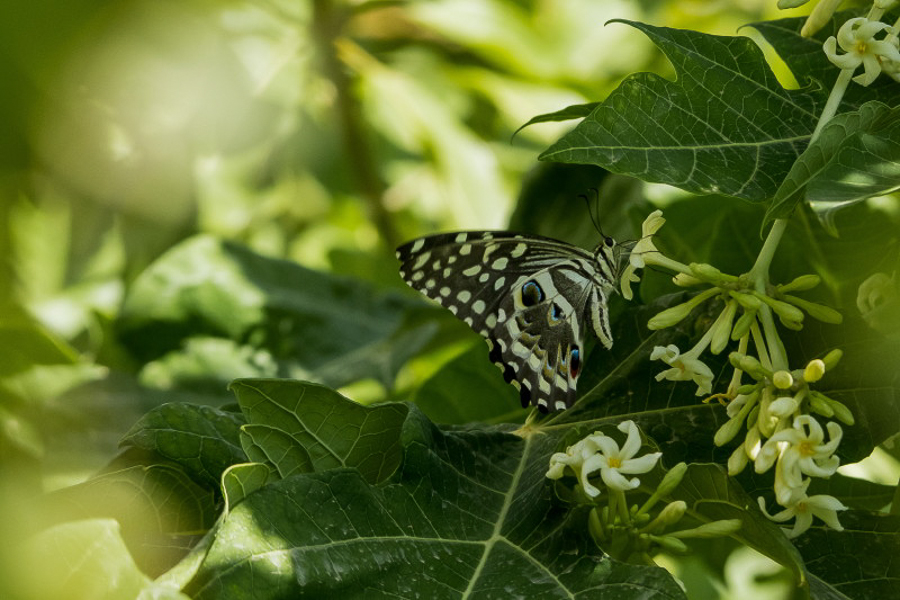
Viv Wilson found an African Lime Butterfly near
Tabuk and sent me a few photographs of it. This is a difficult butterfly to
take photos of as they are always on the move and never settle for more than a
brief second. The African Lime Butterfly is a common and widespread Swallowtail
Butterfly that gets its common name from its favoured host plant but unlike
most swallowtail butterflies, it does not have a prominent tail. It is also
known as the Common Lime Swallowtail, Lemon Butterfly, Lime Swallowtail or
Citrus Swallowtail. Apart from being tailless it has a wingspan 80–100 mm and
above, the background colour is black. A broad, irregular yellow band is found
on the wings above, which is broken in the case of the forewing and also has a
large number of irregular spots on the wing. The upper hindwing has a red
tornal spot with blue edging around it that can be seen on the second
photograph below. The Common Lime Swallowtail is perhaps the most widely
distributed swallowtail in the world and can be found in Oman, United Arab
Emirates, Saudi Arabia, Kuwait, Bahrain, Qatar eastwards to Australia and some
Pacific Ocean Islands. The widespread range indicates the butterfly's tolerance
and adaptation to diverse habitats where it is found in savannahs, fallow land,
gardens, evergreen and semi-evergreen forests and shows a preference for stream
and riverbeds.
16 November 2015
Pied Kingfishers – Bird records by Mohammed Alruqaya
As mentioned previously there
appears to have been a significant influx of Pied Kingfishers into the eastern
part of Arabia in late October and early November 2015. Below are a number of photographs
taken by Mohammed Alruqaya at Sabkhat Al Fasl that are reproduced below with
his permission and remain his copyright.
15 November 2015
Plain Nightjar in the Tanoumah area – Bird record by Khalifa Al Dhaheri
The below photographs were taken by Khalifa Al Dhaheri
in the Tanoumah area of the Asir mountains at about 2100 metres above sea level
in early June 2015. Initially I thought the birds were Montane Nightjars but on
closer inspection changed my mind to Plain Nightjar. As a result I sent the
photos to Nigel Cleere who wrote the main Nightjars book and he replied with
the following “The photo appears to be of Plain Nightjar C.innornatus, although it does seem to be a particularly well
marked individual. Many are much plainer on the upperparts, especially on the
wing coverts.” Plain Nightjar has been seen much more frequently this year in
Saudi Arabia from Abha north tot Taif. Phil Roberts and I heard Montane
Nightjar calling one night in June 2015 in the area this bird was seen
suggesting that both species occur in the area. I am grateful t both Khalifa
for allowing me to see and use his photos on my website and to Nigel Cleere for
helping clarify the identification.
![]() |
| Plain Nightjar |
![]() |
| Plain Nightjar |
14 November 2015
Schmidt's Fringed-toed Lizard – Sabkhat Al Fasl
Whilst ringing at Sabkhat Al Fasl I
found a Schmidt's Fringed-toed Lizard Acanthodactylus
schmidti near the car and took a couple of photogrpahs of it. Schmidt's
Fringed-toed Lizard is one of the most abundant species in the genus Acanthodactylus found in Saudi Arabia
and occupies sandy plains, dunes and sabkhas (salt flats), particularly in
areas of scrubby vegetation. It was named after Karl Patterson Schmidt, with a
type locality of Dhahran, Saudi Arabia and it can be distinguished by the
exceptionally long fourth toe found on each of its rear feet. As its name
suggests it has 'fringes' of elongated scales along the sides of each toe,
which are thought to provide better traction on loose sand. It has a light
brown or coffee coloured back that is richly speckled with oval-shaped, pale or
white spots and can grow to 18 centimetres in length. They have a cylindrical
body with smooth, rectangular scales on the belly that are arranged in
well-defined rows and scales on the head that are larger than those on the rest
of the body. Little is known about the biology of the species but it is thought
that its main prey is ants and when prey is located they instantly go rigid,
suddenly quiver their tail and strike. It is a diurnal species that digs
burrows in the sand among the roots of vegetation and is found throughout the
Arabian Peninsula including Saudi Arabia, United Arab Emirates, Jordan, Kuwait,
Oman, southeast Iraq and south-west Iran.
13 November 2015
Greater Flamingo’s Al Khobar – Bird records by Arnold Uy
The Greater Flamingo is an uncommon but
widespread migrant and winter visitor to all coasts with a few in summer.
Numbers have increased steadily over the last ten years with birds common in
certain key locations such as Sabkhat Al Fasl. Small numbers are also seen
every winter in the Al Khobar area where Arnold Uy took the below photos that
he has kindly allowed me to use on my website. The birds spend much of the time
far out from the coast and only really come close to shore when the tide is
fully in. Numbers at key sites have reached 5000 birds in recent years and even
some inland records have been noted from both Riyadh and Tabuk. A bird with a
plastic ring was seen at Al Khobar a few years ago that had bred in Turkey so
presumably this is where most of birds originate from and would explain the occurrence
of some inland birds.
12 November 2015
Plain Tiger – Record by Vinu Mathew
The below photograph of Plain Tiger Danaus chrysippus was taken by Vinu
Mathew and sent to me. fVinu kindly allowed me to use it on my website. This
butterfly was first depicted in an Egyptian tomb 3,500 years ago, making it the
first ever butterfly to be recorded in history. Its striking tawny-orange
colouration serves as a warning to predators that this species is distasteful,
which ultimately deters predators from attacking. Male butterflies are slightly
smaller than females with the males identified by the presence of a black
scent-producing pouch located in the lower-centre of the hind wing; on the
underside of the wing it appears as a white-centred black patch. In addition,
the males have a pair of brush-like organs hidden within the abdomen, which are
used in reproduction. The Plain Tiger has an extensive range and can be found
throughout the Old World tropics, from Africa to Southeast Asia as well as
Australasia. Recently it has been discovered that there are three subspecies; Danaus chrysippus chrysippus is found in
Asia and tropical Africa, Danaus
chrysippus alcippus ranges from the Cape Verde Islands, across Africa to
Oman and Saudi Arabia, and Danaus
chrysippus orientis is predominantly found in tropical Africa and the
surrounding islands including Madagascar and the Seychelles. They inhabit open,
fairly arid areas and unlike other members of the Danaus genus, the Plain Tiger
often flies in open sunlight, even at the hottest point of the day.
Labels:
Plain Tiger
Subscribe to:
Posts (Atom)