Showing posts with label Indo-Pacific Bottlenose Dolphin. Show all posts

03 August 2014

Red Sea Cetaceans – Details supplied by Peter Rudolph

Peter sent me some details on cetaceans from the Red Sea that still remain among the world’s least known, and some uncertainty surrounds even the species composition in the region. Personal observations combined with a review of the literature suggest that eight cetacean species occur regularly in the Red Sea:
Bryde's Whale Balaenoptera edeni Reported from Farasan Islands (Gladstone and Fisher 2000)

Long-Beaked Common Dolphin Delphinus capensis, Deep waters, found mostly in S. Red Sea
Risso's Dolphin Grampus griseus Deep waters, throughout region
Indo-Pacific Humpback Dolphin Sousa chinensis Coastal shallow waters, throughout
Pantropical Spotted Dolphin Stenella attenuata Deep waters, throughout

Spinner Dolphin Stenella longirostris Deep waters and reefs, throughout
Indo-Pacific Bottlenose Dolphin Tursiops aduncus Coastal waters, found mostly in the north
Common Bottlenose Dolphin Tursiops truncatus Coastal waters, throughout
Indo-Pacific Bottlenose Dolphins
Indo-Pacific Bottlenose Dolphin
Eight other species also occur in the region, but are apparently rare:
Pygmy Killer Whale or Melon-headed Whales Feresa or Peponocephala Observed in deep waters
Humpback Whale Megaptera novaeangliae Young observed and photographed in Gulf of Aqaba, near Dahab (Debelius 1999)
Short-finned Pilot Whale Globicephala macrorhynchus, Observed in deep waters
Sperm Whale Physeter macrocephalus Considered rare but present
False Killer Whale Pseudorca crassidens Observed in deep waters
Striped Dolphin Stenella coeruleoalba Observed in deep waters
Killer Whale Orcinus orca
 Considered rare but present
Rough-toothed Dolphin Steno bredanensis Considered present


The presence in the Red Sea of Common Minke Whales Balaenoptera acutorostrata is mentioned in the literature, but these records are considered unlikely.

22 July 2014

Sightings of Red Sea Cetaceans – Details supplied by Peter Rudolph

Peter Rudolph contacted me regarding my records of Indo-Pacific Bottlenose Dolphins Tursiops aduncus offshore Farasan Islands and is looking for details of any cetacean sightings from the Red Sea as he is part of a team working on a new checklist of the whales and dolphins of the Red Sea. If anyone has details of cetacean sightings from this area could they please contact me via my e-mail (see contact me tab at top of website), and your records may/will be cited in the new checklist.  Peter is now sure, that the Indo-Pacific Bottlenose Dolphin can be found in all coastal areas of the Red Sea. The holotype of Tursiops aduncus was found in Belhosse Island, Dahlak Archipelago, just “opposite” the Farasan Islands. Distinguishing the two Bottlenose Dolphin species in the Red Sea is not easy and to be 100% certain, you should know if the dolphins have spots on their belly. Peter says that all other information we have on my Farasan Islands sightings (water depth, group size, shape of the dorsal fin) clearly speaks for Tursiops aduncus and the sighting is 99.9% certain.
Indo-pacific Bottlenose Dolphins
Indo-pacific Bottlenose Dolphin

17 October 2013

Indo-Pacific Bottlenose Dolphin – Offshore Farasan Islands

One day on the Farasan Islands we went to some offshore islands and spent quite a bit of time looking for Dolphins. There are three species of dolphins in the Farasan Islands, Indo-Pacific Humpbacked Dolphin Sousa chinensis Spinner Dolphin Stenella longirostris and Indo-Pacific Bottlenose Dolphin Tursiops aduncus. Initially we could not find any dolphins in the main area where they occur but on the way back to Farasan Kabir I found a large group of 50+ Indo-Pacific Bottlenose Dolphin feeding in some open water. We spent two hours at very close quarters looking at them which was a really amazing experience and the family had a great time with the dolphins feeding and playing right in front of the boat. Although there was a minimum of fifty animals present trying to photograph them on a moving boat at close range with a big 600mm lens was very difficult.


The Indo-Pacific Bottlenose Dolphin T. aduncus resembles the Common Bottlenose Dolphin T truncatus, having a relatively robust body, moderately long beak, and a falcate dorsal fin, however, the species tends to be smaller than T. truncatus, has a proportionately longer rostrum and, most distinctively, develops ventral spotting at about the time of sexual maturity. Maximum size can reach over two metres in length and 150 kilogramms in weight. Information on the distribution of T. aduncus suggests the species is widespread along the entire eastern coast of Africa, through the Red Sea and Persian Gulf, eastwards as far as Taiwan and south-eastward to the coastal waters of Australia. Known large concentrations are found in regions with large shallow-water areas such as the Farasan Islands. Preferred habitat appears to be bare sand habitats; however, they also use areas with rocky and coral reefs, or sea grass. They can be found over waters 200 metres deep but are encountered most frequently in waters shallower than 100 metres, generally with water temperatures of 20-30°C. They seem to prey mainly on small to medium sized benthic and reef-dwelling fish and cephalopods.


08 June 2012

Indo-Pacific Bottlenose Dolphin – Half Moon Bay


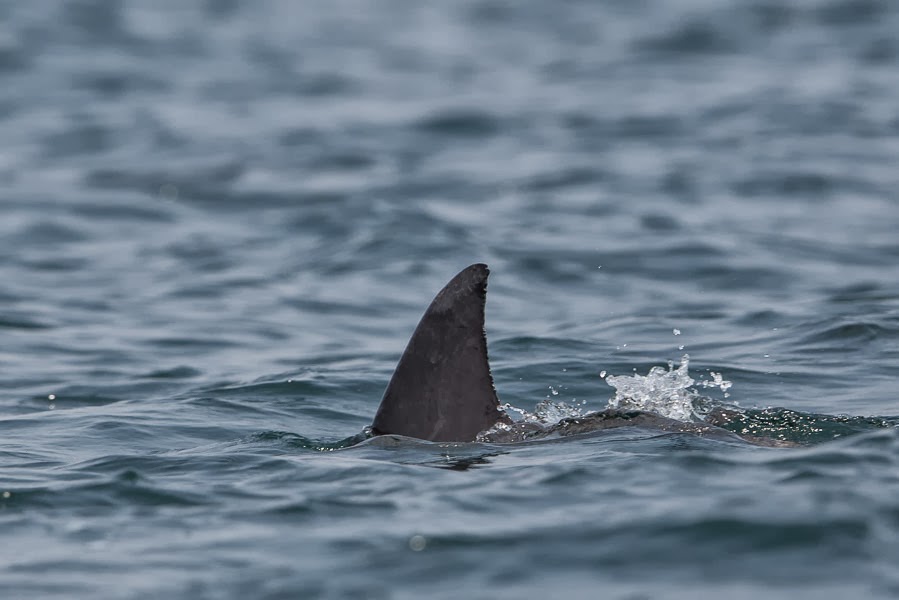
Whilst at Half Moon Yacht Club, Sunfish Beach, Half Moon Bay with the family on Friday evening, we saw an Indo-Pacific Bottlenose Dolphin catching fish just offshore from the swimming area. This is the first dolphin I have seen in Saudi Arabia although my wife and children saw one at the same place last year. The dolphin stayed quite close to shore but never showed very much of itself apart from its back and fin, very much like the photogrpah below which was taken by Con Foley in Singapore and shows an Indo Pacific Bottlenose Dolphin. This photograph is coyright and is used by kind permission of Con Foley who's excellent website is here

The Bottlenose Dolphin (Tursiops truncatus) has two main varieties; a smaller, inshore form and a larger, more robust form that lives mainly offshore. They were all previously recognised as a single species the Bottlenose Dolphin T. truncatus, but recently the genus has been split into two species: the pan-tropical and temperate Tursiops truncatus and the endemic Indian Ocean Tursiops aduncus now called the Indo-Pacific Bottlenose Dolphin. T. aduncus is the species sighted in Saudi Arabian waters with this species range more limited than the T. trucatus, covering from the east coast of Africa eastwards through the Persian Gulf, Arabian Sea and Bay of Bengal to Taiwan and Australia. In the Indian Ocean, T. aduncus is the predominant coastal species while T. truncatus is usually seen offshore. Bottlenose dolphins in general are highly active animals, frequently bow-riding and breaching. They typically show their forehead when surfacing but not the beak (unlike the humpback dolphin). These dolphins have a stocky, torpedo-shaped body, a short beak and pointed flippers. They are usually dark grey on the back with paler grey flanks and have a tall, sickle-shaped dorsal fin is positioned centrally on the back. Bottlenose Dolphins primarily feed by themselves, such as the one we saw in Half Moon Bay, but are known on occasion to form co-operative groups to catch schools of prey. They have a broad diet, with a wide variety of fish and invertebrates being taken. The main threats facing this dolphin in the Arabia Gulf are pollution, habitat degradation and entanglement in fishing nets. Like all dolphins they are also susceptible to human disturbance and noise pollution.