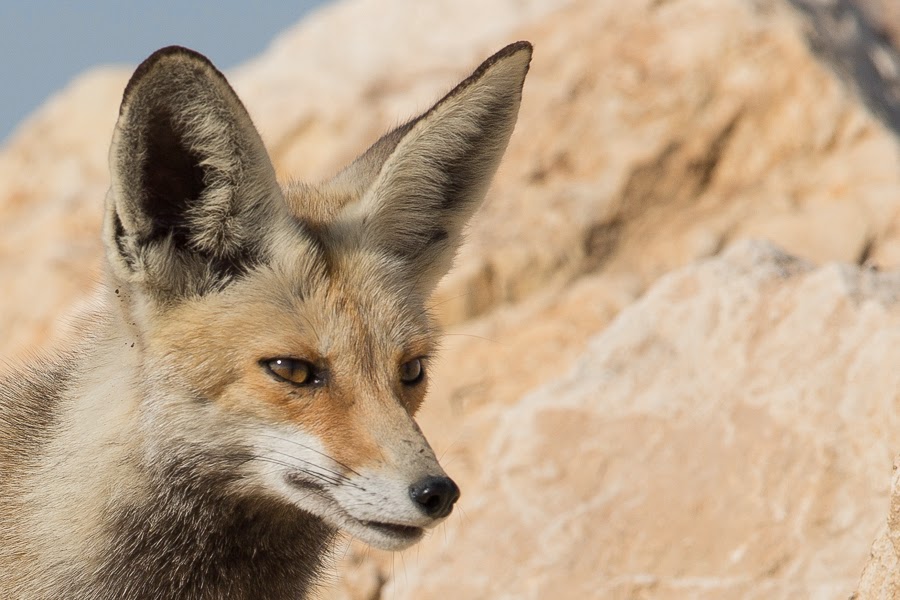
When out walking around the edge of Dhahran Hills Waste-Water Lake recently I came across a single Arabian Red Fox, in a very deep depression area with large trees. The fox saw me immediately and ran away up the steep bank but I managed to get one in focus phot below. They are relatively common in Dhahran and can be seen most weeks of the year if you look in the right areas, particularly around Dhahran Hills golf course. They have very large ears to help dissipate the heat they encounter living in the hot climates of the Middle East as well as more fur between their toes to help them overcome heat issues associated with the ground the walk over.
Jem's Birding & Ringing Exploits in the Eastern Province and elsewhere in Saudi Arabia
28 November 2024
30 January 2024
Arabian Red Fox - Dhahran
When out walking in the rough scrubby area near to Dhahran Hills Waste-Water Lake recently I came across an Arabian Red Fox. This fox was quite wary and kept its distance and never came fully out into the open. They are relatively common in Dhahran and can be seen most weeks of the year if you look in the right areas, particularly around Dhahran Hills golf course. The Red Fox is currently recognized as a single species and has the widest natural distribution of any terrestrial carnivore, possibly any terrestrial mammal (excluding humans). Its range spans approximately 70 million square kilometres encompassing much of Europe, Asia and North America and extending into North Africa, with an introduced population in Australia. The Arabian Red fox has very large ears for its size and is very thin and sandy coloured compared to the European Red Fox, and they look very different.
01 January 2024
Arabian Red Fox – Dhahran Waste Water Lake
When out walking in the early morning at the edge of Dhahran Hills Waste-Water Lake I came across three Arabian Red Fox close to the dried-up edge of the lake. I have seen them in this area previously but they seldom let you close. This one was no exception and as soon as it saw me it moved off into the cover and stopped for a while to make sure I was not a treat before running off. I only managed a couple of photos, but quite like the one below. They are relatively common in Dhahran and mostly seen in the early morning or late evening.
01 August 2023
Arabian Red Fox – Dhahran Waste Water Lake
When out walking in the early morning at the edge of Dhahran Hills Waste-Water Lake I came across two Arabian Red Fox on the dried-up edge of the lake. I have seen them in this area previously but this time they were far away. I eventually managed to get a bit closer before one saw me and they both ran off. One stopped briefly and looked back at me allowing a photo to be taken before running off into the red beds. They are relatively common but always nice to see in my opinion.
22 June 2023
Arabian Red Fox - Dhahran
When out walking in the rough scrubby area near to Dhahran Hills Waste-Water Lake in mid-June I came across three Arabian Red Fox. The foxes were far away when I first saw them at the far end of the lake, but as I walked around, I saw one hiding behind a bush at very close range. I managed to work my way so I could see its head and ears before it moved off. Over the next half hour, I saw a couple more and managed to take the below photos. They are relatively common in Dhahran and can be seen most weeks of the year if you look in the right areas, particularly around Dhahran Hills golf course. The Arabian Red fox has very large ears for its size and is very thin and sandy coloured compared to the European Red Fox, as can be seen from the photos below.
22 May 2023
Arabian Red Fox – Dhahran Hills
When out walking in the rough scrubby area near to Dhahran Hills Waste-Water Lake in mid-May I came across an Arabian Red Fox. The fox was aware of me, and I spent a few minutes playing hide and seek with it, until I finally manage to get into a position to at least see its face properly. They are relatively common in Dhahran and can be seen most weeks of the year if you look in the right areas, particularly around Dhahran Hills gold course. The Red Fox is currently recognized as a single species and has the widest natural distribution of any terrestrial carnivore, possibly any terrestrial mammal (excluding humans). Its range spans approximately 70 million square kilometres encompassing much of Europe, Asia and North America and extending into North Africa, with an introduced population in Australia. The Arabian Red fox has very large ears for its size and is very thin and sandy coloured compared to the European Red Fox, and they look very different.
07 January 2023
Arabian Red Fox – Dhahran Hills
When out walking in the rough scrubby area near to Dhahran Hills Lake I came across an Arabian Red Fox running across the rough ground at some distance from me. I managed to take one distant photo before it disappeared from view. As the photograph was taken in December the fox is in its winter coat that is thicker than the one it has in the summer months. The Red Fox is currently recognized as a single species and has the widest natural distribution of any terrestrial carnivore, possibly any terrestrial mammal. Its range spans approximately 70 million square kilometres encompassing much of Europe, Asia and North America and extending into North Africa, with an introduced population in Australia. The Arabian Red fox has very large ears for its size and is very thin and sandy coloured compared to the European Red Fox, and look very different.
26 September 2021
Arabian Red Fox – Jubail area
Whilst birding the Jubail area 17 September we came across an Arabian Red Fox. Initially the animal was quite some distance but we managed to manouver the car to get excellent views of the fox which was completely unfazed by our presence. These are the best views I have had of this species for quite a few years and was an excellent start to the days birdwatching. Red Fox is currently recognized as a single species and has the widest natural distribution of any terrestrial carnivore, possibly any terrestrial mammal. Its range spans approximately 70 million square kilometres encompassing much of Europe, Asia and North America and extending into North Africa, with an introduced population in Australia. The Red Fox occupies a wide variety of ecosystems, including forests, grasslands, deserts and agricultural and human-dominated environments with a recent genomically comprehensive study suggesting the originated from the Middle East. The Arabian Red fox has very large ears for its size and is very thin and sandy coloured compared to the European Red Fox looking quite different. This individual appears to have most of its summer coat remaining, but its tail is coming into winter plumage.