Showing posts with label Moustached Warbler. Show all posts

29 October 2020

Ringing again – Jubail

Phil Roberts and I have again been allowed to ring at Sabkhat Al Fasl by the Saudi Wildlife Authority. Our first trip ringing was good for us with 25 birds caught of 15 species and some good birds. We ringed Kentish Plover, Eurasian Blackcap, Menetries Warbler, Moustached Warbler and Savi’s Warbler amongst others. The hot temperatures meant we had to stop ringing early to ensure safety of the birds but it was and enjoyable return to the nets. 

Eurasian Blackcap

Kentish Plover

Kentish Plover


Moustached Warbler


25 January 2018

Moustached Warbler trapped – Sabkhat Al Fasl

While ringing on Friday 12 January 2018 we trapped and ringed a Moustached Warbler, this is the fifth bird we have ringed at this site with the first being on 7 February 2014. This is the third January bird trapped with the others in November and February. The bird showed an appearance similar to the eastern subspecies A. m. mimica that occurs from eastern Turkey, Iraq, Transcaucasia, and the lower Volga east to Kazakhstan and northwest India. Records of Moustached Warbler are now quite widespread from the Eastern Province, with the first record at Sabkhat al Fasl seen in 1990 but there have been no breeding records from the site. We have not seen or trapped birds in the spring, summer or autumn at the site, and there is evidence of an influx of birds in winter to the area, suggesting they are a winter visitor to the site. Away from the Eastern Province of Saudi Arabia, they are mainly a scarce migrant and winter visitor mainly in the north of the country. The Moustached Warbler has been recorded as a local breeder in the Central region and Eastern Province of Saudi Arabia with the first breeding site in Saudi Arabia located at Hufuf in the Eastern Province where birds are regularly recorded at Al Asfar Lake.

Measurements of birds (n5) are as below:
Tarsus       19.7 – 20.8
Wing          55.0 – 64.0
Weight       9.2 – 11.2
Tail            49.0 – 55.0
Bill / Skull   15.3 – 16.3
Bill depth    2.6 – 3.1
Fat             0.0 – 2.0
Muscle       2.0 – 2.0

Moustached Warbler

Moustached Warbler

Moustached Warbler


21 January 2018

First ringing trip of 2018 – Sabkhat Al Fasl

We went ringing on 12 January and caught 29 birds of 10 species including Common Kingfisher, Clamorous Reed Warbler, Little Bittern, Graceful Prinia, Red-spotted Bluethroat, Moustached Warbler, Common Chiffchaff, White-eared Bulbul, Water Pipit and Daurian Shrike. White-eared Bulbul was a new species for us at our ringing site, although birds are common in the region they are scarce at the site itself with birds only being seen in the last year suggesting they may be colonising the area. We set nets in the same locations each tip with some over water and other over land in rides between reed beds. We set and additional three nets along the edge of a reed bed as well as the normal ten nets we set every trip (11 x 18 metre and 2 x 15 metre). As normal, we arrived well before first light and set the nets during the hours of darkness. The best time for catching birds for us are the first couple of hours of day and this was the case this trip. We retrapped 11 birds including five Clamorous Reed Warbler, two Red-spotted Bluethroat, a Graceful Prinia and a Little Bittern. The Clamorous Reed Warblers were from as early as 23 September 2016 with the Bluethroats only trapped this winter. The Graceful Prinia was trapped in November 2017 and the Little Bitter in March 2017. The number of birds was less than normal as it was the middle of winter and the weather was very cold with temperatures in the morning only reaching 5 degrees Celsius. Normally we have to take care of birds overheating but it was the opposite this time with care needed to ensure the birds did not become too cold.
Common Chiffchaff
Common Chiffchaff
Red-spotted Bluethroat
Common Kingfisher
Common Kingfisher
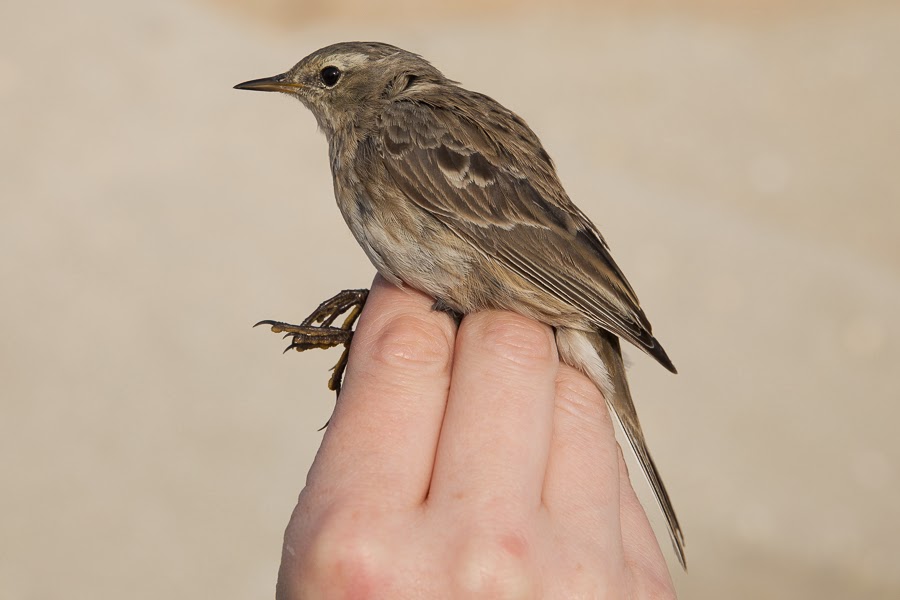
Water Pipit
Water Pipit
Little Bittern
Little Bittern

03 December 2017

Moustached Warbler trapped and ringed – Jubail

While ringing on Friday 17 November 2017 we trapped and ringed a Moustached Warbler, this is the fourth bird we have ringed at this site in two winters with the first being on 7 February 2014. This is the earliest bird trapped with the others in January (2) and February. The bird showed an appearance similar to the eastern subspecies A. m. mimica that occurs from eastern Turkey, Iraq, Transcaucasia, and the lower Volga east to Kazakhstan and northwest India. This subspecies differs from nominate A. m. melanopogon by having dull olive-grey upperparts, not rufous-brown with the black of the crown less intense, more heavily streaked olive. The underparts are largely white with the flanks rather pale pink-brown similar to Sedge Warbler A. schoenobaenus. The Moustached Warbler has been recorded as a local breeder in the Central region and Eastern Province of Saudi Arabia with the first breeding site in Saudi Arabia located at Hufuf in the Eastern Province. Records of Moustached Warbler are now quite widespread from the Eastern Province, with the first record at Sabkhat al Fasl seen in 1990 but there have been no breeding records from the site. There are breeding records from nearby where Brian Meadows found them at a small wetlands in Jubail as well as at nearby Khafra Marsh about 30 kilometers south. Pairs have been seen at Sabkhat Al Fasl in April and May indicating a strong likelihood of breeding although birds tend to be resident on their breeding grounds. We have not seen or trapped birds in the spring, summer or autumn at the site, and there is evidence of an influx of birds in winter to the area, suggesting they are a winter visitor to the site. Away from the Eastern Province of Saudi Arabia, they are a scarce migrant and winter visitor mainly in the north of the country.
Moustached Warbler

Moustached Warbler

11 February 2015

Another Moustached Warbler & Grey-headed Swamphen trapped and ringed – Sabkhat Al Fasl

Nicole and I went ringing to Sabkhat Al Fasl on Saturday rather than our normal Friday as the wind was forecast to be a little less strong on the Saturday. We set off from Dhahran at 03:30 hrs and had all the nets set up by first light of 06:15 hrs. The wind was a little stronger than we would have liked but we caught a reasonable number of birds for us ending the morning with 25 birds. Most were the normal suspects for this time of year with wintering birds including Bluethroat, Common Chiffchaff, Common Kingfisher, Moustached Warbler and Water Pipit, resident species including Indian (Clamorous) Reed Warblers and Purple Swamphen. The Purple Swamphen was caught in a mist net as it flew across an open area of water to a reed bed and is the second one we have caught in two weeks after not catching any up to that point. They are really smart birds and I have collected a couple of loose feathers from both birds and will, hopefully, be sending them off for DNA work to be conducted on them to try to work out exactly which subspecies occurs here as currently we are uncertain. They are certainly a Grey-headed type but which of the several grey-headed subspecies are involved we do not know. The other stand out bird was the second Moustached Warbler in two weeks which is only the third record since we started ringing.
Moustached Warbler
Moustached Warbler
Grey-headed (Purple) Swamphen
Common Chiffchaff
Common Chiffchaff
Common Kingfisher - female
Indian (Clamorous) Reed Warbler
Red-spotted Bluethroat
Water Pipit - coutelli

01 February 2015

Moustached Warbler trapped and ringed – Sabkhat Al Fasl

While ringing on Friday 23 January 2015 we trapped and ringed a Moustached Warbler, this is the second bird we have ringed at this site in two winters with the first being on 7 February 2014. The bird showed an appearance similar to the eastern subspecies A. m. mimica that occurs from eastern Turkey, Iraq, Transcaucasia, and the lower Volga east to Kazakhstan and northwest India. This subspecies differs from nominate A. m. melanopogon by having dull olive-grey upperparts, not rufous-brown with the black of the crown less intense, more heavily streaked olive. The underparts are largely white with the flanks rather pale pink-brown similar to Sedge Warbler A. schoenobaenus. The Moustached Warbler has been recorded as a local breeder in the Central region and Eastern Province of Saudi Arabia with the first breeding site in Saudi Arabia located at Hufuf in the Eastern Province. Records of Moustached Warbler are now quite widespread from the Eastern Province, with the first record at Sabkhat al Fasl seen in 1990 but there have been no breeding records from the site as yet. There are breeding records from nearby where Brian Meadows found them at a small wetlands in Jubail as well as at nearby Khafra Marsh about 30 kilometers south. Pairs have been seen at Sabkhat Al Fasl in April and May indicating a strong likelihood of breeding although birds tend to be resident on their breeding grounds. We have not seen or trapped birds in the spring, summer or autumn at the site, and there is evidence for an influx of birds in winter to the area, suggesting they are a winter visitor to the site. Away from the Eastern Province of Saudi Arabia they are a scarce migrant and winter visitor mainly in the north of the country.
Moustached Warbler

Moustached Warbler

Moustached Warbler

Moustached Warbler


15 February 2014

Moustached Warbler – Sabkhat Al Fasl

While ringing last Friday we trapped and ringed a Moustached Warbler. This is a local breeder in the Central region and Eastern Province of Saudi Arabia that is only a scarce migrant and winter visitor in the north of the country. The Moustached Warbler is now quite widespread in the Eastern Province, with the first record at Sabkhat al Fasl seen in 1990 but there are no breeding records from the site as yet.  There are breeding records from nearby where Brian Meadows found them at a small wetland in Jubail as well as at nearby Khafra Marsh about 30 kilometers south. Pairs have been seen at Sabkhat Al Fasl in April and May indicating a strong likelihood of breeding.  They tend to be resident on their breeding grounds but there is evidence for an influx of birds in winter to the area. It was a surprise find as we have not ringed the species before in Bahrain and it is mentioned as a vagrant there with less than 12 records. As Nicole had ringed them before in Turkey I ringed the bird and added it to my birds ringed list. Not bad for the first ringing expedition in Saudi Arabia for us. The first breeding site in Saudi Arabia was located at Hufuf in the Eastern Province. Breeding numbers are small and it will be interesting to see if we catch more of this species as the year progresses.