Showing posts with label Asian Desert Warbler. Show all posts

16 March 2023

An amazing barbed-wire fence – Al Uqayr

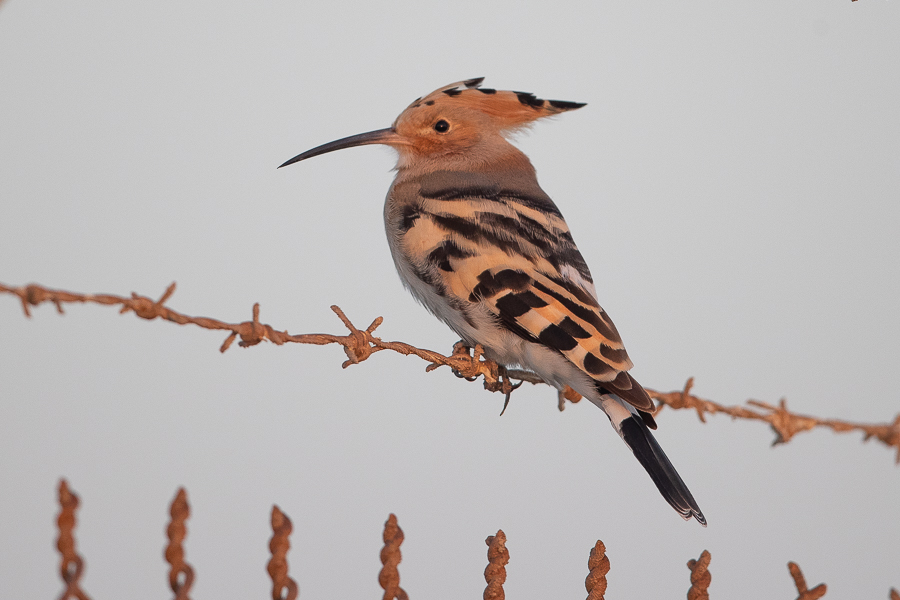
I arrived at first light at Al Uqayr in early March and as the sun was not up decided to drive along a fenced off area with a small area of trees enclosed. As I was driving, I came across a Great Grey Shrike sitting on the fence and this was closely followed by four Eurasian Hoopoe and a male Namaqua Dove. The light was not good as otherwise I may have got some good photos of these species. A few small warblers were also seen flitting about, but I could not get close to make any positive identifications. As it appeared migrants were about, I went to a nearby small farm for a few hours and returned to the fence at about 10:00 hrs. The light was better but not ideal and more birds were seen lined up along the fence. Two Asian Desert Warbler were noted and further down the fence a Daurian Shrike was perched. It took flight before I could get close but luckily flew straight towards me and perched almost directly beside the car. As I watched this bird another Shrike joined it which was a nice Turkestan Shrike also very close to the car. The amazing fence then had a male Rufous-tailed Rock Thrush on it that allowed me to get very close. This bird was even doing some sub-song that I recorded on my I-phone. Lastly three Pied Wheatears were also on the wires of the fence making an amazing hour or so of birding.

Turkestan Shrike

Turkestan Shrike

Turkestan Shrike

Rufous-tailed Rock Thrush

Rufous-tailed Rock Thrush

Rufous-tailed Rock Thrush

Rufous-tailed Rock Thrush

Rufous-tailed Rock Thrush

Rufous-tailed Rock Thrush

Pied Wheatear

Namaqua Dove

Great Grey Shrike

Eurasian Hoopoe

Daurian Shrike

Daurian Shrike

Daurian Shrike

Asian Desert Warbler


14 February 2023

Birding the Judah and Hanidh areas

In late January Phil Roberts and I set out early to go to Judah and Hanidh. We stopped at Judah first, but it was very slow going without a bird being seen for the first thirty minutes excluding feral Rock Dove. The pivot fields that used to attract a lot of birds to this area are now dismantled and the vegetation around the bottom of the escarpment is either dead or dying and this is even after a lot of heavy rain in recent weeks. We did eventually see Desert Lark and Pale Crag Martin, two common birds in the area and as always in winter Desert Wheatear and Eastern Morning Wheatear. This is probably to best site to see the later species in the Eastern Province with birds being very confiding when found. We moved on Hanidh in the hope of seeing more birds with the total species count from Judah amounting to nine. We went to a couple of large pivot irrigation fields a couple of which we gained permission to look around. Best birds seen were nine Common House Martin, a very early migrant species in KSA, as well as European Stonechat, Daurian Shrike, Tawny Pipit, a single Northern Lapwing, several Eurasian Skylark, Asian Desert Warbler & Menetries’s Warbler. Whilst driving along a road we saw a single Steppe Eagle in flight, which along with a single Common Kestrel were our only birds of prey.

Desert Wheatear

Eastern Morning Wheatear

Eastern Morning Wheatear

Eastern Morning Wheatear

Eastern Morning Wheatear

Steppe Eagle

Steppe Eagle

Steppe Eagle

Steppe Eagle

Tawny Pipit

Asian Desert Warbler


09 October 2018

Migrants passing – Jubail area

The last few weeks a few more migrants have been passing through with plenty of warbler seen. Most have been Eurasian Blackcap, Lesser Whitethroat and Barred Warbler but also a few Eastern Olivaceous Warbler have been seen and one or two Asian Desert Warblers. Wheatears have also arrived with Black-eared and Pied being the most numerous with the Asian Desert Warblers almost always associated with the Wheatears feeding in close proximity to each other. Eurasian Bee-eaters and Blue-cheeked Bee-eaters have also been plentiful with small groups seen regularly over the last few weeks. Shrikes have been seen in small numbers but many less than previous years. Woodchat Shrike has been the commonest with a few Mauryan Grey Shrikes also seen with the odd Red-backed Shrike also present. 
Asian Desert Warbler
Asian Desert Warbler 
Barred Warbler
Barred Warbler
Blue-cheeked Bee-eater
Eastern Olivaceous Warbler
Mauryan Grey Shrike
Mauryan Grey Shrike
Pied Wheatear
Pied Wheatear
Pied Wheatear
Pied Wheatear
Woodchat Shrike
Woodchat Shrike

02 February 2017

Birding the pivot fields – Haradh

The winter months are a good time to visit Haradh pivot irrigation fields as they hold a lot of good birds at this time of year. Large numbers of wintering Harriers, particularly Western Marsh Harrier and Pallid Harrier occur here and I saw well over thirty birds of both species during my visit. Another group that frequents the fields in winter are Lapwings and I saw at least 26 Spur-winged Lapwing a species that has started using the fields only in the last few years and well over 350 Northern Lapwings the second largest group ever seen in the Kingdom. Western Cattle Egrets are beginning to use the fields in good numbers in recent years and we saw well over 300 birds feeding in the short cut fields. Other good birds seen along the field edges included Asian Desert Warbler, Desert Wheatear, Common Kestrel and several Mauryan Grey Shrikes and a single Southern Grey Shrike. All in all I had a great days birding these fields and saw plenty of good birds. These fields hold a lot more birds than similar fields closer to my home of Dhahran so the longer journey is well worth the effort.
Western Marsh Harrier - male
Pallid Harrier
Pallid Harrier
Western Cattle Egret
Northern Lapwing
Northern Lapwing
Asian Desert Warbler
Asian Desert Warbler 
Mauryan Grey Shrike
Mauryan Grey Shrike
Desert Wheatear
Desert Wheatear
Common Kestrel
Common Kestrel

17 January 2015

Interaction between Asian Desert Warbler & Desert Wheatear – Hanidh

It is common knowledge that interactions happen between various types of Wheatear and Asian Desert Warblers, with the most common being with Isabelline Wheatears. The birds follow each other around the same habit never straying too far from each other. This was the case at a large pivot irrigation field near Hanidh. We have stopped at this field a few times in the past and it has always proved good for birds and have met the farmer to allow us permission to enter. When walking towards the main green area of the field we crossed some scrubby areas that had both Desert Wheatear and Isabelline Wheatear in them when Phil located an Asian Desert Warbler. The bird seemed to be actively feeding close to the wheatears and moved around with the Desert Wheatears for some time. Also in this area were about six Stonechats and in the pivot field were around 50 Eurasian Skylarks. A smaller bird with a different call kept us busy for some time but we never managed to locate the bird on the ground although saw it briefly in flight on two occasions. There was a possibility it may have been a Small Skylark but unfortunately we did not get enough on the bird for positive identification.
Desert Wheatear - male
Asian Desert Warbler
Isabelline Wheatear

22 March 2013

Lesser Short-toed Larks – Dibdibah near Qaryat Al Ulya


Whilst looking for migrants at the weekend Phil and I drove off-road looking for Bar-tailed Desert Lark or anything else we could find. Birding the Dibdibah, which are large expanses of gravel/stone sandy areas is hard work with very few birds seen. If you do see something, though, it is often a good quality bird. We found a small group of larks that kept us busy trying to identify them and it turned out that they were mostly Lesser Short-toed Larks with two Greater Short-toed Larks in amongst them. Arabian Spiny-tailed Lizards are common in this habitat and an Arabian Toad-headed Agama was also seen. The only other birds of note seen in the Diddibah were an adult male Lesser Kestrel and a few Pied Wheatears. 
Lesser Short-toed Lark
Greater Short-toed Lark
Whilst driving over the stony desert we came across a very large set of pivot irrigation fields where I noticed what appeared to be a large flock of Plover in flight that quickly landed. Views were poor due to distance but we decided to go and check them and the field they landed in out for birds. Any large plover in the Eastern Province is a good bird, but unfortunately the birds turned out not to be plovers but a group of 20+ Ruff. A wet pool in the field and others along the road produced ten species of waders which is very good for a desert area many kilometres from the nearest coast. Waders seen included ten Black-winged Stilts, two Common Ringed Plovers, 30 Ruff, eight Kentish Plovers, Wood Sandpiper, Green Sandpiper, six Common Redshanks, two Common Greenshanks, two Marsh Sandpipers and ten Little Stints. The pivot field held numerous species of birds many in good numbers including 100+ Black-headed Wagtails, 10+ Red-throated Pipits and 100+ Eurasian Skylarks. Some larger and bulkier larks also flew over in small groups of up to ten and these birds turned out to be my first records of Bimaculated Lark for Saudi Arabia. We saw a minimum of 40 birds in total. A small group of eight Spanish Sparrows were my first ones of the year and whilst walking out of the field Phil and I flushed a Grasshopper Warbler. This acted like a typical Grasshopper Warbler in only flying a short distance and ditching down in the cover. We walked to where it had landed but I knew they ran fast on the ground and it would be some way off and likely running through the cover. We luckily found the bird again doing as I had suspected before losing it in the greenery. This is a good bird for Saudi Arabia and one Phil had not seen before, but which I had fortunately seen in Dhahran in March 2012. They are presumably reasonably regular in the region just very difficult to see. On the way home we stopped at Jebal Nayriyyah produced Desert Lark, Pied Wheatear and Desert Warbler. We ended up seeing 55 species of birds on our trip, in 15 hours in the field, and had an excellent days birding.
Tawny Pipit
Asian Desert Warbler