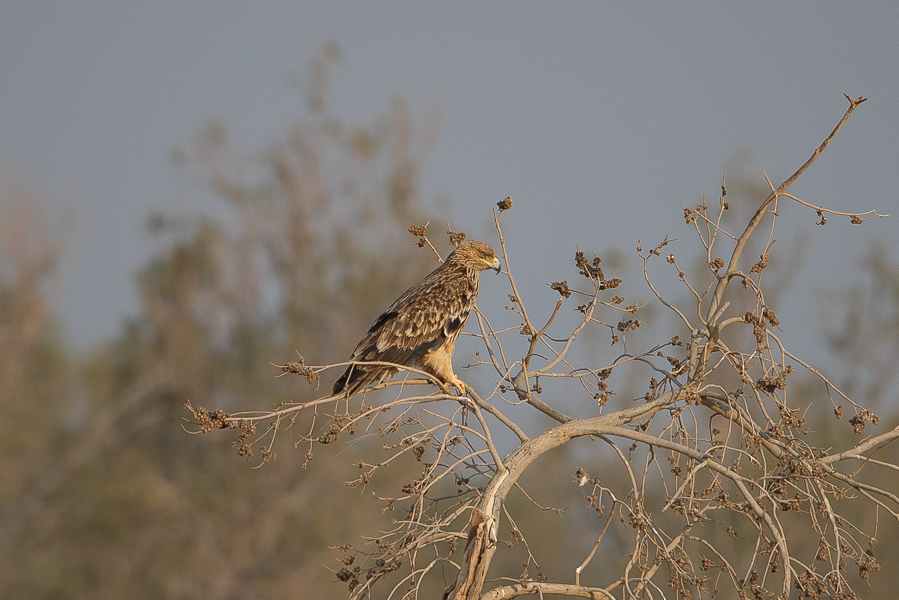
Whilst birding in the Al Jouf area in late December we came across a number of both Juvenile & adult Eastern Imperial Eagles. We counted a maximum of ten on a single day, mainly seen in the early morning when they flew from their roosting areas. We are used to seeing them perched on pivot irrigation frames or in the pivot fields in the Eastern Province, but we only really saw them in flight in Al Jouf. Most of the large eagles in the Al Jouf area when we visited were Eastern Imperial Eagles with only a single Steppe Eagle seen. At one point there was an interaction between a male Pallid Harrier carrying prey and a juvenile Eastern Imperial Eagle, of which I managed to get a couple of phots of both birds together. The Eastern Imperial Eagle is an uncommon winter visitor to Saudi Arabia with most records coming from the north of the country where they are generally seen inland rather than near the coast. The species breeds from Eastern Europe across Asia to China and winters in the Middle East, east Africa south to Tanzania, the Arabian Peninsula, India, and from Thailand to Korea. Currently Eastern Imperial Eagle is listed as vulnerable on the IUCN Red List as it has a small global population and is likely to be undergoing continuing declines, primarily as a result of habitat loss and degradation, adult mortality through persecution and collisions with power lines and prey depletion. The status in Saudi Arabia appears to be more or less stable, however.
Jem's Birding & Ringing Exploits in the Eastern Province and elsewhere in Saudi Arabia
29 January 2023
02 December 2022
Juvenile Eastern Imperial Eagle - Jubail
Whilst birding in the Jubail area in late November we came across a Juvenile Eastern Imperial Eagle. We counted ten Great Spotted Eagle, either sitting on the power masts or in the reeds, with a single, much scarcer Eastern Imperial Eagle also noted. The Eastern Imperial Eagle was seen sitting on a mast but flew before we got near to it but luckily only across the track to the next pylon. I maneuvered the car to try to get the light in a good position for photography, but the bird again flew this time directly over the car. It was so close in flight that most of my photos only captured parts of the bird but luckily one (uncropped photo) had all the bird in the frame. It they circled around allowing some more distant photos to be taken in flight. The Eastern Imperial Eagle is an uncommon winter visitor to Saudi Arabia with most records coming from the north of the country where they are generally seen inland rather than near the coast. The species breeds from Eastern Europe across Asia to China and winters in the Middle East, east Africa south to Tanzania, the Arabian Peninsula, India, and from Thailand to Korea. Currently Eastern Imperial Eagle is listed as vulnerable on the IUCN Red List as it has a small global population and is likely to be undergoing continuing declines, primarily as a result of habitat loss and degradation, adult mortality through persecution and collisions with power lines and prey depletion. The status in Saudi Arabia appears to be more or less stable, however.
06 December 2021
Fulvescens Greater Spotted Eagle & Eastern Imperial Eagle – Jubail
Whilst birding the Jubail area in late November we came across two eagles sitting on a power line mast. One was a fulvescens Greater Spotted Eagle, with this colour type being very uncommon making up a maximum of 3% of the birds seen in the Middle East. Fulvescens is more common in the Middle East than in any other area where it occurs, and when you think how uncommon the species is on a world scale there are not that many fulvescens about worldwide. Greater Spotted Eagle is a regular winter visitor to the Juabil area where up to 15 have been recorded on a single day, but only the occasional fulvensens type are noted, although they are seen most years. The other bird was an immature Eastern Imperial Eagle that was much bigger in size with a much larger bill. The Eastern Imperial Eagle is an uncommon winter visitor to Saudi Arabia with most records coming from the north of the country where they are generally seen inland rather than near the coast. The species breeds from Eastern Europe across Asia to China and winters in the Middle East, east Africa south to Tanzania, the Arabian Peninsula, India, and from Thailand to Korea. Currently Eastern Imperial Eagle is listed as vulnerable on the IUCN Red List as it has a small global population and is likely to be undergoing continuing declines, primarily as a result of habitat loss and degradation, persecution and prey depletion. Eastern Imperial Eagle is much scarcer than Greater Spotted Eagle in Jubail but birds are seen almost every year. This particular Eastern Imperial Eagle has been around for almost a month which is unusual as normally they are only seen on single days.
![]() |
| Eastern Imperial Eagle |
![]() |
| Eastern Imperial Eagle |
![]() |
| Eastern Imperial Eagle |
![]() |
| Fulvescens Greater Spotted Eagle |
![]() |
| Fulvescens Greater Spotted Eagle |
![]() |
| Fulvescens Greater Spotted Eagle |
10 November 2021
Eastern Imperial Eagle - Jubail
Whilst birding in the Jubail area 5 November we came across good numbers of Blue-cheeked Bee-eaters with more than 30 seen, continuing the good passage of this species this autumn. A single Great Grey Shrike was located with Daurian Shrike numbers still quite high and White Wagtail and Water Pipit numbers both increasing. Two Mallard were located hiding in the reeds, with Great White Egret numbers increasing to 132 birds with over 300 Caspian Terns still remaining from last weeks count of over 500. A lone Black-tailed Godwit and a few Eurasian Curlew were seen on the sabkha edge but wader numbers were down on the last couple of weeks. We counted ten Great Spotted Eagle, either sitting on the power masts or in the reeds, with a single, much scarcer Eastern Imperial Eagle with three Greater Spotted Eagles on one mast.
![]() |
| Black-tailed Godwit |
![]() |
| Blue-cheeked Bee-eater |
![]() |
| Blue-cheeked Bee-eater |
![]() |
| Daurian Shrike |
![]() |
| Eastern Imperial Eagle |
![]() |
| Eastern Imperial Eagle |
![]() |
| Eurasian Curlew |
![]() |
| Great Grey Shrike |
04 August 2021
Eastern Imperial Eagles - Ushaiqer
Whilst birding Ushaiqer waste dump I found at least two Eastern Imperial Eagles. The birds were seen sitting on the ground amongst about fifty Steppe Eagles and allowed close approach in the car. I took the below photos which are some of the best photos I have of the species. The Eastern Imperial Eagle is an uncommon winter visitor to Saudi Arabia with most records coming from the north of the country where they are generally seen inland rather than near the coast. The species breeds from Eastern Europe across Asia to China and winters in the Middle East, east Africa south to Tanzania, the Arabian Peninsula, India, and from Thailand to Korea. Currently Eastern Imperial Eagle is listed as vulnerable on the IUCN Red List as it has a small global population and is likely to be undergoing continuing declines, primarily as a result of habitat loss and degradation, persecution and prey depletion.
02 May 2020
Eastern Imperial and Greater Spotted Eagles - Ushaiqer
![]() |
| Eastern Imperial Eagle |
![]() |
| Eastern Imperial Eagle |
![]() |
| Eastern Imperial Eagle |
![]() |
| Greater Spotted Eagle |