Showing posts with label Hooded Wheatear. Show all posts

19 January 2023

Three species of Wheatear – Sakaka

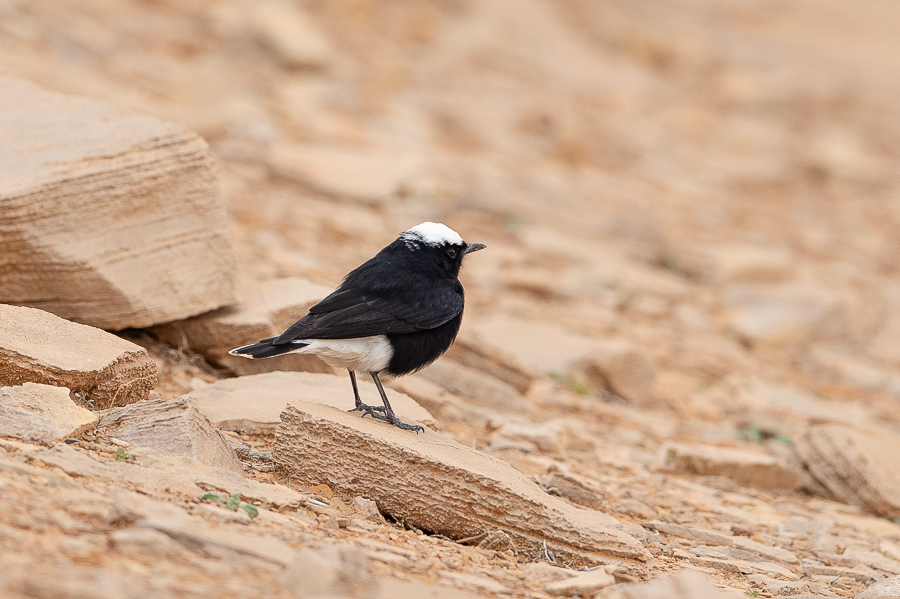
Whilst birding the stony Desert area around Sakaka with Phil Roberts and Nader Fahd, we came across a wheatear at the bottom of the escarpment on the stony ground. It was a black and white wheatear, which Nader pointed out had more extensive black on the throat that the nearby Eastern Morning Wheatear and on closer inspection in became apparent it was a male Hooded Wheatear. These birds are quite distinct with their large size and long thin bill but this single bird was hard to judge the size on. They are a scarce but widespread bird throughout the region and are most often encountered in barren, remote stretches. They are a rare but widespread breeding resident of Central Arabia and also occur at Najran in the south to the Northern Hejaz. This was the first time I have seen a male of this species with all previous records having been females. We also saw two Eastern Morning Wheatear and a few White-crowned Wheatears in the same area.

Eastern Morning Wheatear

Eastern Morning Wheatear

White-crowned Wheatear

White-crowned Wheatear

White-crowned Wheatear

White-crowned Wheatear

Hooded Wheatear - male

Hooded Wheatear - male

Hooded Wheatear - male

Hooded Wheatear - male


06 December 2018

Female Hooded Wheatear – Jebal Hamrah

Whilst birding the Jebal Hamrah with Phil Roberts recently we came across a wheatear at the bottom of the escarpment in a largish wadi. It lwas perched ontop of a large boulder in a slightly vegetated area at the foot of the escarpment. On closer inspection in became obvious it was a female Hooded Wheatear. These birds are quite distinct with their large size and long thin bill and the females have reddish tails with restricted black. They are a rare or scarce but widespread bird throughout the region and are most often encountered in barren, remote stretches such as those between Buwayb and Towqi in the Riyadh area and the Jebal Hamrah and Shedgum Escarpment areas of the Eastern Province. I saw a different female on the other side od the escarpment in March 2018 suggesting the birds may winter in the area although they could still be passage migrants. Further visits to the area may show more clearly their status in the region. Elsewhere in Saudi Arabia they are a rare but widespread breeding resident of Central Arabia and also occur at Najran, Northern Hejaz.
Hooded Wheatear

Hooded Wheatear

31 March 2018

Birding the jebals – Jebal Hamrah

Whilst birding the Jebals of the Jebal Hamrah area with Phil Roberts we relocated the Hooded Wheatear that I had seen the week previously. This may be because the bird has wintered here although alternatively may be a long staying spring migrant or possibly looking for somewhere to breed. A visit during the summer may shed some more light on the species status in the Eastern Province as a possible breeder. A single Blue Rock Thrush was located at the bottom of the escarpment, but did not linger long before flying off. This species is an uncommon passage migrant to the Eastern Province and is generally not seen on the coast, with most birds moving well inland before settling as this bird did. The number of species seen in the jebal areas is normally very low but this area is very good for both White-crowned Wheatear and Desert Lark. More than ten of each of these species were seen, with a few of the Wheatears singing and the larks regularly calling to each other. This area is a less populated and more pleasant area to bird then the Shedgum Escarpment but is further to drive to reach unfortunately.
Hooded Wheatear - female
White-crowned Wheatear

White-crowned Wheatear
Desert Lark
Desert Lark
Desert Lark
Desert Lark
Desert Lark
Desert Lark
Desert Lark
Desert Lark
Desert Lark
Blue Rock-Thrush - female

28 March 2018

Seven species of Wheatear – Jebal Hamrah

Whilst birding the Jebal Hamrah area in March I came across seven species of Wheatear in a single day including Black-eared Wheatear, Hooded Wheatear, White-crowned Wheatear, Northern Wheatear, Isabelline Wheatear, Pied Wheatear and Desert Wheatear. The week previously, I also saw an Eastern Mourning Wheatear, making a total of eight species in a week. The birds were found in varying habitats with the Jebals holding Hooded Wheatear and White-crowned Wheatear, the pivot fields holding Northern Wheatear, Isabelline Wheatear and Pied Wheatear and the surrounding stony desert having both Black-eared Wheatear and Desert Wheatear. This location is proving to be a very good one for wintering birds as well as residents and passage migrants and is certainly worth looking at more regularly from my point of view.
Eastern Black-eared Wheatear
Hooded Wheatear - female
Hooded Wheatear - female 
Isabelline Wheatear
Isabelline Wheatear
Pied Wheatear
Pied Wheatear
White-crowned Wheatear

20 March 2018

Female Hooded Wheatear – Jebal Hamrah

Whilst birding the Jebal Hamrah with Greg Askew recently we came across a wheatear at the bottom of the escarpment in a largish wadi. It looked a little different, so we got out of the car and went and had a look. After a short while we saw the bird again and it turned out to be a female Hooded Wheatear. These birds are quite distinct with their large size and long thin bill and the females have reddish tails with restricted black. They are a rare or scarce but widespread bird throughout the region and are most often encountered in barren, remote stretches such as those between Buwayb and Towqi in the Riyadh area and the Jebal Hamrah and Shedgum Escarpment areas of the Eastern Province. Greg saw a different female in the same general area a couple of weeks earlier and it is unclear if the birds are winter visitors, breeding residents or passage migrants. Further visits to the area may show more clearly their status in the region. They are probably resident however, as I have seen birds in the summer months also. Ealsewhere in Saudi Arabia they are a rare but widespread breeding resident of Central Arabia. Also occurs at Najran, Northern Hejaz as well as the Gulf.
Hooded Wheatear

Hooded Wheatear