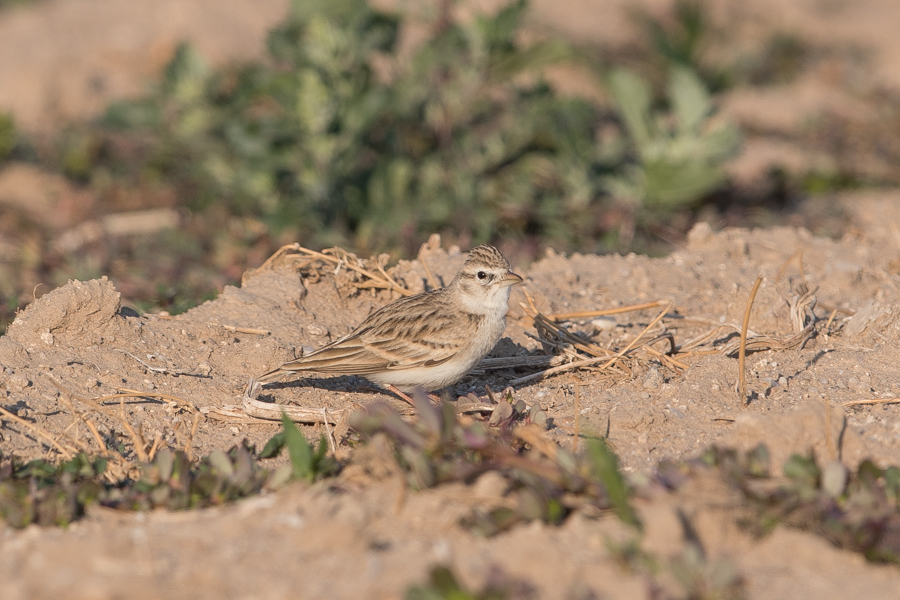
Whilst birding Dhahran Hills Cricket Pitch I am across two Greater Short-toed Larks. Birds that pass through Saudi Arabia are migratory populations, which breed from Ukraine to Mongolia and winter 2,000 km south. In Saudi Arabian it has a status as a rare breeding migrant, very common passage migrant and common winter visitor. They prefer open sandy or gravel plains with herbs and grasses, or cultivated areas and feed mainly on invertebrates in spring and autumn and seeds in winter. They usually forage alone or in pairs, as these birds were doing but can form large groups.
Jem's Birding & Ringing Exploits in the Eastern Province and elsewhere in Saudi Arabia
Showing posts with label Greater Short-toed Lark. Show all posts
20 September 2023
26 July 2021
Greater Short-toed Lark with deformed bill – Jubail area
Whilst birding the Jubail area recently we came across an odd-looking lark. It had a deformed bill making it look quite strange, but it also had what appeared to be longish primary projection. On first impressions it was close to a Greater Short-toed Lark with a reddish cap under certain poses but was a little confusing. After checking details when back home it appears to be a Greater Short-toed Lark. This is the second lark with a deformed bill I have seen recently with the first being a Bar-tailed Lark with a bill like a Curlew seen in Al Ula
11 February 2020
Winter birding – Haradh
Haradh is an excellent site with many pivot irrigation fields that attract a lot of wintering birds. We visited recently and were quite disappointed to find many of the pivots have stopped being used to grow crops. This is probably as a result of the Kingdoms requirement for farmers to stop growing fodder crops from November 2018 to save precious underground water supplies. The fields were mainly there to feed the large herds of cows owned by NADEC and they have probably stopped growing the crop. There were a few fields with what looked like potatoes growing that had a few birds but numbers were significantly down on previous years due to lack of irrigated fields. We did manage to see a few good birds such as a male and female Pallid Harrier, good numbers of both Greater Short-toed Lark and Lesser Short-toed Lark and hundreds of White Wagtail. Several Desert Wheatear were also scattered around the fields. One field with crops held a flock of over thirty Northern Lapwings but nothing else of note could be seen with them. A flock of thirty Chestnut-bellied Sandgrouse flew over at one point only the fifth record for the Eastern Province but the second in two years from Haradh. A Greater Hoopoe Lark gave good views as did a few Spanish Sparrows.
![]() |
| Desert Wheatear |
![]() |
| Chestnut-bellied Sandgrouse |
![]() |
| Greater Hoopoe Lark |
![]() |
| Greater Hoopoe Lark |
![]() |
| Greater Hoopoe Lark |
![]() |
| Greater Short-toed Lark |
![]() |
| Greater Short-toed Lark |
![]() |
| Lesser Short-toed Lark |
![]() |
| Northern Lapwing |
![]() |
| Northern Lapwing |
![]() |
| Pallid Harrier |
![]() |
| Spanish Sparrow |
22 October 2019
A few migrants - Jubail
Whilst birding the Jubail area recently I saw a small number of migrants. A few Daurian Shrikes were sitting about on the bushes and Spotted Flycatchers were catching insects from various low perches. Great Egrets and a couple of Purple Herons were flying around and plenty of Squacco Herons were hiding in the Reed beds. Yellow Wagtails were seen flying over calling with a few on the ground in the scrub along with up to ten Greater Short-toed Larks. Barn Swallow, Sand Martin and Blue-cheeked Bee-eaters were around in good numbers. It was not a great day for migration but there were enough birds around to keep the interest up.
![]() |
| Spotted Flycatcher |
![]() |
| Spotted Flycatcher |
![]() |
| Greater Short-toed Lark |
![]() |
| Purple Heron |
13 March 2019
Buntings & Larks – Jebal Hamrah
Whilst birding the Jebal Hamrah pivot irrigation fields recently with Phil Roberts, we came across a huge flock of Corn Buntings. The total seen was a minimum of one hundred birds and possibly many more. They were feeding in the grassy pivot fields but a couple of times all took to the air and landed on rough ground under the pivot irrigation equipment allowing reasonable views. In amongst the Corn Buntings were several small groups of Eurasian Skylarks and Greater Short-toed Larks. Corn Buntings are uncommon winter visitors to the region but this winter we have seen a few large flocks, like one in Tabuk and this one. Eurasian Skylarks are regular winter visitors in small numbers often seen in pivot irrigation fields. Greater Short-toed Larks are common passage migrants with flocks of several hundred often seen in suitable habitat.
![]() |
| Corn Bunting |
![]() |
| Corn Bunting |
![]() |
| Eurasian Skylark |
![]() |
| Eurasian Skylark |
![]() |
| Eurasian Skylark |
![]() |
| Eurasian Skylark |
![]() |
| Greater Short-toed Lark |
01 April 2018
Birding the pivot fields – Jebal Hamrah
A look at the three accessible pivot
irrigation fields near Jebal Hamrah produced a lot of species with many birds
using the fields and others the spray equipment as resting places whilst on
migration. The majority of birds were larks with 400 Greater Short-toed Lark
and several Crested Larks in the pivot fields and two Bar-tailed Lark and ten
Desert Larks on the stony ground approaching the fields. Several Common
Chiffchaff were around as were Barn Swallows and the first Sand Martin of the
year for me. Pale Crag Martins were also over the fields in small numbers along
with a couple of Brown-necked Raven and a single unidentified eagle. Common
Kestrel was on the cliffs and a female Pallid Harrier flew over one of the
pivots. Tawny Pipit was common with up to twenty birds seen feeding in the
grassy areas.
![]() |
| Bar-tailed Lark |
![]() |
| Bar-tailed Lark |
![]() |
| Greater Short-toed Lark |
![]() |
| Greater Short-toed Lark |
![]() |
| Greater Short-toed Lark |
![]() |
| Greater Short-toed Lark |
![]() |
| Crested Lark |
19 March 2018
Greater Short-toed Larks – Jebal Hamrah
Whilst birding some pivot irrigation
fields near Jebal Hamrah recently I came across very large numbers of Greater
Short-toed Larks, totalling several hundred birds. Some of the birds were quite
rufous in colour with others much paler and greyer suggesting two sub-species
may be present. The trouble with Greater Short-toed Larks is that the
geographical variation is clinal in nature becoming paler and greyer towards
the east and more rufous and streaked above to the west. The photos below show
the difference in colour between the most rufous bird and the other more
typical ones. There were probably a hundred Lesser Short-toed Larks in the
flock but I did not manage to photograph any.
29 September 2016
A few migrants in Dhahran – Records by Paul Wells
Migration has started picking
up, and now there is a break in the very high humidity it allowed Paul to take his
camera out. Paul has been seeing shrikes for the last week or so including Woodchat,
Turkestan and Mauryan Grey Shrike. Paul has also been seeing a number of
hirundines for several weeks that were impossible to photograph, but were
mainly Sand Martins. Also seen and photographed were Greater Short-toed Larks a
species not so commonly seen in Dhahran although common in the spray fields
nearby. Kentish Plover was another species seen by Paul with many birds passing
through the region at present.
![]() |
| Woodchat Shrike |
![]() |
| Mauryan Grey Shrike |
![]() |
| Greater Short-toed Lark |
![]() |
| Kentish Plover |
Subscribe to:
Posts (Atom)