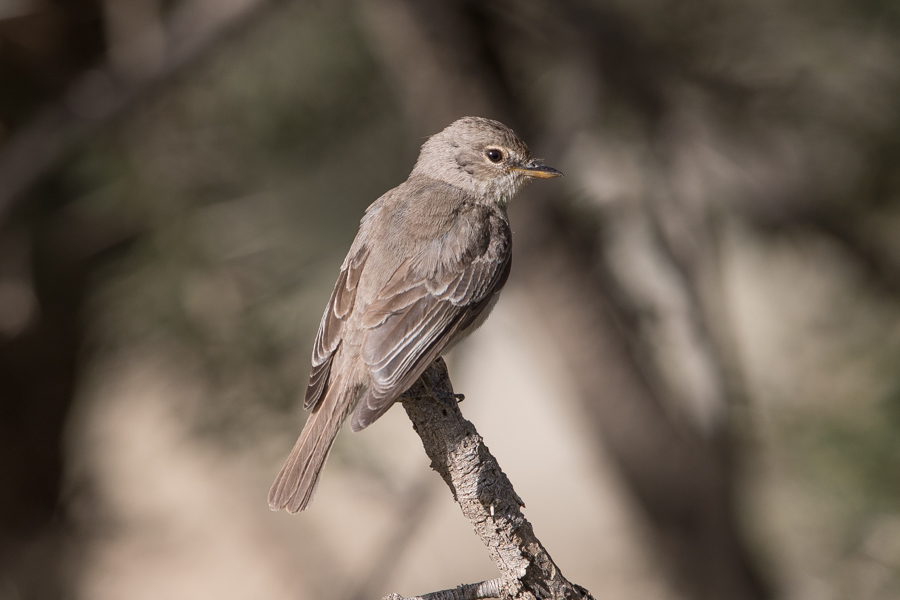
Whilst driving down the raod in the Talea Valley I found a pair of Red-breasted Wheatear Oenanthe bottae at the side of the road with a juvenile. As I did not have many photos if this species I stopped in the hope the birds may come closer to the car. Luckily for me they performed well allowing some good photos to be taken whcich are shown below. It is a common breeding resident, mostly sedentary in the highlands of the southwestern mountains of Saudi Arabia and Yemen. It occurs north to Taif always above 2300 metres in flattish areas such as wadi bottoms and cultivated fields with walls. There are two subspecies O. b. frenata from Eritrea, Ethiopia, and nominate O. b bottae from southwest Saudi Arabia to Yemen.
Jem's Birding & Ringing Exploits in the Eastern Province and elsewhere in Saudi Arabia
Showing posts with label Red-breasted Wheatear. Show all posts
26 May 2020
06 November 2018
Birding An Namas
An Namas is an area north of Tanoumah in the Asir Mountain chain. It is the northerly most point where Asir (Arabian) Magpie can currently be found and is a good birding location. Whilst birding a small valley there I found a lot of good birds including Ruppells Weaver, Violet-backed Starling, Crested Lark, Gambaga Flycatcher, Red-breasted Wheatear, African Pipit, Long-billed Pipit, Cinnamon-breasted Bunting and Arabian Wheatear. The African Pipit is also the furthest north this species has been recorded in the Kingdom in the last forty years proving the area is rich for birdlife. Most birders and photographers who come to the Asir stop at Tanoumah and go no further north but there are plenty of great areas north of this location with much to be discovered.
![]() |
| African Pipit |
![]() |
| Arabian Wheatear |
![]() |
| Cinnamon-breasted Bunting |
![]() |
| Crested Lark |
![]() |
| Gambaga Flycatcher |
![]() |
| Gambaga Flycatcher |
![]() |
| Long-billed Pipit |
![]() |
| Red-breasted Wheatear |
![]() |
| Ruppell's Weaver |
![]() |
| Violet-backed Starling |
03 November 2012
Raydah Escarpment Reserve - Abha
We went to the Raydah Escarpment in the early morning of 28th November to look for some Arabian Endemic species as well as a few restricted range (in Saudi Arabia) African species. The escarpment is very poorly signed and could only be found with the help of a very friendly local Saudi who showed us the route and even offered to drive to the site and allow us to follow. The best way to get to the top is to drive up the Soudah road and once you see the I’m Hotel on the left turn around. Drive back down the road a couple of hundred metres past the shops, now on the right, and then to a red and blue sign with an arrow on it pointing to a turning to the right. Drive down here for about five kilometres, through some small village, until the road splits and take the left turn signed to the Raydah Escarpment. The tarmac road down is extremely steep and quite dangerous with numerous sharp turns and is not for the faint hearted. There are a number of places to stop off-road to look for birds but the best plan for birding would be to walk down the road birding on the way and then hitch a lift back up with one of the locals who also infrequently use the road. Care would, however, have to be taken as there are plenty of Hamadryas Baboons in the park along with Arabian Wolf. We saw a few good birds on the way down including a party of ten Arabian Partridge which were the first birds of this Arabian endemic species I had seen, making my total seven out of the ten possible. They were located on the edge of the road in a very steep section about a third of the way down the escarpment and were in a place where it was difficult to photograph them as there was nowhere to pull the car off the road. They did, however, give very good views and the very large size of these birds was obvious as was the head pattern. The birds are zoned to reflect the vegetation changes with species seen at the top including temperate species such as the Arabian endemic Yemen Thrush, Yemen Linnet & Yemen Warbler. Other good birds seen here included Brown Woodland Warbler, Dusky Turtle Dove, Tristram's Grackle, Brown-necked Raven, Fan-tailed Raven, Steppe Eagle, Palestinian Sunbird, White-spectacled Bulbul, Abyssinian White-eye and Red-breasted Wheatear. As I was with my family we did not stop too much on the way down as it was very steep and dangerous but at the lower slopes where there is a village with arid acacia we stopped and had a walk and saw a lot of birds including Blackstart, ten Little Green Bee-eaters, several Shining Sunbird, two Cinnamon Breasted Bunting, all new Saudi Arabian species for me, as well as Common Redstart, Black Redstart, Siberian Stonechat and a group of Weaver type birds whose identity I am still trying to work out as they do not look like Ruppell’s Weaver to me. The journey back up the escarpment was also quite daunting but less so than the journey down and our Toyota Corolla found it very difficult to get back up the very steep road, although it was thankfully an automatic making things much easier.
![]() |
| Red-breasted Wheatear |
![]() |
| Raydah Escarpment Reserve - top section |
![]() |
| Raydah Escarpment Reserve - lower section with Aloe |
![]() |
| Raydah Village - bottom section |
![]() |
| Green Bee-eater |
![]() |
| Weaver sp |
![]() |
| Splendid Sunbird |
![]() |
| Blackstart |
The Raydah reserve area (estimated at 12 km² is a largely undeveloped section of the western escarpment of Jebal Souda that has been protected to some degree since the 1980s. It is located in the biologically rich Asir Mountains and is also an Important Bird Area. It encompasses strata of highland and foothill habitat from 2800 meters to Wadi Jaw at 1350 meters, including a succession of vegetation from juniper dominated upper regions, with olive Oleo europaea, through to the Afrotropical foothills at Wadi Jaw with Ficus trees and where coffee growing occurs. This is the premier site in Saudi Arabia for trying to find the Arabian Endemic species with ten Arabian endemic bird species recorded in this reserve, as well as the Asir subspecies of the Eurasian Magpie and there are numerous Afrotropical species in the lower altitudes. It is the most densely wooded mountainside in Saudi Arabia and is located 10 Kilometers west of Abha on the Sarawat Escarpment, immediately south of Jebal Souda and is a very steep west-facing slope with crags. The contrast in climate can be tremendous with cool, damp, cloudy and temperate conditions at the top to hot, oppressive tropical conditions at the bottom.
01 November 2012
Looking for Arabian Regional Endemics at Mount Soudah - Abha
Over the Eid holiday (25 – 29th October) we went on a family holiday to Abha in the Asir Province of Saudi Arabia. Although it was a family holiday I managed to get in quite a bit of birding time, concentrating mainly on the Mount (Jabal) Soudah region of the highlands. At just over 3000 m Jebal Souda is the highest peak in Saudi Arabia and includes the Raydah protected area on its western escarpment, and is surrounded by a plateau, mostly over 2500 m. The south-west of Arabia is the stronghold of the Arabian endemic bird fauna with 10 of the 11 endemic species in Arabia occurring in this area, the missing species being Arabian Accentor Prunella fagani. In addition the highlands are the only place in Arabia where the Asir endemic race of the Eurasian Magpie occurs which is given specific status by some authorities. The timing of the trip was not ideal as the summer is probably the best time to visit as many afro-tropical summer visitors arrive to breed such as White-throated Bee-eater and Grey-headed Kingkisher. The region does, however, have a wide diversity of bird life throughout the year with varied vegetation and topography. The juniper Juniperus procera forests in the highlands are probably the most extensive anywhere in Arabia and there are also some thickly wooded acacia valleys. In the foothills below 1,500 m vegetation becomes much more Afrotropical with numerous Ficus trees and genera such as Commiphora, Aloe, Ceropegia and Caralluma being well represented. These lusher habitats of the foothills soon give way on the tihama to arid sandy deserts interspersed with very fertile irrigated fields where water runoff from the highlands can be controlled or where water is close to the surface. These tilled areas usually have high bunds around them and grow a variety of crops, including sugarcane, millet and maize. Being on the periphery of the major weather systems of the northern Indian Ocean (notably the South-west Monsoon) the weather can be unsettled although when we went we had excellent weather although clouds built up each afternoon and on the last afternoon a huge thunderstorm with torrential rain and even hailstones curtailed our outside activities for the day. The birding at Mount Soudah was excellent and although birds were limited in number I saw six Arabian endemic species here as well as a number of other restricted range species, for Arabia. We visited the site every day as the family liked the area and there were play areas for the children which enabled me to do some birding whilst they were playing and everyone was happy.
![]() |
| Steppe Buzzard |
![]() |
| Steppe Buzzard |
![]() |
| Steppe Eagle - first calendar year |
![]() |
| Pied Wheatear |
![]() |
| Red-breasted Wheatear |
![]() |
| Red-backed Shrike |
![]() |
| Brown Woodland Warbler |
The road to Mount Soudah is very good up to the top, although little steep, and is well signposted from the city of Abha. There are several car parks and pick-nick areas to stop at and have a look around as you approach the summit, many of which were good for birds. At the summit there were plenty of Fan-tailed Ravens along with a lesser number of Brown-necked Ravens. Other birds seen in this area included tens of Steppe Eagles of various ages along with a Lesser Kestrel and a confiding Steppe Buzzard. Tristram's Grackles were common near settlements as were Arabian Babblers and my first Arabian endemic of the trip Arabian Wheatear. My second endemic of the trip appeared in the trees of a pick-nick spot singing and turned out to be an Arabian Serin and this was followed soon after by a small flock of another Arabian endemic Yemen Linnet which turned out to be quite common in the park areas. Shrikes were also common in the parks with Woodchat, Masked and Red-backed all seen. Looking around further enabled me to locate my fourth and fifth Arabian endemic species in the shape of four Yemen Thrushes and a Yemen Warbler. House Sparrows, White-spectacled Bulbuls, Abyssinian White-eyes and Spotted Flycatchers were all added to the steadily growing species list. A loudly calling brownish warbler turned out to be a Brown Woodland Warbler a species with a restricted range in Arabia and a Palestine Sunbird added a bright flash of colour to the otherwise grey surroundings. A sighting of a Hammerkop flying over caused some excitement and whilst trying to locate where it had landed I flushed a party of seven Philby’s Partridge my sixth Arabian Endemic all seen in the first day of the trip. Other good birds seen here included seven Arabian Babblers, four Red-breasted Wheatears and two Pied Wheatears. White-spectacled Bulbuls were common and were continually singing from their vantage points.
![]() |
| Mount Soudah Park |
![]() |
| Mount Soudah Park |
Subscribe to:
Posts (Atom)