Showing posts with label Sanderling. Show all posts

21 March 2024

Wader flock – Al Uqair

Whilst birding the Al Uqair area in March we came across a gathering of waders on the beach. This is an excellent place to see Sanderling and this flock held nine birds, and increase from the two seen the prevous visit. A single Greater Sand Plover and a single Kentish Plover were also in the group feeding on the coast. The commonest wader was Ruddy Turnstone with over ten birds. Greater Sand Plover is a common species on passage, with small numbers staying throughout the winter, but it is difficult to get close to them as they are normally out on the tide line or in the flooded sabkha. Kentish Plover and Ruddy Turnstone are common passage migrants and winter visitors with Kentish Plover staying to breed in good numbers. Sanderling is a migratory bird that is a common passage migrant and uncommon winter visitor in Saudi Arabia. It occurs on both coasts during migration (Apr–Jun, Sep–Oct) and occasionally inland, especially in spring but is more common on the west coast than the east coast. It prefers sandy beaches but is also less commonly seen on muddy shores and saline lagoons.

Greater Sand Plover

Greater Sand Plover


Kentish Plover

Ruddy Turnstone

Ruddy Turnstone

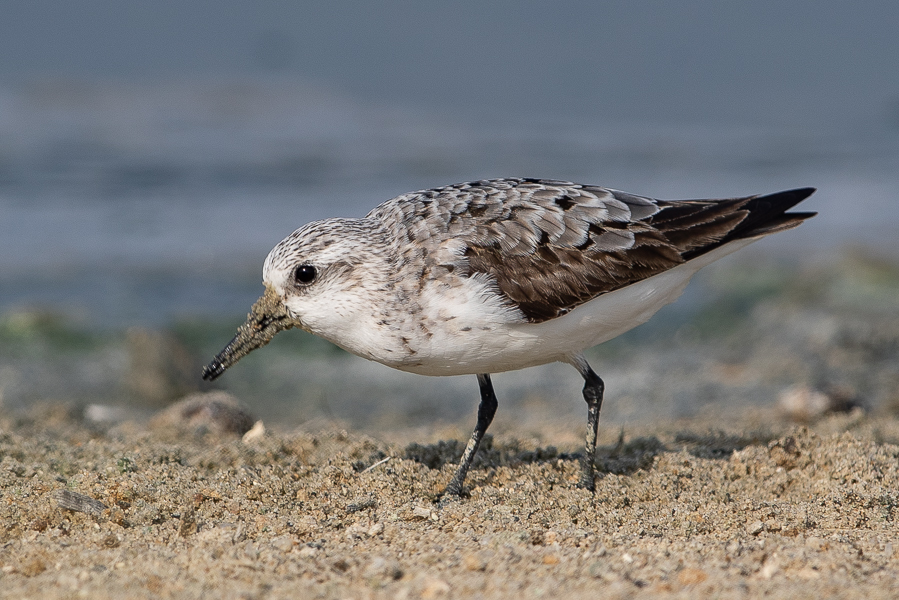
Sanderling

Sanderling


18 February 2024

Sanderling – Al Uqair

At first light, along the main beach at Al Uqair, I came across a couple of Sanderling feeding along the edge of the beach. The bird was feeding actively as they always seem to do making getting good photos a little tricky. The Sanderling is a migratory bird that is a common passage migrant and uncommon winter visitor in Saudi Arabia. It occurs on both coasts during migration (Apr–Jun, Sep–Oct) and occasionally inland, especially in spring but is more common on the west coast than the east coast. It prefers sandy beaches but is also less commonly seen on muddy shores and saline lagoons. This is the third winter I have found Sanderling in Al Uqair, so looks like it is a regular wintering location. 


23 October 2022

Sanderling - Jubail

Whilst birding the Jubail area recently I came across a single Sanderling feeding along the edge of a large area of flooded sabkha. The bird was feeding activel as they always seem to do making getting good photos a little tricky. This is a species that occurs rarely inland in Jubail and was a pleasing find. The Sanderling is a migratory bird that is a common passage migrant and uncommon winter visitor in Saudi Arabia. It occurs on both coasts during migration (Apr–Jun, Sep–Oct) and occasionally inland, especially in spring but is more common on the west coast than the east coast. It prefers sandy beaches but is also less commonly seen on muddy shores and saline lagoons. 


25 February 2022

Waders – Al Khobar

Whilst birding on a beach in Al Khobar we came across a few waders. On scanning the few waders that were present we noticed a few Sanderling amongst the Dunlin and Kentish Plover. This is an uncommon passage migrant and uncommon winter visitor to Saudi Arabia and bird I don’t see so often, although I had seen quite recently at Al Uqayr. We managed to get reasonably close bit the poor light made the photos not so good. A single confiding Dunlin resting on the sand allowed close photos, however.

Dunlin

Kentish Plover

Sanderling

Sanderling


12 January 2022

Sanderling – Al Uqayr

Whilst birding the area near Al Uqayr Customs House we came across a flooded area caused by the large amount of rain that fell at the end of December. On scanning the few waders that were present I located a single Sanderling amongst the Dunlin and Kentish Plover. This is an Uncommon passage migrant and uncommon winter visitor to Saudi Arabia and bird I don’t see so often. As a result, I turned the car around and carefully tried to get into position to see the waders well with the light behind and avoid getting stick in the mud. On arrival at the area it became apparent there were quite a few Sanderling present totalling twenty birds as well as four Greater Sandplovers and twenty plus Dunlin. We spent some time checking the trees along the coast here for Hypocolious as a large flock had spent last winter in the area and despite quite a lot of effort only managed to find two separate individuals some distance apart. A Lesser Whitethroat, Song Thrush, Eastern Black Redstart, several Common Chiffchaff and a calling Siberian Chiffchaff were only other really notable birds seen. 


04 October 2021

Birding the Sharma Beach area - Sharma

The Sharma Beach area is now part of the NEOM complex and is thus difficult to access many previously available locations. The beach area is good in winter for waders and Gulls with some places where you can drive a four-wheeled drive vehicle along the beach edge. When we were there in January we located a Sanderling working its way along the beach. This is a species I do not see very often in the East of the country so spent some time trying to obtain a few decent photographs of the species. Only a handful of Large White-headed Gulls were found and most were Caspian Gull with a reasonable number of Sooty Gulls intermixed with them. The only other bird of note was a fly over Long-legged Buzzard. 

Sanderling

Sanderling

Sanderling

Sooty Gull

Long-legged Buzzard

Long-legged Buzzard

Long-legged Buzzard

Long-legged Buzzard


09 September 2014

World Shorebirds Day – Dammam / Al Khobar Wader Roost south

On 6th September Phil Roberts and I counted shorebirds at the Dammam / Al Khobar Wader Roost south site as part of the World Shorebirds day. The tide was a very low high tide and the time was the middle of the day when the temperatures were 42 degrees Celsius, so we were not expecting to see a great number of waders. We were pleasantly surprised by the final numbers which were collated by Phil and are shown below. World Shorebirds Day is an effort to raise awareness of the importance of regular bird monitoring as the core element of bird protection and habitat conservation. About half of the world’s shorebird populations are in decline, and the rate of habitat loss is worse than ever before. Saving birds without knowing the actual number of individuals of a bird species living in the world is impossible & population figures should not be guesses. If proper monitoring is conducted then population figures and trends can be worked out for the species monitored. This program aims to give a picture of the power of field work, to help non-counters to improve their counting skills, and to increase the number of counters worldwide. Healthy populations of shorebirds mean healthy wetlands, something that thousands of human lives depend on. Action on a global scale needs to be organized to encourage people to be connected with shorebirds, their spectacular life and their habitats. With this in mind Gyorgy Szimuly a Hungarian bird conservationist thought of World Shorebirds Day to be held every year on the 6th of September or the closest weekend to the 6th of September (preferably on Saturday). The main aims are:

·                To raise public awareness about the need to protect shorebirds and their habitats throughout their life cycles

·                To raise public awareness about the need for ongoing shorebird research

·                To connect people with shorebirds through important shorebird sites around the world

·                To get shorebird enthusiasts to introduce shorebirds to more birdwatchers

·                To raise awareness about the need for increased funding for shorebird research, monitoring and conservation.
Dunlin
Greater Sand Plover
Little Stint
Sanderling 

29 August 2014

A good days birding - Sabkhat Al Fasl


A good days birding was had at Sabkaht Al Fasl last Friday with a scattering of migrants and the highest ever Saudi Arabian count of Egyptian Nightjars (see previous post). A flock of 20 Garganey flew over, along with three Northern Shoveller, but the commonest migrants were Barn Swallows and Sand Martins with tens of each. Small groups of European Bee-eaters passed over most of the morning and two Great Reed Warblers were also seen at the edge of the reed beds and nearby scrub. The majority of birds seen were herons and waders with good numbers of Squacco Heron, Grey Heron and Indian Reef Heron and a group of eleven Eurasian Spoonbills, a very large group for the Eastern Province of Saudi Arabia. Waders included 2000+ Black-winged Stilts, 1000+ Kentish Plovers, 1000+ Little Stints and 100+ Curlew Sandpipers. Lesser numbers of Common Ringed Plovers, Greater Sand Plovers, Lesser Sand Plovers, Marsh Sandpipers, Little Ringed Plovers and Dunlin were seen as were a single Temminck’s Stint, one Pied Avocet and one juvenile Collared Pratincole. A single Sanderling was also seen a new species for the site for both Phil and I along with large numbers of Little Terns, Caspian Terns and Gull-billed Terns. A good return of scarce and unusual species were seen making it a very good days birding especially as it is only mid-August.
European Bee-eater
Great Reed Warbler
Greater Sand Plover
Greater Sand Plover
Pied Avocet
Sanderling
Caspian Tern

27 November 2013

Sanderling a new ‘patch’ species – Dhahran Hills

Whilst birding the ‘patch’ during the week I have come across a couple of interesting birds. Two were on the settling ponds with the best being two Sanderlings feeding along the stone edges and muddy fringes. This is the first time I have seen the species on my local patch and takes my total to 202 species. They are an uncommon winter visitor and passage migrant to the Eastern Province of Saudi Arabia and winter along the littoral where they are present from August through May. On passage a few birds occur regularly inland. In Saudi Arabia as a whole they are regarded as a common migrant and winter visitor to all coasts.
Sanderling

 The other good bird seen on the settling pond was a Baillon’s Crake feeding in a small clump of reeds growing in the middle of the pond. The bird showed well and good ‘scope’ views were obtained before it disappeared into the reeds and could not be re-found. Other birds included two Ruff, two Black-tailed Godwits and two Clamorous Reed Warblers. The trees around the percolation pond had a first calendar year Greater Spotted Eagle sitting in them and nine Great Cormorants were seen flying over.

02 September 2013

Lesser Sand Plover numbers increasing – Dammam/Al Khobar Wader Roost South


Development of the Dammam/AlKhobar Wader Roost South is still on going, with tarmac being laid along some of the high bunds. It will not be too long now before full-scale house building starts and this site will probably become difficult to access. Disturbance from the house building and occupation will also badly affect the site, which is a shame as it was the best site for seeing crab Plover. Birds were present if good numbers with many of the small waders using the banks as resting places when the tide was in. Good numbers of Lesser Sand Plovers and similar numbers of Greater Sand Plovers made up the majority of birds with well over 200 of each species seen.
Lesser Sand Plover
Greater Sand Plover

Other waders seen in good numbers included Ruddy Turnstones and Terek Sandpipers with a few Dunlin, Little Stint, Common Redshank, Whimbrel and Grey Plovers. A minimum of 100 Terek Sandpipers were present which is the highest number I have seen together at one site in Saudi Arabia since I have been here. Five Sanderling were also seen which are an uncommon visitor to the Eastern Province, although probably overlooked amongst the many other waders. A single Indian Reef Heron and three Slender-billed Gulls made up the remaining birds seen.
Ruddy Turnstone
Terek Sandpiper
Sanderling