Showing posts with label Caspian Turtle. Show all posts

26 May 2023

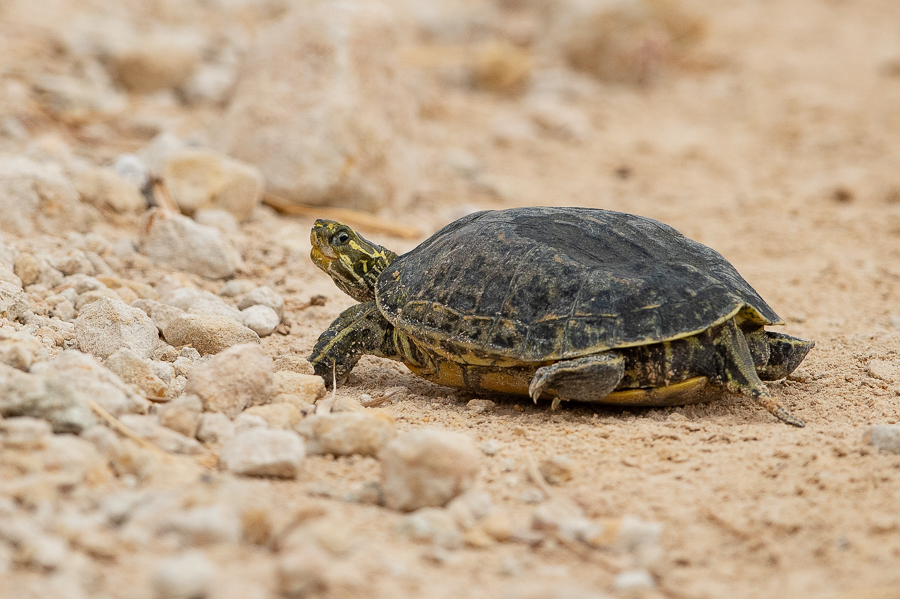
Caspian Turtle – Al Asfar Lake (Hufuf)

Whilst birdwatching at Al Asfar Lake in late May Phil and I came across a Caspian Turtle Mauremys capsica in the unusual place of crossing a track rather than in the water. This is a tan to blackish, medium-sized (to 25 cm), semi-aquatic turtle that occurs in Israel, Saudi Arabia and Iran, northwards into Eastern Europe, through Turkey & Bulgaria into the former Yugoslavia. It has a low, oval carapace that is tan to olive or black with yellow to cream-colored patterning on their shells, legs and head. Some stripes extend anteriorly from the neck onto the head of which one on each side passes above the eye and onto the snout where it meets the stripe from the other side. The neck, limbs, and tail are tan-gray to olive or black with yellow, cream, or gray stripes or reticulations. Females are generally larger than males although have shorter, thinner tails. There are four sub-species of the Caspian Turtle of which the one occurring in Saudi Arabia is the Siebenrock's Caspian turtle. Siebenrock's Caspian turtle M. c. siebenrocki, occurs in Iran and Iraq, with relict populations in Saudi Arabia and Bahrain. This light form with contrasting colors resembles M. c. caspica but has a yellow-to-orange plastron with a small to medium-sized regularly shaped dark blotch on each scute. The soft parts are lighter than in M. c. caspica. They can occur in large numbers in almost any permanent freshwater body within their range where they like to bask in the sun. Breeding usually takes place in early spring and nesting occurs in June and July. A typical clutch is four to six, elongated (20-30 x 35–40 mm), brittle-shelled, white eggs. Hatchlings have round carapaces about 33 mm in length and are brighter colored than the adults. In temporary waters it is forced to aestivate in the mud in summer. They are carnivorous, feeding on small invertebrates, aquatic insects, amphibians and carrion.


14 May 2015

Caspian Turtle – Dhahran golf course

The Caspian turtle Mauremys caspica is a tan to blackish, medium-sized (to 25 cm), semi-aquatic turtle that occurs in Israel, Saudi Arabia and Iran, northwards into Eastern Europe, through Turkey & Bulgaria into the former Yugoslavia. It has a low, oval carapace that is tan to olive or black with yellow to cream-colored patterning on their shells, legs and head. Some stripes extend anteriorly from the neck onto the head of which one on each side passes above the eye and onto the snout where it meets the stripe from the other side. The neck, limbs, and tail are tan gray to olive or black with yellow, cream, or gray stripes or reticulations. Females are generally larger than males although have shorter, thinner tails. There are four sub-species of the Caspian Turtle of which the one occurring in Saudi Arabia is the Siebenrock's Caspian turtle. Siebenrock's Caspian turtle M. c. siebenrocki, occurs in Iran and Iraq, with relict populations in Saudi Arabia and on Bahrain. This light form with contrasting colors resembles M. c. caspica but has a yellow-to-orange plastron with a small to medium-sized regularly shaped dark blotch on each scute. The soft parts are lighter than in M. c. caspica. They can occur in large numbers in almost any permanent freshwater body within their range where they like to bask in the sun. Breeding usually takes place in early spring and nesting occurs in June and July. A typical clutch is four to six, elongated (20-30 x 35–40 mm), brittle-shelled, white eggs. Hatchlings have round carapaces about 33 mm in length, and are brighter colored than the adults. In temporary waters it is forced to aestivate in the mud in summer. They are carnivorous, feeding on small invertibrates, aquatic insects, amphibians and carrion.
Caspian turtle


Caspian turtle

27 July 2011

Caspian Turtle

Yesterday I saw a Caspian Turtle (Mauremys caspica) on the dried up edge of the percolation pond. They are a cold-blooded, freshwater, medium sized semi-aquatic turtle. The carapace is normally tan to olive and the head is not enlarged and is olive to dark brown with yellow or pale cream-coloured stripes. Females are generally larger than males. Siebenrock's Caspian Turtle(M. c. siebenrocki) occurs in Iran and Iraq with relict populations in Saudi Arabia and Bhahrain.


The best bird of the day was a Southern Grey Shrike (aucheri) also known as Arabian Grey Shrike. Other good birds included a Gull-billed Tern, Little Tern, eight Little Stint, one Green Sandpiper, seventeen Wood Sandpiper, twenty three Little Ringed Plover, fifteen Kentish Plover and two hundred and sixteen Black-winged Stilt.