18 July 2014

Flocks of Yemen Serins at Al Mehfar Park – Tanoumah

Yemen Serin Serinus menachensis is a scarce, but locally common resident breeder in the southwest of Saudi Arabia. It is restricted to highlands of the Asir from the Abha area north to As Shafa escarpment. This was one of my last two southwest Arabian endemics to see along with Arabian Scops Owl and despite extensive searching I had not managed to see one on my previous trips to the area. This trip turned out very differently with birds seen in good numbers at two different sites. The first birds seen were a group of more than thirty birds seen drinking water from a leaking water tank in the early morning of 11 July 2014. These birds then flew down into some nearby stony fields and were joined by more with at least 51 birds present. These birds were reasonably tame and allowed close approach even on foot, allowing some good photographs to be taken. Amazingly we saw another flock of 50 birds in another area of Al Mehfar Park and the next day 57 in a completely different area. We have made a conservative estimate that we saw 100 birds at this location. The location of Al Mehfar Park has plenty of the species favourite habitat of stony hillsides, rocky outcrops, cultivated fields and flat waste ground with scrub. Habitat and its flocking tendency are two ways of separating Yemen Serin form the similar Arabian Serin.


17 July 2014

Eurasian Griffon Vultures at Tanoumah Park – Tanoumah

Tanoumah Park is positioned along the edge of the main escarpment. It is reached by taking a left turn at the main junction in Tanoumah town and has a parking area with picnic tables and some trees and grass. The rocky edge of the escarpment has had Yemen Serin previously and Eurasian Griffon Vulture can be seen flying over these cliffs. We had good views of eight birds in the air together, which was encouraging for this declining species. This is probably the best site in the Kingdom for seeing this species, so are worth looking for if you are in the area. We did not stay in the area for very long as but also saw Long-billed Pipits, Tristram’s Starlings, Red-rumped Swallows, Palestinian Sunbirds, Gambaga Flycatchers and African Paradise Flycatcher.
Eurasian Griffon Vulture
Gambaga Flycatcher
Palestinian Sunbird

16 July 2014

Breeding Shikra at Sallal Al Dahna – Tanoumah

Sallal Al Dahna is a wadi or valley with large mature trees and a permanent pool of water with a small waterfall. The valley is situated about two kilometres from Tanoumah on the road to Abha. This site is good for seeing the increasingly rare Arabian Magpie. The taxonomic position of the Arabian Magpie Pica pica asirensisis is uncertain, but it is generally regarded as a subspecies of the European Magpie Pica pica with an isolated population endemic to the Asir mountains, Asir Province, southwest Saudi Arabia. The birds have a very restricted range from Abha about 150 kilometres north to An Numas. Unfortunately when we went on 11 & 12 July 2014 we could not find any Arabian Magpies but did find a disused nest of the birds in a mature tree in the valley bottom. In the same area we also located a breeding pair of Shikra. Shikra is a scarce breeding resident of the southwest of Saudi Arabia with a few scattered records of migrants elsewhere. The birds we saw were adult male and female and a juvenile. One was seen in flight high over the waterfall when we arrived but we later got very good views of all three birds sat in mature trees in the valley bottom. This was a new species for Saudi Arabia for Phil and I and with the excellent views made up for not seeing the Magpies.
Shikra
Shikra
Shikra
Shikra


Other good birds seen in the valley included at least two African Paradise Flycatchers that gave very good and close views as well as Brown Woodland Warbler and Abyssinian White-eyes. The most obvious birds were Fan-tailed Ravens seen on arrival with well over 50 birds flying about calling over the waterfall area. A few Palestinian Sunbirds, two Bruce’s Green Pigeons and a male Violet-backed Starling were other good birds seen here.
African Paradise Flycatcher
Fan-tailed Ravern
Sallal Al Dahna
Arabian Magpie Nest

15 July 2014

Arabian Scops Owl at Al Mehfar Park - Tanoumah

As Arabian Scops owl Otus pamelae has recently been elevated to full species status (see below), and neither Phil Roberts or I had seen the species in the country we decided to try to locate birds in the Tanoumah area, an area where birds had been seen in 2001. This area is in southwest Saudi Arabia north of Abha at 1950 metres elevation. We spent the first night looking for suitable areas in the Al Mehfar Park area trying to hear birds calling but had no success. The second evening we again tried without luck and heard no birds calling. After a few hours as we were contemplating giving up I tried a very quick burst of Arabian Scops owl call and got and immediate response. We followed the Calling bird and could hear it was clling from a thick Juniper tree. Despite being right uder the tree and the bird still calling we could not se anything. After about ten minutes we saw the birds move slightly within the same tree but the views were brief and poor. The bird was still calling and was then joined by a second bird when one and then the other moved to a more open tree where I managed to locate it sitting right out in the open on a branch. Phil had kindly loaned me his back up flash and we managed to get a few photos before leaving the birds alone still calling. This was the last but one of the twelve Arabian Endemics (not including Arabian Magpie that some regard as a species but is generally regarded as a sub-species, and which we have also seen) for Phl and I to see in Saudi Arabia and we were very happy with our nighttime efforts. Arabian Golden-winged Grosbeak is the only one missing. Whilst looking for the owls we also managed to see at least two Montane Nightjars, one sitting along the top branch of a Juniper tree.


In 2008 work by Keonig (Keonig, C., Weick, F. & Becking, J.-H. 2008. Owls: A Guide to the Owls of the World, 2nd edn. London: Christopher Helm) concluded that Arabian Scops Owl Otus (senegalensis) pamelae was a distinct species from African Scops Owl O. s. senegalensis. Recent work by Pons et al (Jean-Marc Pons, Guy M. Kirwan, Richard F. Porter & Jerome Fuchs (2013). A reappraisal of the systematic affinities of Socotran, Arabian and East African scops owls (Otus, Strigidae) using a combination of molecular, biometric and acoustic data. Ibis (2013)), has also shown Otus senegalensis pamelae, represents a very distinct lineage and is well differentiated phylogenetically, morphologically and vocally from O. s. senegalensis. As a result it has been recommended that elevating it to species status, as Arabian Scops Owl Otus pamelae is warranted. The main reasons for this are this southern Arabian taxon is highly divergent from African senegalensis (uncorrected-p mitochondrial genetic distance = 4%). The song of pamelae is very different from that of Eurasian Scops Owl O. scops and Pallid Scops Owl O. brucei but more similar to that of African Scops Owl O. senegalensis. It nevertheless differs from the latter’s song in being higher pitched, sounding ‘scratchier’ and having more prolonged notes; the song sounds two-parted, due to the much quieter first note.  In terms of biometrics, results clearly suggest that pamelae is longer winged and longer legged than mainland African populations of senegalensis. In comparison with populations of O. senegalensis in continental Africa, Arabian pamelae is distinguished in being paler overall, with less distinct streaking over the underparts and a less obvious whitish line on the scapulars (Keonig et al. 2008). Arabian Scops Owls possess several diagnostic genetic and phenotypic characters and it is therefore consider the most appropriate taxonomic treatment is to recognize Arabian Scops Owl as a species Otus pamelae, and not as a subspecies of O. senegalensis as it was originally described based solely on morphological data. This change means that Arabian Scops Owl becomes a new Arabian endemic, found in South-west Saudi Arabia, South-west Yemen and north-east to southern Oman and African Scops Owl Otus senegalensis is now no longer found in Arabia but instead occurs in parts of Ethiopia, Eritrea & Somalia.

14 July 2014

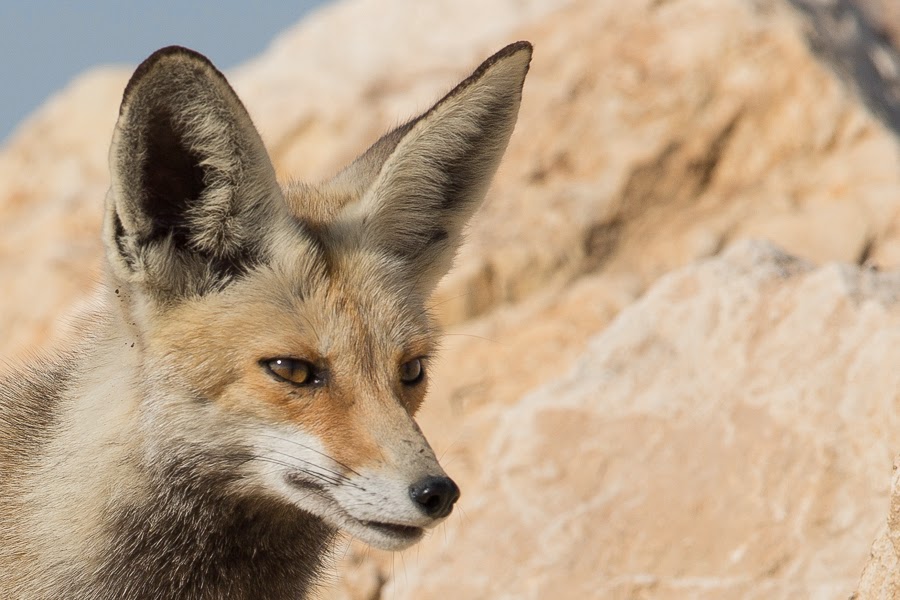
Arabian Red Fox – Dhahran Hills

The Arabian Red Foxes are currently being seen in a number of places around the camp. I have had many reports of the foxes on or near the golf course with others in a few places around Dhahran Hills. Most are seen after dark but a few occur just as the sun is setting making taking photographs of them difficult, as the light is poor. On one occasion this week I managed to photograph one Arabian Red Fox in good sunlight as it was seen early in the morning with the best photos shown below. I am always happy to see the foxes and happier still if I can manage a few good photos of them.


13 July 2014

Egyptian Nightjars – Sabkhat Al Fasl

Whilst birding at Sabkhat Al Fasl in the early morning of 4 July Phil and I found two Egyptian Nightjar Caprimulgus aegyptius resting under different bushes in different parts of the site. One was well hidden in the shade but the second was more out in the open. The birds have complete confidence in their ability to hide and this allows very close approach in a car. The second bird allowed us so close that it completely filled the frame of my camera and did not move the entire time we were there. The status has changed in the Eastern Province of Saudi Arabia in the 21st Century where it was previously regarded as a vagrant, with only six known records Mach to April & September to December (Bundy et al 1989). It is now known as a scarce passage migrant from June to September and scarce winter visitor with spring records very scarce. July & August is the best period for locating them and Sabkhat Al Fasl the best single site. Birds have also started wintering in very small numbers with probably less than five birds seen each winter. Summer records have also been noted in the Eastern Province of Saudi Arabia since 2004 when a pair was discovered at Khafrah Marsh 24 June where the possibility of this nightjar being overlooked as a breeding species was briefly discussed (Meadows 2005). Since 2006 additional birds have been located at Sabkhat Al Fasl (Jubail) in August with the highest count being ten birds together on 22 August 2008. Birds have been seen every year in August at this site since 2006 with birds also seen in July from 2011 to 2014 and the earliest record 27 June 2014. These summer records are interesting as the subspecies that occurs Caprimulgus aegyptius aegyptius occurs in north-east Egypt and northern Arabian Peninsula, eastwards to extreme central-west China, north-east Kazakhstan, Tajikistan, extreme western Pakistan and south-east Iran and winters in the eastern Sahel arrives on its breeding grounds in early April to mid- May and leaves in September. Birds in Iraq arrive in mid-March and are plentiful in April and depart in September with numbers increasing in August & September (Cramp 1985). Migrant birds further to the east in Kazakhstan, where the species also breeds, occur from mid-April to mid-May and from late August to early October (Gavrilov and Gavrilov 2005). There have been no confirmed breeding records of Egyptian Nightjar in Arabia (Jennings 2010) but he mentions that summer records are normally seen in areas where freshwater can be found. These records indicate birds are breeding, attempting to breed, or are very early migrants to the region. If they are very early migrants as it appears then they presumably breed somewhere much closer than current knowledge indicates?


12 July 2014

Locust Swarm returns to Khamis Mushait – Record by Farah Imran Shams

The images of the locusts flying in the air are from the 27th of June in the city of Khamis Mushait.. They came back around 6 in the evening and did not land on the ground. They mostly stayed in the air for around half an hour again. The rest of the images are from the next day. On 28th June, the locusts came back in the morning, around 9 am. Their visit was even shorter this time, barely 15 minutes long. This time, they descended on the roads and roofs in great numbers. I managed to get a few shots of them before they all moved on to some other spot. Again Digger Wasps were associated with the locust swarm and again all the photographs have been taken by Farah Imran Shams who has kindly allowed me permission to put them on my website.


11 July 2014

Greater Sand Plovers returning – Dhahran Expro Wader roost south

There are now hundreds of Greater Sand Plovers returning to the Dhahran Expro Wader Roost south with some birds still showing some signs of breeding plumage but most being juveniles. The Greater Sand Plover is one of the first returning waders and shows that autumn migration is now underway for waders at least. It will take a few more weeks for peak numbers to build up but it is great to see the first signs already. Other waders were thin on the ground with a small group of 13 Eurasian Curlews and two Common Redshanks all that I could find with the exception of the locally breeding Kentish Plovers and Black-winged Stilts. A few Indian Reef Herons of both light and dark colour morphs were also in the area but very little else. Soon the numbers will build up and we should start seeing our first returning Crab Plovers of the year. There are quite a few summering Greater Flamingos along the coast this years and at least six birds, adults and juveniles, were present at the wader roost. There is some bad news though and that is that the entire area is now being filled in for housing and it is only a matter of time before this area is useless for birds. I will keep looking until the end though as this is a good place to try to locate unusual waders.
Greater Sand Plover
Eurasian Curlew
Greater Flamingos
Indian Reef Heron - dark phase

10 July 2014

Some good summer birds – Sabkhat Al Fasl

Phil and I set out for Sabkhat Al Fasl early to see if there was anything about. This is generally the worst time in Saudi Arabia but Sabkhat Al Fasl has a record of Egyptian Nightjars turning up early in July and so we were on the look out for this species. They tend to stay incredibly well hidden and take some looking for unless you happen to disturb one into flight. We found two birds, both of which are shown below, without disturbing them in two separate areas of the site. There had been a juvenile Red-wattled Lapwing around for a few weeks but it was not seen last weekend despite a few birders searching. We were thus quite surprised when I re-found the same juvenile in a different area of the location feeding alongside a wet area by the main reed beds. The bird has now been about for a month and makes an interesting record, as they are scarce in the Eastern Province. Other waders have started to return already showing autumn migration is underway with ten Green Sandpipers, three Greater Sand Plovers and two Eurasian Curlews the best birds. A single Little Bittern and a single Squacco Heron were in the reeds  and up to 1000 greater Flamingos were spread out over the flooded sabkha area. Here there were plenty of terns with White-cheeked Terns and Little Terns the main species, although we did also see a single Caspian Tern and two White-winged Terns. Three Barn Swallows and two Sand Martins were over the reeds but not much else.
Egyptian Nightjar
Egyptian Nightjar
Red-wattled Lapwing - juvenile
Eurasian Curlew
Green Sandpipers
White-winged Tern
Greater Flamingo

09 July 2014

2nd Calendar year female Crested Honey Buzzard still present – Dhahran Hills

The second calendar year female Crested Honey Buzzard is still about in Dhahran, present since 8 June, in the golf course area. At 04:50 on 5 July I saw the bird with Mats Ris flying over the golf course and landing on a floodlight. I managed to take a couple of photos of the bird before it flew off after being disturbed by the noise of a grass cutter. In Saudi Arabia information on the Crested Honey Buzzard is scarce although birds have been seen in every month of the year with the exception of August with peaks in the winter months of January to March. Small peaks also occur in April and October to November showing that the species is now a scarce passage migrant and winter visitor that also occurs rarely in summer. Most records are from the Eastern Province in winter and spring with additional records in the west of the Kingdom in autumn, winter and spring. The first confirmed records for Saudi Arabia were a second calendar year bird at the Raydah Escarpment (18.20N, 42.22E) in the Asir mountains near Abha, Asir Province, on 11 October 1994, with another second calendar year bird 5-10 kilometres south at Wadi Maraba on the same day. Both of these birds were in an extremely exhausted state with one being taken into care and subsequently released The only other records prior to the turn of the century appear to be two birds on 6 January 1999 and 25 February 1999 in landscaped areas within the city of Jubail in the Eastern Province but since this time records have become more frequent with at least 27 additional birds seen. Summer records are rare with this being only the third occurrence, one in Dhahran, Eastern Province in July 2011, one in Tanumah, Asir Province in July 2013 and this bird.