19 February 2015

A build up in numbers of Squacco Herons – Sabkhat Al Fasl

Squacco Heron is a common bird at Sabkhat Al Fasl with hundreds seen on occasions. Numbers, however, drop significantly in the winter when only a few birds remain. On 6 February the numbers of birds had increased significantly from the previous week where we saw about ten birds to well of fifty birds. At one point we saw a group of 27 birds all sitting together in a small open area of reeds. This is the first sign of the buildup of numbers for spring migration. Other herons seen were a good number of Little Egrets as well as four Western Great Egrets. A single Purple Heron was seen in flight and five Grey Herons as well. About twenty Indian Reef Herons were in the reeds and an unusual sight of three Western Cattle Egrets were also present. Western Cattle Egret is a common winter visitor to grassy areas of the Eastern Province such as Dhahran Camp but is uncommon at Sabkhat Al Fasl, which is surprising as the habitat looks ideal.
Squacco Heron
Squacco Heron
Squacco Herons
Squacco Herons
Western Great Egret
Western Great Egret
Western Great Egret
Western Great Egret

18 February 2015

Western Marsh Harriers – Sabkhat Al Fasl

Western Marsh Harrier is a common winter visitor to wetland areas of the Eastern Province with a large number wintering at Sabkhat Al Fasl near Jubail. Although the species is common you very rarely get close enough to them to take photographs when they are on the ground as they fly long before you can get anywhere near them. As a result the only real way to photograph them is to try to do so when they are flying. As they spend most of the time hunting over reed beds this is difficult as the camera finds it hard to lock onto the bird due to the fact the reed beds also attract the cameras attention and it regularly focuses here instead of the bird. I am quite an expert in getting out of focus shots of the harriers but last weekend Phil Roberts and I stayed for some time in an area where six or seven birds were quartering a reed bed. As a result we both took a few nice photos of the birds and were happy with our efforts.
Western Marsh Harrier

Western Marsh Harrier

Western Marsh Harrier

Western Marsh Harrier

17 February 2015

Pied Kingfisher a new ‘patch’ species – Dhahran golf course

A Pied Kingfisher was found on a small pool on the edge of the golf course a Dhahran on 13 February and as this was a new species for me on the ‘patch’ I went to have a look for it first thing in the morning the next day. Although I saw some god birds during this visit I failed to find the Pied Kingfisher. I was then busy with the family until late afternoon when I decided to have another look for the bird. This time I was successful and the Kingfisher was busy feeding at the pond. It would often come by and do its normal hovering over the water before flying off and landing in the top of a tall acacia bush. Pied Kingfisher is a scarce winter visitor to the Eastern Province and although I have seen the species before in the Eastern Province I had until this sighting not do so on my local birdwatching area so I was very happy with this record. Unfortunately the light was poor for taking photographs as it was cloudy and there was a lot of dust still in the air from the previous days strong winds. Other good birds seen included a female Common Kingfisher and several Clamorous Reed Warbler and a Bluethroat that may have been a White-spotted Bluethroat. Recent records from the Eastern Province have included as many as six Pied Kingfishers 25 February 1999, outside Al Jubail, a single present at Sabkhat Al Fasl 6 November to 1 December 2011 and one at Al Fanateer marina, Jubail 24 January 2014.
Pied Kingfisher
Pied Kingfisher
Pied Kingfisher
Pied Kingfisher
Pied Kingfisher
Pied Kingfisher
Pied Kingfisher
Pied Kingfisher 
Pied Kingfisher
Pied Kingfisher
Pied Kingfisher
Pied Kingfisher
Common Kingfisher
Common Kingfisher
Common Kingfisher
Common Kingfisher
Bluethroat
Bluethroat

16 February 2015

The first signs of migration starting – Sabkhat Al Fasl

Migration starts very early in Saudi Arabia compared to my home country of the UK. Here migrants can be seen in January and by early February numbers are increasing. The first signs of migration are normally Barn Swallows and Pallid Swifts with small numbers of each seen in the last few weeks. Phil Roberts also saw a couple of House Martins that are also early migrants. A good number of singing Reed Warblers were also migrants as these are not resident in the Eastern Province although stay until November and are only absent for a couple of months. A few Purple Herons in the last three weeks may well also have been migrants but it is difficult to tell. A number of waders may also be moving as there are now a few more Green Sandpipers and Wood Sandpipers present. Another species it is difficult to tell if they are migrants or not are the Stonechats as some winter and some are on passage  We saw a few SCT Stonechats as well as a smart male NCT Stonechat this I failed to get any photographs of. Migration should start building over the next few weeks and peak in March and April. Let’s hope we get a good spring migration this spring as last year was relatively poor compared to other recent years.
SCT Stonechat - male
Citrine Wagtail
Citrine Wagtail
Common Kingfisher - male
Daurian Shrike
Daurian Shrike
Green Sandpiper
Green Sandpiper
Little Grebe
Little Grebe
Purple Swamphen
Purple Swamphen
Red-spotted Bluethroat
Slender-billed Gull
Slender-billed Gull

15 February 2015

Three species of Kingfisher together on the golf course pond – Dhahran Hills

Harald Ris who is visiting Dhahran visiting his father found three species of Kingfisher together on a small pond on Dhahran Hills golf course on 13 February 2015. Any Kingfisher on the patch is good but three species together is very unusual but not unique. The species seen were Pied Kingfisher, White-throated Kingfisher and Common Kingfisher. As I had not seen any Kingfishers on the ‘patch’ previously I was keen to look for the birds so went out at first light the next day. The White-throated Kingfisher was present hunting from the trees near the pond and a male Common Kingfisher was present as well on the rocks and reeds of the pond edge, but there was no sign of the Pied Kingfisher. Interestingly the Common Kingfisher seen and photographed the day before was a female bird. Both Pied Kingfisher and White-throated Kingfisher are scarce visitors to the Eastern Province of Saudi Arabia with Common Kingfisher being a common winter visitor to wetland areas. There were a number of other good birds in the same area with a Great Egret, a Grey Heron and two Indian Reef Herons, a white and a dark phase bird. Two adult male Little Bitterns were in the reeds as were plenty of Clamorous Reed Warblers, two Bluethroats and five Common Chiffchaffs. A single Song Thrush and three Eurasian Sparrowhawks made up the other good birds seen.
White-throated Kingfisher
Indian Reef Heron
Indian Reef Heron
Indian Reef Heron
Indian Reef Heron

14 February 2015

Mediterranean Chameleon

This Mediterranean Chameleon Chamaeleo chamaeleon was found in Dana Reserve in Jordan in October 2014 but is the same chameleon that occurs in Saudi Arabia, mainly down the western side of the country where it can be found from sea level to 1850 metres above sea level in the mountains. The Mediterranean Chameleon, also known as the Common Chameleon, is a diurnal species that usually varies in colour from green to dull brown, tan or grey. It has a remarkable ability to change colour which is done for camouflage, to signal to other chameleons and to regulate its temperature. Whatever its background colour, the Mediterranean chameleon generally has two light stripes along each side of its body, with the stripes often being broken into a series of dashes or spots. They are an arboreal species that have strong, grasping feet with four toes, two on each side for grasping branches and a prehensile tail, used to maintain balance and stability, making it well adapted to living in bushes and trees. It uses its long, sticky tongue to capture passing prey, that when extended, can be twice the length of the body. They have very sharp eyesight and each eyeball is able to move independently of the other and a light crest of scales along its throat, and a crest of small, serrated scales along its back and can measure up to 20 -40 cm long. They are active during the day and its diet consists mainly of arthropods including grasshoppers, flies, bees, wasps, and ants. Like other chameleons, the Mediterranean Chameleon is slow-moving, often with a slight swaying motion to avoid detection by predators, and is a ‘sit-and-wait’ predator that captures prey with its long, sticky tongue when prey comes within reach. Their range is the broadest of all chameleon species, extending from northern Africa, Arabia to southwest Asia and southern Europe. In North Africa and the Middle East it occurs in Morocco, Algeria, Tunisia, Libya, Egypt, Israel, Palestine, Jordan, Saudi Arabia, Yemen, Lebanon, Syria Iraq and Iran. They are found in a variety of habitats including open pine woodland, shrubland, plantations, gardens and orchards and spends the majority of its time in trees or bushes, preferring dense cover for camouflage. However, this habit changes during the mating season when males move to the ground to find a mate and females descend to a lower level of vegetation.


13 February 2015

The first Common Shelduck of the winter – Sabkhat Al Fasl

The Common Shelduck is an irregular winter visitor to all coastal areas from October to April. In the Eastern Province it was regarded as an uncommon winter visitor in the 1980’s but large winter gatherings of over 100 birds occurred at Sabkhat Al Fasl every year from1994 to 2004 with a maximum 2535 in winter 2003. Since this date numbers have decreased but birds occur at this site every winter in numbers of up to 100 and 357 were on the flooded sabkhat at Sabkhat Al Fasl on 5 January 2012. In the southwest of Saudi Arabia birds occur on the Red Sea coast from December to February with 50 seen well inland at Malaki Dam Lake 8-9 February 1992. This location is the southern limit of their wintering range. In the Riyadh area birds are winter visitor in variable numbers, occurring between November and early April with 50 plus recorded in one flock. On 6 February I saw two small flocks at Sabkhat Al Fasl totalling 80 birds. These were the first sightings of the winter at this location and unusually they were reasonably close inshore. This may be due to the fact hunting is being stopped at this site by the SWA and the birds are thus less disturbed. As a result of the birds being relatively close I managed to get a few photos of the species for the first time in the kingdom. At one point a Greater Spotted Eagle flew over and disturbed the flock of 54 birds and I thus also managed a couple of flight photos as well.
Common Shelduck

Common Shelduck

12 February 2015

Close views of White-throated Kingfisher – Sabkhat Al Fasl

As mentioned in a previous post there have been three White-throated Kingfishers at Sabkhat Al Fasl this winter with the first birds seen in early January 2015. On 31 January whilst driving back through the site after ringing, at about midday, I found an adult White-throated Kingfisher sitting on a dead tree near to the main scrape. I was quite close to the bird by the time I had stopped and managed to get the best views and photographs I have managed so far of the bird. I keep forgetting how large these kingfishers are, but although they are large they don’t normally allow very close approach at this location, although there are many good photographs of White-throated Kingfisher at the closest breeding locations near Riyadh in central Saudi Arabia. In my view all Kingfishers are beautiful birds with White-throated Kingfisher up there with the best of them. Hopefully these birds will stay about for the rst of the winter at least as it is always enjoyable to see them.
White-throated Kingfisher

White-throated Kingfisher

11 February 2015

Another Moustached Warbler & Grey-headed Swamphen trapped and ringed – Sabkhat Al Fasl

Nicole and I went ringing to Sabkhat Al Fasl on Saturday rather than our normal Friday as the wind was forecast to be a little less strong on the Saturday. We set off from Dhahran at 03:30 hrs and had all the nets set up by first light of 06:15 hrs. The wind was a little stronger than we would have liked but we caught a reasonable number of birds for us ending the morning with 25 birds. Most were the normal suspects for this time of year with wintering birds including Bluethroat, Common Chiffchaff, Common Kingfisher, Moustached Warbler and Water Pipit, resident species including Indian (Clamorous) Reed Warblers and Purple Swamphen. The Purple Swamphen was caught in a mist net as it flew across an open area of water to a reed bed and is the second one we have caught in two weeks after not catching any up to that point. They are really smart birds and I have collected a couple of loose feathers from both birds and will, hopefully, be sending them off for DNA work to be conducted on them to try to work out exactly which subspecies occurs here as currently we are uncertain. They are certainly a Grey-headed type but which of the several grey-headed subspecies are involved we do not know. The other stand out bird was the second Moustached Warbler in two weeks which is only the third record since we started ringing.
Moustached Warbler
Moustached Warbler
Grey-headed (Purple) Swamphen
Common Chiffchaff
Common Chiffchaff
Common Kingfisher - female
Indian (Clamorous) Reed Warbler
Red-spotted Bluethroat
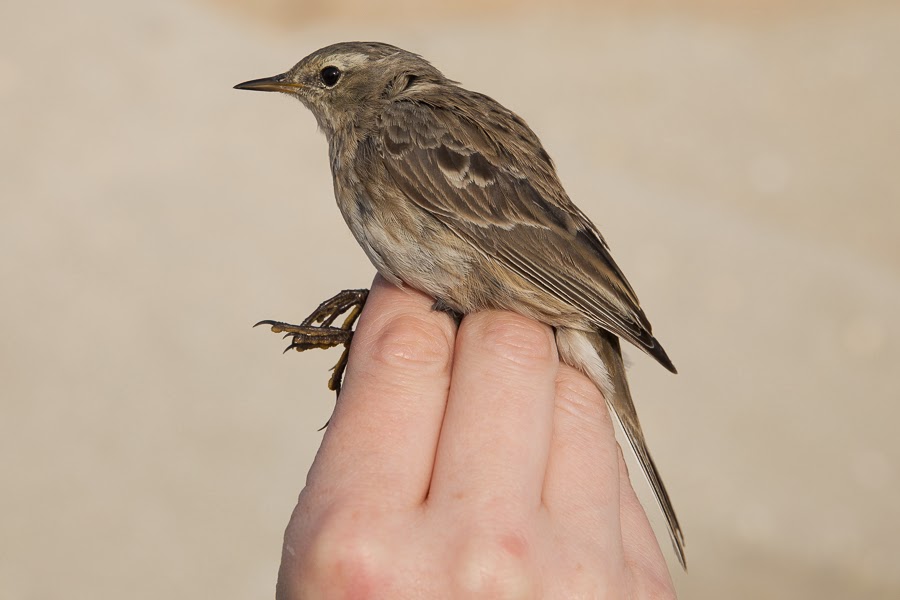
Water Pipit - coutelli

10 February 2015

Stripped Hawk Moth caterpillar at Dhahran – Records by Colin Knight

Colin Knight came across my website while hunting for the id of a Hawk Moth caterpillar he photographed in Dhahran Hills in 2009 where he worked for Saudi Aramco for over 25 years, leaving in 2008. Colin returned briefly to Dhahran in March 2009 and photographed two different looking Hawk Moth caterpillars near the percolation pond that he has just identified as the Striped Hawk Moth Hyles livornica which have considerable variation in the pattern of caterpillar. Colin very kindly gave me permission to use his photographs on my website which are reproduced below. The Striped Hawk-moth is the most common Hawk Moth in Arabia, it is an insect of the open desert where it breeds on a number of different plants. It flies at night and migrates to other countries reaching as far north as Scandinavia.  A successful breeding season often occurs after heavy rain with vast numbers of moths occurring. The thorax of the Striped Hawk-moth has four distinct white stripes running lengthways, and the antennae have white tips. There is a white dorsal stripe running along the abdomen and each of the underwings has a bright red patch.
Striped Hawk Moth

Striped Hawk Moth

Striped Hawk Moth

Striped Hawk Moth