23 August 2017

Desert Hedgehog in Dhahran – Record by Phil Roberts

Whilst in Dhahran main camp Phil Roberts found a Desert Hedgehog in his garden where he took the below photo that he has kindly allowed me to use on my website. The Desert Hedgehog is a species found in northern Africa, from Morocco & Mauritania in the west to Egypt in the east as well as the Middle East including Israel, Jordon, Syria, Iran, Iraq, Kuwait, Saudi Arabia, United Arab Emirates, Oman & Yemen. A typical hedgehog in appearance the Desert Hedgehog has a dense, spiny coat, an elongated snout and the ability to curl into a defensive ball when threatened. Its most distinctive feature is the contrasting dark muzzel and broad white, spineless band across the face, which extends onto the flanks. The ears are relatively short and rounded and like other members of the genus, there is a naked patch on the forehead. The legs are long and dark and the underside is softly furred and is usually a mixture of black, brown and white while the spines on the back are a light colour with two dark bands. The overall colouration is quite variable, with some individuals almost totally white, and others completely dark. It is one of the smallest of hedgehogs being 14 - 28 cms in length and weighing 285 - 510 grams. As its common name suggests, the Desert Hedgehog inhabits dry deserts, dry steppe and other arid terrain and often favours areas such as oasis and vegetated wadis where food is more readily available. It has also been recorded in gardens, cultivated areas, open woodland and parks like the areas it is found in Dhahran Camp. It is active at night, is solitary and forages on the ground for a range of insect and other invertibrate prey, as well as occasionally small vertibrates and even species such as scorpions, spiders and snakes. They enter hibernation between January & February, when the temperatures are cooler and may also become less active during the hottest months and when food is scarce.
Desert Hedgehog

22 August 2017

Ruppell's Warbler at Sharma – Bird record by Euan Ferguson

Euan Ferguson was in Saudi Arabia with a couple of other birdwatchers in spring 2017, conducting an environmental survey and found a male Ruppell's Warbler at Sharma in the far northwest coast of the Red Sea on 19 March 2017. This species is a rare migrant to western regions of the Kingdom with early to mid-March the best time to see it. I thank Euan for sending me the details of this bird and allowing me to use his excellent photo on my website. This is made even better by being the first time I have been able to show a photo of the species on my website.
Ruppell's Warbler

21 August 2017

Common Redstart - Jubail

The below photos were taken in the spring in Jubail but I did not post them at the time. Normally birds keep well hidden but this individual was quite happy being out in the open feeding along the side of a track. The Common Redstart is a common passage migrant throughout Saudi Arabia and passes through in March to May and again from early September until late November. Samamisicus are regular and normally pass through one or two weeks earlier than nominate occurring in early March and outnumbering the nominate subspecies during the very start of migration.
Common Redstart

Common Redstart

Common Redstart

Common Redstart

Common Redstart

20 August 2017

Anderson’s Rock Agama Raydah Escarpment near Abha – Record by Munzir Khan

Whilst birdwatching in the Abha area, in the mountains of southwest Saudi Arabia, Munzir came across an Anderson’s Rock Agama. This species is endemic to the Arabian Peninsula, where it is found in west and south Arabia, from Taif (Saudi Arabia) in the north to Dhofar (Oman) in the east. It is found to around 2,000 metres above sea level. It is common in Saudi Arabia where it is a rock dwelling lizard mainly present in mountainous areas. I thank Munzir for sending me the photo that he has kindly allowed me to use on my website.
Anderson’s Rock Agama

19 August 2017

Spur-winged Lapwing breeding? – Jubail

Whilst biding the Jubail area in early August 2017 I saw two Spur-winged Lapwing again in the same place where they have been present since April. The behaviour of the birds being very vocal and calling in flight as was the case the last time I saw it suggests the bird are breeding. Despite searching for young birds none were found so confirmation of breeding will have to wait a little while longer. The species has not been proved to breed in the Eastern Province yet but hopefully this will change if when we see the young of this pair.
Spur-winged Lapwing

18 August 2017

Graceful Prinia breeding in Bahrain – Record by Jehad Alamaddi

Graceful Prinia is a very common resident breeder in the Eastern Province of Saudi Arabia, mainly around the edges of the main reed beds. They are not so easy to photograph though as they are fast moving so Jehad has dne well to get good photos of some juveniles from Bahrain. They nest in low tamarisk as well as reed beds and singing has been heard as early as February with the species becoming common in the summer months. They presumably have at least two broods as I have trapped and ringed a female with a brood patch on 27 March, Phil has photographed nestlings in a nest on 2 May and Jehad’s Juveniles are from the end of June. The subspecies occurring is P. g. hufufae from north-east Saudi Arabia and eastern areas of the Arabian Peninsula, including Bahrain, south to Oman as they had a broad, sharply defined black band on tail-tips about 6 mm wide with a narrow white tip and paler upperparts than in P. g. palaestinae. I thank Jehad for sending me the photos and for kindly allowing me to use them on my website.
Graceful Prinia

Graceful Prinia

Graceful Prinia

17 August 2017

Some southwest specialities – Phil’s Fields

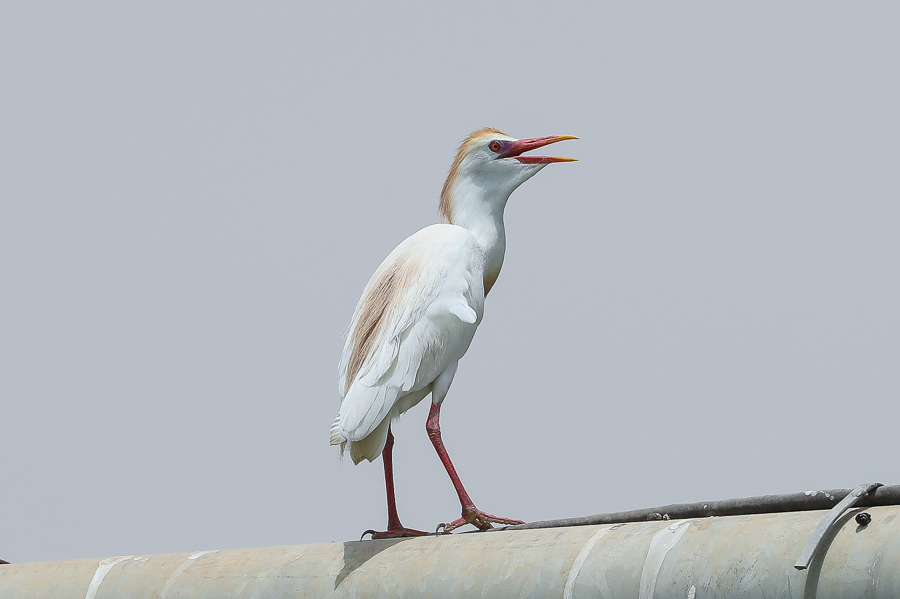
I visited Phil’s Fields three times in July 2017 and saw a lot of good birds in the area. Some of the birds seen were summer visitors from Africa and others specialities of the southwest of the Kingdom. The area is a set of three large pivot irrigation fields and surrounding trees edging the fields and scrubby land to the side. The pivot irrigation equipment is always good for birds to perch on when they are disturbed from the fields and this visit I saw a large flock of Indian Silverbills, twenty Western Cattle Egrets and a couple of Arabian Babblers. The fields are the best place I know of for seeing both Zitting Cisticola and Singing Bush Lark but is also good for White-throated Bee-eater and White-spectacled Bulbul. Other birds seen included House Sparrow and a fly over Yellow-billed Kite. This site is an excellent birding location and one I visit every time I am in the area and it always turns up good birds.
African Silverbill
African Silverbill
African Silverbill
African Silverbill
African Silverbill
African Silverbill
Arabian Babbler
Arabian Babbler
House Sparrow
House Sparrow
Western Cattle Egret
White-spectacled Bulbul
White-throated Bee-eater
Yellow-billed Kite
Yellow-billed Kite
Zitting Costicola
Zitting Costicola

16 August 2017

Hamadryas Baboon Raydah Escarpment near Abha – Record by Munzir Khan

Munzir saw Hamadryas Baboon Papio hamadryas whilst birding the Raydah Escarpment near Abha. This is a very good place the see the species with large troops somwtimes present. This species is the northernmost of all the baboons and is distinguished from other baboons by the male’s long, silver-grey shoulder cape (mane and mantle), and the pink or red rather than black face and rump. The male is considerably larger than the female, often twice as large, and has a heavy silvery-grey coat, bushy cheeks, and large canine teeth. Males may have a body measurement of up to 80 cm and weigh 20–30 kg. They occur in north-eastern Africa, mainly in Ethiopia, but also eastern Sudan, Eritrea, Djibouti and northern Somalia as well as the Arabian Peninsula, in Saudi Arabia and Yemen. I thank Munzir for sending me his photo and for allowing me to use it on my website.
Hamadryas Baboon

15 August 2017

Egyptian Nightjars in the open - Jubail


The Egyptian Nightjars Caprimulgus aegyptius that are again spending the summer in Jubail are still around in good numbers with eight seen at various places around the site in mid-August. The Egyptian Nightjar is an uncommon bird in Saudi Arabia but birds are regular in the Jubail area in the summer. The birds are normally seen sitting in the shade under small bushes but some of the ones we saw were alongside a track and out in the open allowing for some good photos to be taken. The photos below were of a three different birds. This year birds have been seen all over Jubail in many areas where I had not seen them before. As I do not want to disturb the birds I have not got a clear idea of numbers this year but there are at least 13 present and probably many more.
Egyptian Nightjar

Egyptian Nightjar

Egyptian Nightjar

Egyptian Nightjar

Egyptian Nightjar

14 August 2017

Western Osprey catching fish - Jubail

Whilst at Jubail recently I saw a Western Osprey being mobbed by hundreds of Black-winged Stilts. The bird was not put off its fishing attempts and managed to catch a fish before flying off. I managed to only get a few photos of it taking off from the water, which are shown below. In the Eastern Province birds are most often seen near the coast where they are regular passage migrant from March to April then again in September and October.as well as resident breeding species.
Western Osprey

Western Osprey

Western Osprey

Western Osprey