06 November 2018

Birding An Namas

An Namas is an area north of Tanoumah in the Asir Mountain chain. It is the northerly most point where Asir (Arabian) Magpie can currently be found and is a good birding location. Whilst birding a small valley there I found a lot of good birds including Ruppells Weaver, Violet-backed Starling, Crested Lark, Gambaga Flycatcher, Red-breasted Wheatear, African Pipit, Long-billed Pipit, Cinnamon-breasted Bunting and Arabian Wheatear. The African Pipit is also the furthest north this species has been recorded in the Kingdom in the last forty years proving the area is rich for birdlife. Most birders and photographers who come to the Asir stop at Tanoumah and go no further north but there are plenty of great areas north of this location with much to be discovered.
African Pipit
Arabian Wheatear 
Cinnamon-breasted Bunting
Crested Lark
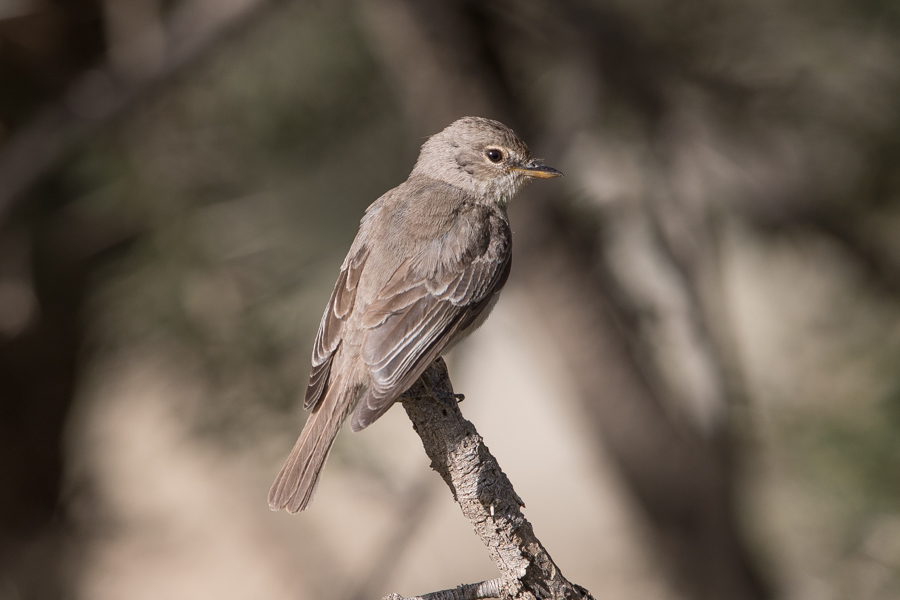
Gambaga Flycatcher
Gambaga Flycatcher
Long-billed Pipit
Red-breasted Wheatear 
Ruppell's Weaver
Violet-backed Starling

04 November 2018

Hunter and Hunted - Judah

Whilst searching for scorpions we found a very small Black-sting Scorpion or possibly a Deathstalker in the ultraviolet torchlight. When we got closer a spider was in attendance and it became clear the scorpion was entangled in the spider’s web and was in fact already dead. It appears the spider had killed the scorpion or at least it had died in its web and was about to eat the dead arachnid. Their most common natural predators are other types of scorpions with young and adults having high mortality rates, although Deathstalkers also kill and eat themselves. Centipedes are also common enemies who often kill scorpions.


02 November 2018

Birding Wadi Grosbeak – Near Bani Saad

Wadi Grosbeak is a site where Arabian Golden-winged Grosbeak has been see I recent years although when we went this year we failed to find any. The site is good for a number of other species and Arabian Babbler can always be found there in small noisy groups. Another bird regularly seen in the area is Long-legged Buzzard, which are almost always dark phase birds. These are the most common phase in the west rather than the pale birds we see in the East of the Kingdom. Other birds seen were Eurasian Hoopoe, Cinnamon- Breasted Bunting and Streaked Scrub Warbler.
Arabian Babbler
Arabian Babbler
Cinnamon-breasted Bunting
Eurasian Hoopoe
Long-legged Buzzard 
Scrub Warbler
Scrub Warbler
Scrub Warbler

01 November 2018

Jizan Corniche - Jizan

This site is one of the main birding locations in the region and has good wader habitat holding the highest concentration of shorebirds along the Saudi Red Sea coast. The site is easily viewed from the cornice road and in the early morning the sun is behind the observer allowing good viewing conditions. We birded the coast from the cetre of Jizan a short distance to the south, but did not go too far due to the issues near the Yemen boarder. The Corniche is also good for birds other than shorebirds with Black-crowned Sparrow Lark, Sooty Gull, Spur-winged Lapwing, White-winged Tern, Namaqua Dove and Pink-backed Pelican all photographed. The only waders photographed were Bar-tailed Godwit and Black-tailed Godwit.
Sooty Gull
Spur-winged Lapwing
White-winged Tern
White-winged Tern
White-winged Tern
Black-crowned Sparrow-lark
Namaqua Dove
Pink-backed Pelican
Pink-backed Pelican
Pink-backed Pelican
Pink-backed Pelican
Bar-tailed Godwit
Bar-tailed Godwit
Bar-tailed Godwit
Black-tailed Godwit

31 October 2018

Black-sting Scorpion - Judah

Whilst out looking for owls at night near Juadh we came across three scorpions, and although I am not an expert on scorpions they resemble Black-sting Scorpion Buthacus yotvatensis nigroacleatus. They were found by using an ultraviolet light that’s shows them glowing in the light, with the photos taken with strong flash showing off their colours. The Black-sting Scorpion Buthacus yotvatensis nigroacleatus is a small very poisionous scorpion. They are golden brown to greenish yellow coloured with a black sting. Thin elongated pincer-like pedipalps, jointed abdomen which ends in a swollen black sting. Antennae absent and the mouthparts are formed by small pincer-like chelicerae (fangs). There is a pair of dorsal eyes and two to five smaller pairs of lateral eyes. There are four pairs of walking legs. The legs are hair-covered and end in hooks which are used to hold on to vegatation.They are not often seen as they hide by day and emerge at night, when they feed on other invertebrates. Their poison or venom is used to kill or paralyze their prey so that it can be eaten; in general it is fast-acting, allowing for effective prey capture and is sometimes fatal to humans. They arefound mostly in rocky areas and gravel plains but also occur in sandy areas and make their burrow under bushes.Scorpions are known to glow when exposed to certain wavelengths of ultraviolet light, such as that produced by a blacklight, due to the presence of fluorescent chemicals in the cuticle. The principal fluorescent component is now known to be beta-carboline. A hand-held UV lamp has long been a standard tool for nocturnal field surveys of these animals. However, a glow will only be produced in adult specimens as the substances in the skin required to produce the glow are not found in adolescents.


29 October 2018

First fully documented record of Ruppell's Vulture in Saudi Arabia and Arabian Peninsula - Tanoumah

Whilst birding the Tanoumah area, along the edge of the main escarpment of the Asir mountains in southwest Saudi Arabia, 12 October 2018 Phil Roberts and I came across a group of about 50 Eurasian Griffon Vulture Gyps fulvus in the air together, many later came down and rested on the rocks before again moving southwards. This is easily the largest gathering of this species either of us have observed in Saudi Arabia. We did not get great views of the birds when initially seen, as we saw them from the car and could not stop quickly. I parked the car as soon as possible, but the road was busy and dangerous, and by the time we returned to the area on foot some of the birds were on the ground. No birds could be seen in the air at this point but soon the birds on the ground took off and a group of about twelve birds flew around briefly before disappearing behind the cliffs. I quickly took a few photos of two birds but unfortunately, the terrain prevented any further sightings. On seeing low-resolution photographs, Yoav Perlman pointed out that one of the vultures looked odd and thought that it could be a Rüppell's Vulture Gyps Ruppelli or a hybrid, as it did not look quite right. Yoav suggested I contacted Dick Forsman for his opinion, so I sent him two high-resolution images. Dick responded saying the bird was so far from a typical adult Eurasian Griffon of the eastern type and this option could definitely be excluded. With the very contrasting black-and-white pattern to greater and even median underwing coverts, narrow head and typically marked axillars Dick felt quite sure that the bird was a Ruppell's Vulture of the NE African erlangeri subspecies. Most of the long undertail coverts seem to be missing due to moult, but the ones remaining showed the pale tips typical of Ruppell's Vulture. Dick also mentioned that having studied Ethiopian Ruppell's Vultures on many trips to the country he has a very strong feeling of them being some kind of a hybrid population between fulvus and nominate rueppellii, as mentioned in his book (Forsman 2016). Dick said the Saudi Arabian bird was a brilliant example of this type, showing features from both species. Dick’s views thus matched Yoav’s original thoughts almost exactly. The status of Rüppell's Vulture in Saudi Arabia is unclear and clouded by the records of Meinetzhagen. Recent views are that the species does not occurred in Arabia as Meinertzhagens records are discounted due to his indiscretions as documented elsewhere. When looking through the recently compiled list of species occurring in Saudi Arabia, it is not recorded, thus this record becomes the first fully documented record of Rüppell's Vulture Gyps Ruppelli for Saudi Arabia. There are no accepted records from any countries that make up the Arabian Peninsula, making it a first for this region as well. The closest and only record for the entire Middle East region is a probable third calendar year bird seen at Lakhish Hills, South Judean Plains, Israel, 5 May 2014 where the bird was associating with Eurasian Griffon Vultures away from their main colonies. The likelihood of the species occurring in Saudi Arabia was very small due to its current population of only 22,000 and the fact that it is Critically Endangered, however vulture passage has been noted down the Asir Mountains in autumn. Rüppell's vulture Gyps rueppelli is a large vulture that can be found throughout the Sahel region of central Africa in areas of arid steppe, grasslands, mountains (up to 4500 m in Ethiopia) and woodlands. Once considered common in these habitats, the Rüppell's vultures are experiencing steep declines, especially in the Western portion of their range. They feed entirely on carrion and bone fragments of larger carcasses, mainly soft muscle and organ tissue. It is named Rüppell's vulture is named in honor of Eduard Rüppell, a 19th-century German explorer, collector, and zoologist. There are two subspecies known Gyps rueppelli rueppelli (A. E. Brehm, 1852) – Southwest Mauritania and Senegambia east to Sudan and western Ethiopia, and south to Kenya and northern Tanzania. Gyps rueppelli erlangeri (Salvadori, 1908) – Ethiopia (except west), Eritrea and Somalia. The eastern subspeices is paler and more like Eurasian Griffon Vulture than its darker relative to the west. Finally, I would like to take this opportunity to thank both Yoav Perlman and Dick Forsman very much for their generous help in identifying this bird. Without their help and knowledge, this bird may well have remained unidentified.
Ruppells Vulture

27 October 2018

Migrants in the southwest

Whilst birding the southwest mountains in mid-October we saw a few migrants. Numbers were low but we saw a good selection of species. They included Spotted Flycatcher, Common Redstart, Pied Wheatear, Barn Swallow, Rufous-tailed Rock Thrush, Blue Rock Thrush, Steppe Eagle, Eurasian Griffon Vulture, Eurasian Blackcap, Lesser Whitethroat, Eastern Olivaceous Warbler, Green Sandpiper, Wood Sandpiper, Common Snipe, Turkestan Shrike, European Bee-eater, Ortolan Bunting and Common Swift. The habitat looks ideal for good numbers of migrant but the numbers seen were low with single birds or a few of each species only.
Common Snipe
Common Snipe
Common Snipe
Common Snipe
Eurasian Bee-eater
Eurasian Bee-eater

25 October 2018

Migrating Steppe Eagles – Between Tanoumah & Abha

 Whilst driving between Abha and Tanoumah in mid-October 2018 we saw 28 Steppe Eagles with a further 51 on the return journey. Birds seen included immatures, sub-adults and adults and will probably include birds that will stay the winter in the region along with migrants. These sightings fit in well with the idea that Steppe Eagle is a long-distance trans-equatorial migrant and unlike many other eagles, the species migrates in large, loose flocks. Individuals leave their breeding grounds for wintering grounds between August and October, returning to breeding areas between January and May. In Saudi Arabia 500 Steppe Eagles have been counted passing through Taif escarpment (IBA), daily, during month of October and many hundreds were seen at a rubbish dump 50 kilometres north of An Namas also in October. These records indicate October is the peak month for migrating Steppe Eagles in Saudi Arabia. Like other soaring birds, Steppe Eagles minimize the length of sea crossing and appear to have a loop migration around the Red Sea, arriving via Bab-el-Mandeb Strait (between Yemen and Djibouti) and departing via the Suez, Egypt–Eilat, Israel (the northern end of the Red Sea). This is probably because the prevailing easterly winds between October and April make return migration via Bab-el-Mandeb more difficult. There are two recognised subspecies of steppe eagle, Aquila nipalensis nipalensisand Aquila nipalensis orientalis, the latter being slightly smaller, with paler plumage. Birds from European Russia, eastern Kazakhstan and Turkey (A. n. orientalis) winter in the Middle East, Arabia and East and Southern Africa. Birds from Altai, Siberia eastwards (A. n. nipalensis) winter mainly in south and south-east Asia. The Steppe Eagle has undergone extremely rapid population declines within all its range. The speed and severity of these declines justified the species being moved from ‘Least Concern’ to ‘Endangered’ in the 2015 IUCN Red List assessment. Suspected reasons for decline include, habitat loss/ degradation, electrocution on or collision with energy infrastructure, poisoning through herbicides, pesticides and veterinary drugs in food sources, persecution, mortality of juveniles in fires, taking of chicks and disturbance.
Steppe Eagle

Steppe Eagle

Steppe Eagle

Steppe Eagle

Steppe Eagle

Steppe Eagle

Steppe Eagle

Steppe Eagle

Steppe Eagle

Steppe Eagle

Steppe Eagle

Steppe Eagle

Steppe Eagle

Steppe Eagle

Steppe Eagle