Whilst birding the Jubail area I saw a single small bunting fly from the sandy dirt track and land on another sandy area out of sight. I moved the car around to try to locate the bird and eventually saw it sitting out in the open. It was completely in the shade when I first located it but by moving the car slightly I got the bird in the sunlight and took some nice photos of it. I have only seen a small number of Ortolan Bunting this year and have not managed any photos of any note so far this year so was pleased with my efforts. This species in an uncommon passage migrant throughout Saudi Arabia but is seen in good numbers in some years particularly on the Red Sea coast. Most birds pass from March until mid-May and again from late August to early October and can often be seen in small groups rather than singly. Birds are equally as likely to be seen feeding on the ground, as they are perched in trees, where they normally occur if frightened from their feeding area.
Jem's Birding & Ringing Exploits in the Eastern Province and elsewhere in Saudi Arabia
15 October 2022
13 October 2022
Black-necked Grebes back for winter – Jubail
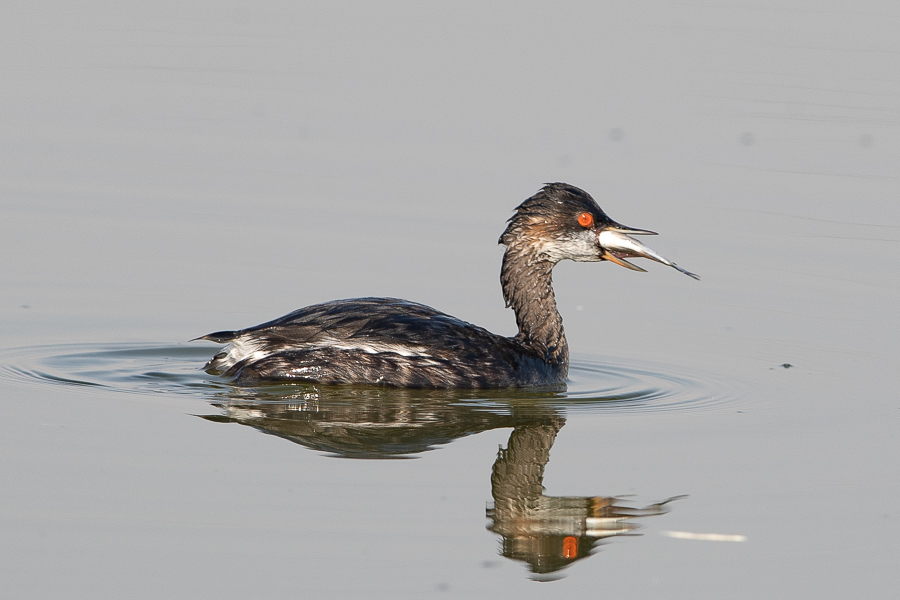
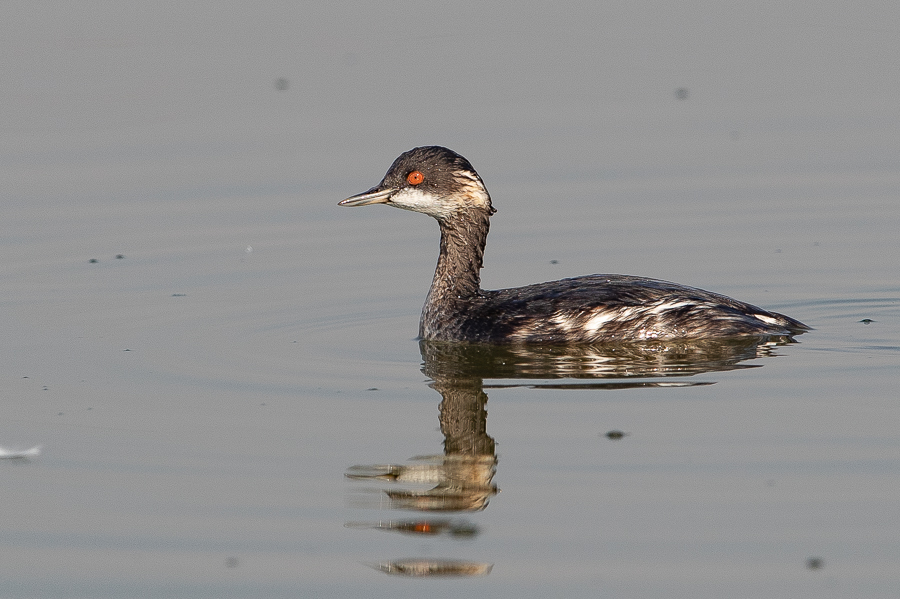
Whilst birding the Jubail in late September I saw came across five Black-necked Grebes. The birds were feeding on a large area of flooded sabkha, initially at some idstnace. I then located two birds slightly closer to the shore in better light and positioned myself with the light behind in the hope they would come closer. Over the next hour the birds moved quite close, and the below photos were taken, but as the sun was very strong they are not as good as they could have been if I located them earlier in the morning with better light. The Black-necked Grebe is an uncommon but regular visitor to the Eastern Province from late August (normally November) through till March becoming scarce in April and May and rare in the summer. It is usually local in coastal waters, but Phil Roberts and I found the largest ever gathering of this species for the Kingdom at Uqair in November 2020 where over 500 birds were counted in the Arabian Gulf. Numbers of fifty or more have been recorded in the Half Moon Bay area, 50 kilometres north off this record in the 1980’s. Another large group was 192 birds at Dawmat Al Jandal Lake, inland in Jouf Province in the northwest of the Kingdom in January 2019.
11 October 2022
Wader numbers building - Jubail
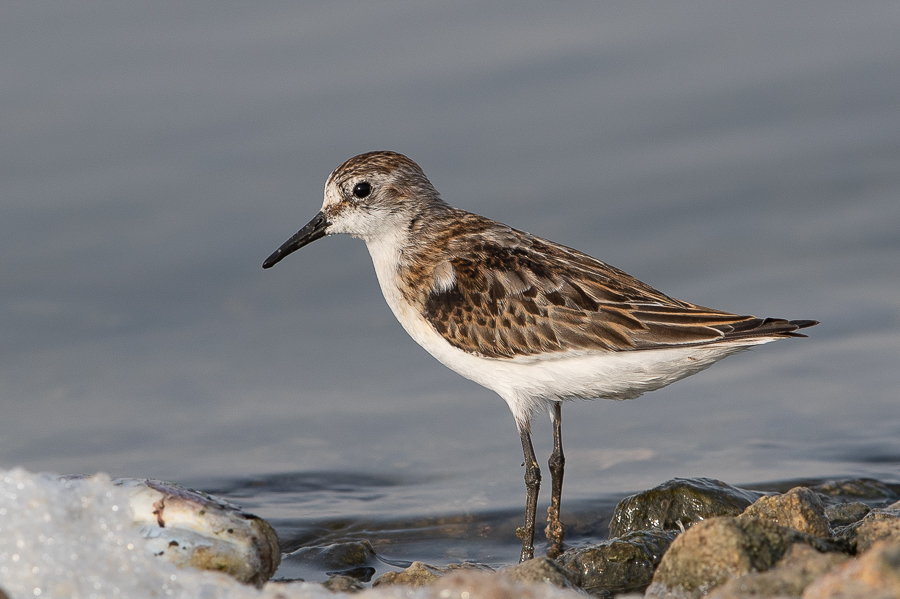
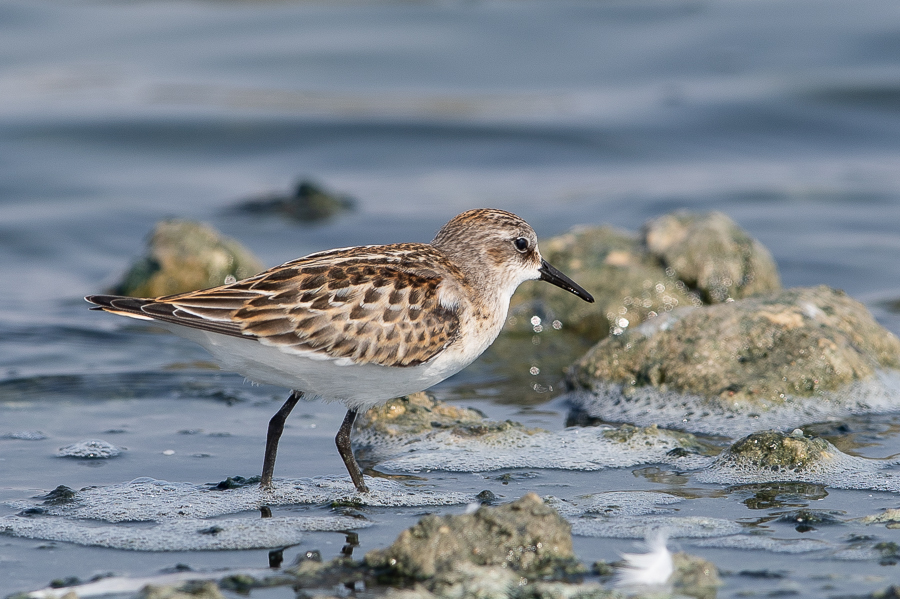
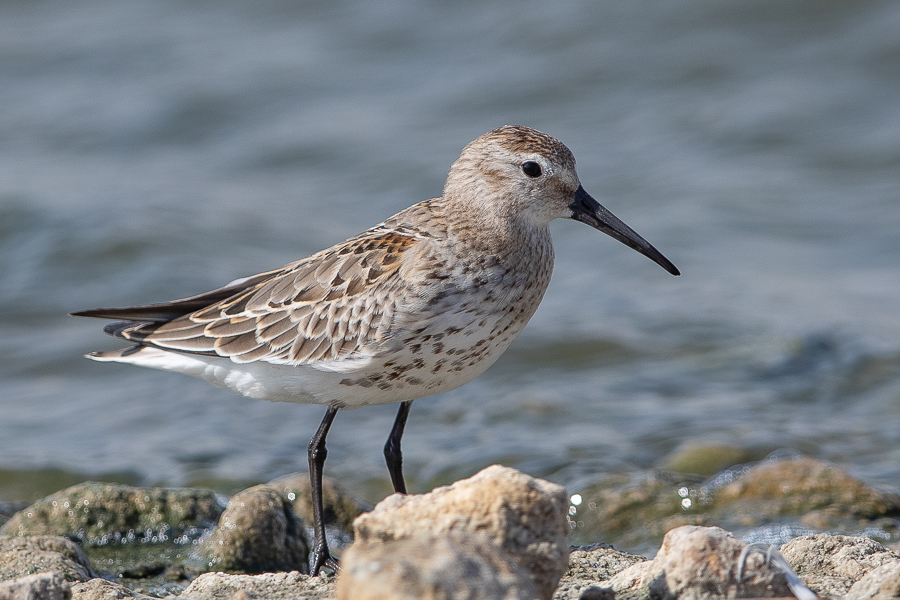
Wader numbers in Jubail have been fluctuating quite a bit week by week with Little Stint always the commonest species seen. Recently the number of Dunlin have increased slightly with a few juvenile birds in with the adults. Numbers of Ruddy Turnstone appear to be increasing in the Eastern Province in recent years with birds normally hard to get good photos of, but the last few weeks I have managed to get a few nice shots of a few different birds. Eurasian Curlew is another species I find it difficult to get good photos of, with only one or two birds seen in recent visits.
![]() |
| Ruddy Turnstone |
![]() |
| Ruddy Turnstone |
![]() |
| Ruddy Turnstone |
![]() |
| Ruddy Turnstone |
![]() |
| Little Stint |
![]() |
| Little Stint |
![]() |
| Little Stint |
![]() |
| Little Stint |
![]() |
| Little Stint |
![]() |
| Little Stint |
![]() |
| Little Stint |
![]() |
| Little Stint |
![]() |
| Little Stint |
![]() |
| Little Stint |
![]() |
| Little Stint |
![]() |
| Eurasian Curlew |
![]() |
| Dunlin |
![]() |
| Dunlin |
![]() |
| Dunlin |
![]() |
| Dunlin |
![]() |
| Dunlin |
![]() |
| Dunlin |
09 October 2022
Some different migrants - Jubail
Migration has been a little slow this autumn but a few birds are passing through. Last visit to Jubail produced good numbers of Barn Swallow and Sand Martins mainly in flight over the reed beds but a couple of Barn Swallows perched nicely in a stick allow the below photos to be taken. A single European Turtle Dove was in a small bush with three European Collared Doves. As I approached the three European Collared Doves flew off leaving the European Turtle Dove for me to try to get pictures. The trouble was that branches or leaves were always in the way but as I have not seen this species at all this year I took a few photos of the bird. Later a single Lesser Short-toed Lark was noted in amongst the bushes that were also holding two Egyptian Nightjar, the last ones of the year. A single European Bee-eater was perched in the reeds and the first few returning Greater Flamingo were noted out on the flooded Sabkha.
![]() |
| European Bee-eater |
![]() |
| European Turtle Dove |
![]() |
| Greater Flamingo |
![]() |
| Lesser Short-toed Lark |
![]() |
| Barn Swallow |
![]() |
| Barn Swallow |
07 October 2022
Blue-Cheeked Bee-eaters – Jubail
Last weekend in Jubail, I saw a few Blue-cheeked Bee-eaters flying over calling as well as some others perched catching insects. The species is a common passage migrant through the Eastern Province of Saudi Arabia with good numbers of birds passing in the spring as well as the autumn. Numbers are commoner in the autumn when they outnumber European Bee-eater whereas the opposite is true in the spring. The bird below was part of a bigger group at Jubail and was busy catching and eating bees as can be seen in two of the below photographs. The bird was faithful to one particular branch that made photography a little bit easier.
05 October 2022
European Roller – Jubail
Whilst birding the Jubail area in late September I came across a juvenile European Roller sitting on a metal frame. The bird would occasionally drop down to the ground and return with what looked like large moths to eat. At one point it flew off some distance but eventually returned to the same perch where it continued feeding happily until I left. Some European Rollers are quite timid and fly well before you can get close, with others being the opposite and remain in place even when the car gets quite close (possibly tired migrants). Luckily for photography, this one fell into the second group allowing me to take a few decent photos shown below. Saudi Arabia has three species of roller on the country list. These are Indian Roller Coracias benghalensis a vagrant, Abyssinian Roller Coracias abyssinicus a breeding resident of the southwest region of the Kingdom and European Roller Coracias garrulus an uncommon to common passage migrant from March to May and again from mid-July to late September when juveniles, such as the one I saw, are also seen along with the occasional adult. Birds are regularly seen in all areas of the Eastern Province almost every year in both spring and autumn but less commonly in autumn.