10 July 2023

Juvenile Egyptian Nightjars - Jubail

Whilst birding the Jubail area 7 July I found 16 Egyptian Nightjars with at least seven juveniles. Two of the juveniles could hardly fly and indicate they were bred locally at this site. The plumage is very fresh and smoothly soft, and they pretty much all have nice, neat white fringed coverts forming neat lines across the wing as well as the tertial tips. The birds are lacking the honey-orange spots on the shoulder of the wing that adults show with the adults also generally having darker plumage than the juveniles. Adult birds at this time of year are mainly in heavy primary moult with up to 4 to 6 new inner primaries that can easily be seen on birds in flight.


Juvenile

Juvenile

Juvenile

Juvenile

Juvenile

Juvenile

Juvenile

Juvenile

Juvenile in flight

Adult

Adult


08 July 2023

Juvenile Black-winged Kite – Dhahran Waste Water Lake

Whilst birding Dhahran Waste Water Lake 28 June I came across a juvenile Black-winged Kite in the very early morning. I took a couple of photographs but the light was poor as the sun was not up properly, and they are not particularly good, although you can see the juvenile plumage of the bird. A juvenile at this time of year suggests, as in previous years the species may breed locally now, but as the bird was able to fly properly it could have come from elsewhere. This is only my second juvenile in the Eastern Province and my first in Dhahran. The first record of Black-winged Kite for the Eastern Province was only found on 17 April 2012, but since then has become more common with birds seen in almost every month and every year since the first record and it is now regarded as a scarce visitor to the province. All birds sub-specifically identified in the east of the Kingdom are the eastern subspecies Elanus caeruleus vociferous a subspecies that occurs from Pakistan east to southern & eastern China, Indochina and the Malay Peninsula.


06 July 2023

June juvenile Blue-cheeked Bee-eater – Jubail

Whilst birding at Khafra Marsh in late June I came across two juvenile Blue-cheeked Bee-eater. This is a very unusual date to see this species as they are a common passage migrant seen in spring from March to May and in autumn from mid-August to November. Small numbers can sometimes be seen in June and December. Blue-cheeked Bee-eater is normally commoner than its close relative the European Bee-eater in autumn but less common in spring. As these birds were juveniles there is a chance they bred nearby as this is a very early date for a juvenile. As the birds could fly it is impossible to prove they bred locally, however. 


04 July 2023

Breeding Red-wattled Lapwing – Khafra Marsh

Whilst birding Khafra Marsh in late June, I came across an adult Red-wattled Lapwing flying over calling continuously and trying to lead me away from the area I had originally seen it. It was obvious young were around and I saw another adult run quickly into some long grass where the young were hiding. I didn't stay long looking for the birds as I did not want to disturb them. This is only the third record I know of breeding Red-wattled Lapwing for Saudi Arabia with the first at Sabkhat Al Fasl, Jubail in 2020 and another in Qatif the same year. Red-wattled Lapwing is scarce species in Saudi Arabia with records from Riyadh, the Empty Quarter, and the Eastern Province. In the Eastern province it is regarded as a scarce passage migrant and winter visitor although records are becoming more common with over twenty birds seen together at Shaybah in recent years with others near Hofuf, Jubail and Dhahran. This species is a resident breeder at wetlands in the United Arab Emirates, Qatar and Kuwait, and is gradually colonizing westwards.


02 July 2023

Summer Upcher’s Warbler – Jubail area

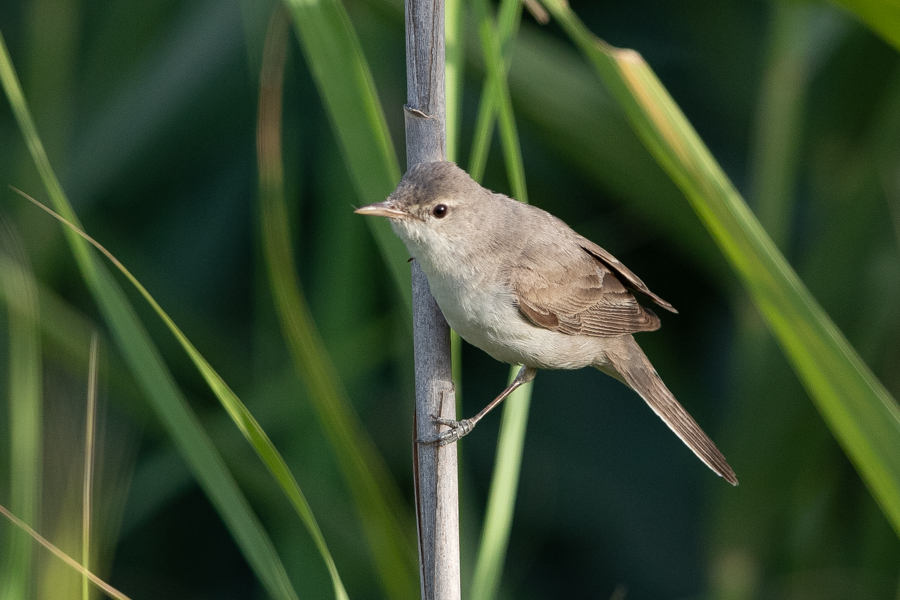
Whilst birding the Jubail area in late-June I came across an Upcher’s Warbler. This was a very unusual sight as the birds are passage migrants in the Eastern Province as far as we are aware. I have seen birds in the summer months in the west of the Kingdom but never in the east. The main identification points to separate Upcher’s Warbler and Eastern Olivceous Warbler are that Upcher’s Warbler is generally bigger and has a stockier appearance although this can be difficult to judge on a lone bird if unfamiliar with them. Wings, legs, tail and bill are all longer on Upcher’s Warbler than on Eastern Olivaceous Warbler with the legs and bill being thicker on Upcher’s Warbler. The tail on Upcher’s Warbler is long and ‘full’ and darkens towards the tip, which is not the case in Eastern Olivaceous Warbler. This darkening of the tail can be seen in the below photographs. The tail is also moved in a rather lazy swinging motion often sideways and also upwards and is also fanned, which is not often if ever shown by Eastern Olivaceous Warbler. The exaggerated tail movements of Upcher’s Warbler are often the first thing that draws attention to the species, especially if they are deep in cover. This bird did not move its tail like this and just did a single downwards movement that is similar to Eastern Olivaceous Warbler. Unfortunately, the bird did not stay on the open for very long and good views could not be obtained.


30 June 2023

Breeding Pied Avocet – Jubail area

Whilst birding the Jubail area in late-June I saw two pairs of adult Pied Avocet Recurvirostra avosetta behaving as if they had young nearby, flying over me calling in an agitated manner. As it appears the birds are breeding at the location for the fourth year in succession, I only took a few flight shots and left so as not to disturb the birds. Pied Avocet is mainly an uncommon migrant and winter visitor to all coasts that is locally common along the southern Red Sea coast and scarce inland. Very few birds have been proven to breed but in Riyadh in 1986, 10 birds over-summered and two pairs nested in June and produced young. In 1987 a pair again bred but the nest was preyed upon by Brown-necked Ravens Corvus ruficollis. In the Eastern Province two pairs attempted to breed at Abqaiq 1976 & 1982 and three pairs in 1983 although it is generally a rather scarce visitor from August to March. Records have occurred throughout the year in the Jubail area but records in summer are much less common. A number of breeding pairs (possible as many as twelve) were found in 2020 at the same location as this year’s breeders, with two breeding paris seen in 2021 and 2022.


28 June 2023

Summer Breeders & Visitors – Jubail

Whilst in the Jubail area recently I photographed a number of the common breeding species as well as a few summer visitors. I managed to find a good place to stop and try to photograph Clamorous Reed Warbler as I heard a number of birds calling loudly. They find a nice reed and slowly move up the reed stem to get in a good position for calling their distinctive very loud call. This sometimes gives a good opportunity to photograph the birds. In the reeds there were plenty of Grey-headed Swamphen, a bird that I love seeing. They are far from elegant when they fly and try to land in the reeds but are great birds to see and watch. They have been expanding their range markedly in the Eastern Province over the last few years and can now be seen in many places. Little Terns breed in the area now and I managed to find a pair in a good position for photographs. Black-winged Stilts also breed commonly in the area with this one below against a nice sandy background. Non-breeding species seen include Caspian Tern, which is common bird year-round and the much scarcer Lesser Crested Tern. Greater Flamingo has bred at this location in previous years but only fifteen birds are currently present so looks unlikely this year.

Little Tern

Little Tern

Greater Flamingo

Grey-headed Swamphen

Grey-headed Swamphen

Grey-headed Swamphen

Lesser Crested Tern

Lesser Crested Tern

Black-winged Stilt

Black-winged Stilt

Clamorous Reed Warbler

Clamorous Reed Warbler


26 June 2023

White-cheeked Terns on the ground – Jubail

Whilst in the Jubail area last Friday I photographed a good number of White-cheeked Tern Sterna repressa in flight and commented that later in the month many birds also form groups sitting on sandbanks so close-up photography becomes easier. The last visit to the area produced a nice gathering of about a hundred White-cheeked Terns on the ground with three second calendar year birds with the adults. If you remain in the car the birds allow quite close approach, and it is easy to position the car with the sun behind to get the best possible position for photography. Below are a few of the photos itook of the birds.

Adult

Adult

Adult

Adult

Adult

Adult

Second calendar year 

Second calendar year 

Second calendar year 

Second calendar year